Facts
The petitioners were employees working in different Municipal Corporations and Municipal bodies in Chhattisgarh. They challenged orders transferring them from one Municipal Corporation to another. Their principal contention was that such inter-corporation transfers were impermissible under Sections 58(5) and 58(6) of the Chhattisgarh Municipal Corporation Act, 1956, unless effected by way of deputation or after taking lien.
Source reference: para. 2The petitioners relied upon the High Court’s earlier decision in Mohammad Wasim Khan v. State of Chhattisgarh & Ors., WPS No. 5385 of 2026, decided on 16 July 2026, contending that the legal issue and factual circumstances were identical. The respondents opposed the petitions and argued that there was no violation of Sections 58(5) and 58(6) of the 1956 Act.
Source reference: paras. 2, 3, 5Issues
Whether an employee of one Municipal Corporation can be transferred to another Municipal Corporation through a simpliciter transfer order, contrary to Sections 58(5) and 58(6) of the Chhattisgarh Municipal Corporation Act, 1956?
Source reference: paras. 2–5Whether the impugned transfer orders were legally sustainable when they were neither deputation orders nor orders passed after taking lien?
Source reference: para. 5Whether the State could nevertheless transfer the petitioners on deputation in accordance with the statutory scheme?
Source reference: para. 5Law Applied
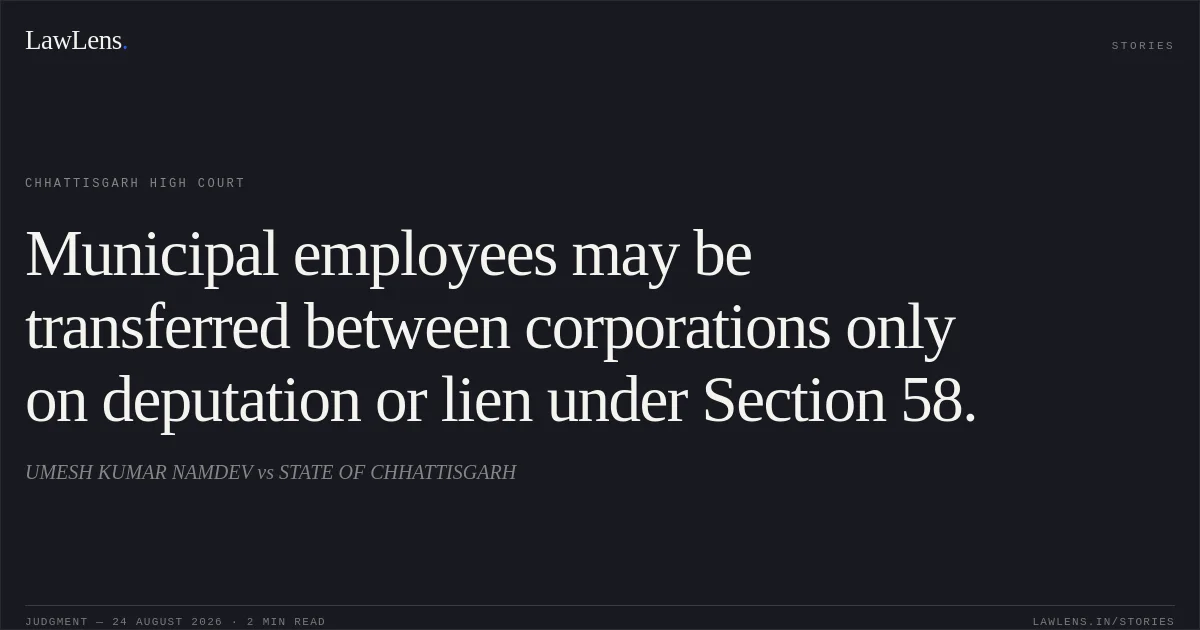
The Court applied Sections 58(5) and 58(6) of the Chhattisgarh Municipal Corporation Act, 1956, under which movement of employees between Municipal Corporations is permissible only through the legally recognised mechanisms of deputation or transfer after taking lien; a simpliciter transfer order does not satisfy the statutory requirement.
Source reference: para. 5The Court followed the binding reasoning in Mohammad Wasim Khan v. State of Chhattisgarh & Ors., WPS No. 5385 of 2026, decided on 16 July 2026, where it was held that a transfer order which is neither a deputation order nor an order involving lien is contrary to the Act.
Source reference: para. 5Reasoning
The Court found that the facts and legal issue in the connected petitions were identical to those considered in Mohammad Wasim Khan.
Source reference: para. 5Applying Sections 58(5) and 58(6), the Court held that the impugned orders were expressed as ordinary transfer orders and did not operate as deputation orders or orders involving the petitioners’ lien. Consequently, the transfers from one Municipal Corporation to another were inconsistent with the statutory scheme. The Court therefore adopted and applied the reasoning and relief granted in the earlier decision.
Source reference: para. 5Holding
The Court allowed all the connected writ petitions in terms of the order dated 16 July 2026 in Mohammad Wasim Khan.
The impugned transfer orders were consequently quashed to the extent they transferred the petitioners between Municipal Corporations through simpliciter transfer orders. The State and respondents were granted liberty to send the petitioners on deputation if required by administrative exigency, provided such action was taken in accordance with the Chhattisgarh Municipal Corporation Act, 1956.
Source reference: para. 5The State was also permitted to verify whether the petitioners were in fact employees of the concerned Municipal Corporations and, if any petitioner was found to have filed a false affidavit asserting such status, to initiate appropriate departmental proceedings.
Source reference: para. 7Acts & Sections Cited
1 provisions across 1 statute referred to in this judgment. Each provision opens on LawLens.
Chhattisgarh Municipal Corporation Act, 19561
Original Court PDF
UMESH KUMAR NAMDEVvsSTATE OF CHHATTISGARH
Click to open original judgment
Original judgment, available to read, download and summarize on LawLens.in
![Courts will not interfere with transfers absent mala fides or violation of statutory rules.. M Ramya vs EMPLOYEES STATE INSURANCE CORPORATION (ESIC). CAT - ['Chennai']. LawLens](/stories/thumbnails/courts-will-not-interfere-with-transfers-absent-mala-fides-or-violation-of-statutory-rules-a6845e9ca6f548fca284c51c8351957f.webp)
![Courts cannot direct one-time recruitment age relaxation absent authority in the governing rules or advertisement.. UT OF PUDUCHERRY vs M ANDAL. CAT - ['Chennai']. LawLens](/stories/thumbnails/courts-cannot-direct-one-time-recruitment-age-relaxation-absent-authority-in-the-governing-895d78fde47143e2a8ed0207c4b6a44f.webp)
![A review cannot correct an allegedly erroneous decision absent an error apparent on the record.. Ajit Kumar Jha vs RAILWAY BOARD. CAT - ['Delhi']. LawLens](/stories/thumbnails/a-review-cannot-correct-an-allegedly-erroneous-decision-absent-an-error-apparent-on-the-re-8ac952fd4eba470c92f7da20af72a220.webp)