Facts
The petitioner sought quashing under Section 482 Cr.P.C. of FIR No. 448 dated 03.05.2018, registered at Police Station Thanesar City, Kurukshetra, under Section 10 of the Haryana Development and Regulation of Urban Areas Act, 1975 (“the 1975 Act”), along with consequential proceedings.
Source reference: para. 1The FIR alleged that the petitioner and co-accused were carving out an unauthorised colony by laying roads and subdividing land situated in village Ratgal, within the urban area of Kurukshetra, without obtaining the licence required under Section 3 of the 1975 Act, thereby violating Sections 3 and 7(i).
Source reference: para. 2The petitioner was arrested, granted bail, and a police report under Section 173 Cr.P.C. was filed on 15.08.2018.
Source reference: para. 3The petitioner contended that the land fell within the municipal limits of Municipal Council, Thanesar; consequently, the Town and Country Planning Department lacked jurisdiction. He also argued that the plots were small and did not require a licence under Section 3.
Source reference: paras. 4–5The State disputed these submissions, relying upon the statutory definition of “urban area” under Section 2(o) of the 1975 Act and asserting that the allegations concerned the development of an unauthorised colony, not merely individual plots.
Source reference: paras. 6–7Issues
Whether the FIR and subsequent criminal proceedings were liable to be quashed under Section 482 Cr.P.C. on the ground that the land fell within the municipal limits and, therefore, the Town and Country Planning Department lacked jurisdiction under the 1975 Act?
Source reference: paras. 4–7, 15, 18–19Whether the petitioner’s assertion that the plots were small and that no licence under Section 3 of the 1975 Act was required justified quashing of the FIR at the threshold?
Source reference: paras. 4, 16, 18Whether the allegations in the FIR disclosed the commission of an offence under the 1975 Act or otherwise constituted an abuse of the process of law warranting interference under Section 482 Cr.P.C.?
Source reference: paras. 9, 13, 15, 18–19Law Applied
The Court applied Section 482 Cr.P.C., which permits the High Court to prevent abuse of the process of any court and secure the ends of justice; the provision is pari materia with Section 528 of the Bharatiya Nagarik Suraksha Sanhita, 2023.
Source reference: para. 9Under the principles in State of Haryana v. Bhajan Lal, 1992 Supp. (1) SCC 335, quashing may be justified where the allegations, taken at face value, do not disclose an offence, are inherently improbable, are legally barred, or constitute mala fide proceedings.
Source reference: paras. 9–10Paramjeet Batra v. State of Uttarakhand, (2013) 11 SCC 673, and Mahendra K.C. v. State of Karnataka, (2022) 2 SCC 129, establish that proceedings may be quashed where the essential ingredients of the offence are absent, but the Court must assess the allegations as they stand without conducting a trial.
Source reference: para. 10Priyanka Jaiswal v. State of Jharkhand, 2024 SCC OnLine SC 685, Minakshi Yadav v. State of Uttar Pradesh, 2024 SCC OnLine SC 643, and Neeharika Infrastructure v. State of Maharashtra, 2021 SCC OnLine SC 315, reiterate that the High Court cannot conduct a mini-trial, assess evidentiary reliability, or stifle investigation where the FIR discloses a cognizable offence.
Source reference: paras. 10–13Under Sections 2(o), 3, 7(i), and 10 of the 1975 Act, land within an “urban area” may be subject to the statutory licensing regime, and development by carving out plots and laying roads without the requisite licence can attract criminal proceedings.
Source reference: paras. 2, 7, 15, 18Reasoning
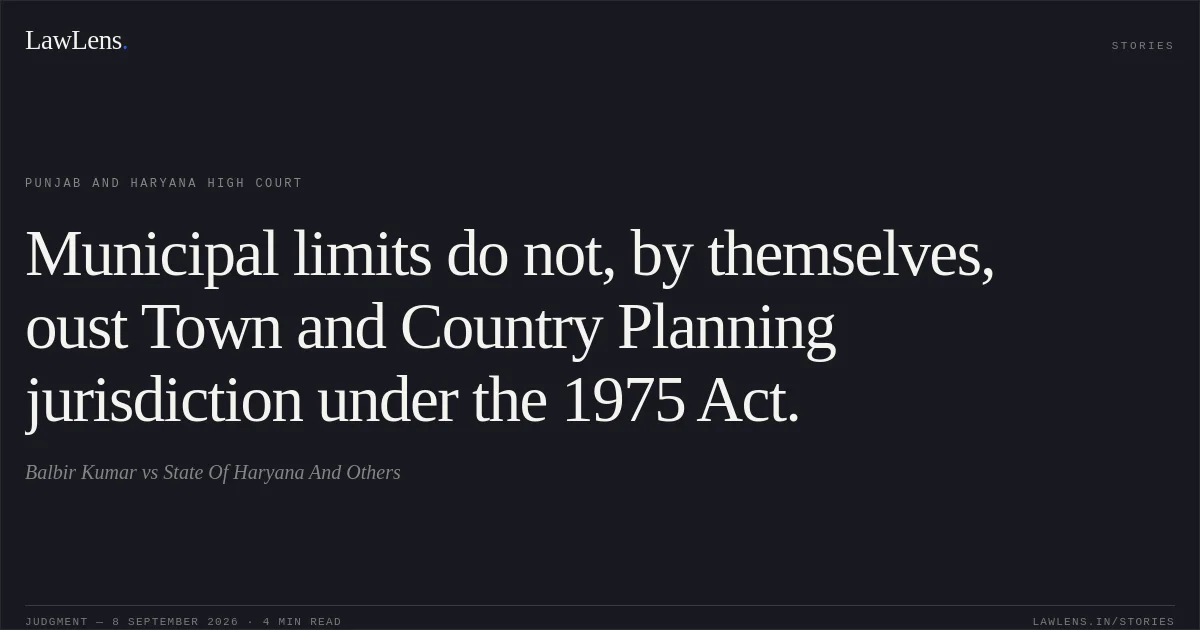
The Court held that the reliance on Rajat Kuchhal was misplaced because that decision concerned the Punjab Scheduled Roads and Controlled Areas Restriction of Unregulated Development Act, 1963, read with municipal enactments, and did not determine the scope of jurisdiction under the 1975 Act.
Source reference: para. 15The mere fact that the land was situated within municipal limits did not, by itself, exclude it from the definition of “urban area” under Section 2(o) or oust the jurisdiction of the Town and Country Planning Department under the 1975 Act.
Source reference: paras. 7, 15The FIR specifically alleged collective development of an unauthorised colony through the laying of roads and division of land into plots without a licence, thereby prima facie disclosing the ingredients of the alleged offences.
Source reference: paras. 16, 18The plea regarding the small size of the plots raised a factual and legal question concerning the nature of the development and could not be conclusively accepted in Section 482 proceedings, particularly after completion of investigation and filing of the challan.
Source reference: para. 16The earlier order in Rimpy Kansal could not assist the petitioner because it had been set aside by the Supreme Court; nevertheless, that Supreme Court decision did not imply that every FIR concerning land within municipal limits was automatically maintainable, and the present FIR had to be assessed on its own allegations and statutory basis.
Source reference: para. 17Since the FIR disclosed a prima facie offence and no recognised ground under Bhajan Lal was established, quashing was unwarranted.
Source reference: paras. 18–19Holding
The Court answered the issues against the petitioner. It held that the inclusion of the land within municipal limits did not, at the threshold, invalidate the FIR or establish lack of jurisdiction under the 1975 Act; nor did the alleged small size of the plots justify quashing.
As the allegations prima facie disclosed unauthorised colonisation by laying roads and subdividing land without the requisite licence, no abuse of process or exceptional ground for exercising inherent jurisdiction was made out.
Source reference: para. 19The petition seeking quashing of FIR No. 448 dated 03.05.2018 and all subsequent proceedings was accordingly dismissed, with the clarification that the observations were confined to disposal of the Section 482 petition and would not prejudice the merits of the case before the trial court.
Source reference: paras. 19–20Acts & Sections Cited
6 provisions across 2 statutes referred to in this judgment. Each provision opens on LawLens.
Code of Criminal Procedure, 19735
Bharatiya Nagarik Suraksha Sanhita, 20231
Original Court PDF
Balbir KumarvsState Of Haryana And Others
Click to open original judgment
Original judgment, available to read, download and summarize on LawLens.in