Facts
The appellant, aged 16 years and 4 months at the time of the incident, was accused of murdering a boy by slitting his throat
Source reference: para. 7-8Following a plea of juvenility, the Juvenile Justice Board (JJ Board) conducted a preliminary assessment under Section 15 of the JJ Act. The majority of the JJ Board held that the appellant lacked the mental capacity to commit the offence and should be tried as a juvenile, whereas the Presiding Magistrate dissented
Source reference: para. 10On appeal by the complainant, the Sessions Court set aside the JJ Board’s order, directing the appellant be tried as an adult
Source reference: para. 11The High Court of Patna affirmed the Sessions Court’s decision, noting that the appellant had subsequently been involved in another murder while in a Children's Home
Source reference: para. 13The appellant challenged this before the Supreme Court, arguing that Section 302 IPC is a "serious" rather than "heinous" offence and that the Sessions Court failed to seek mandatory expert assistance under Section 101(2)
Source reference: para. 14-15Issues
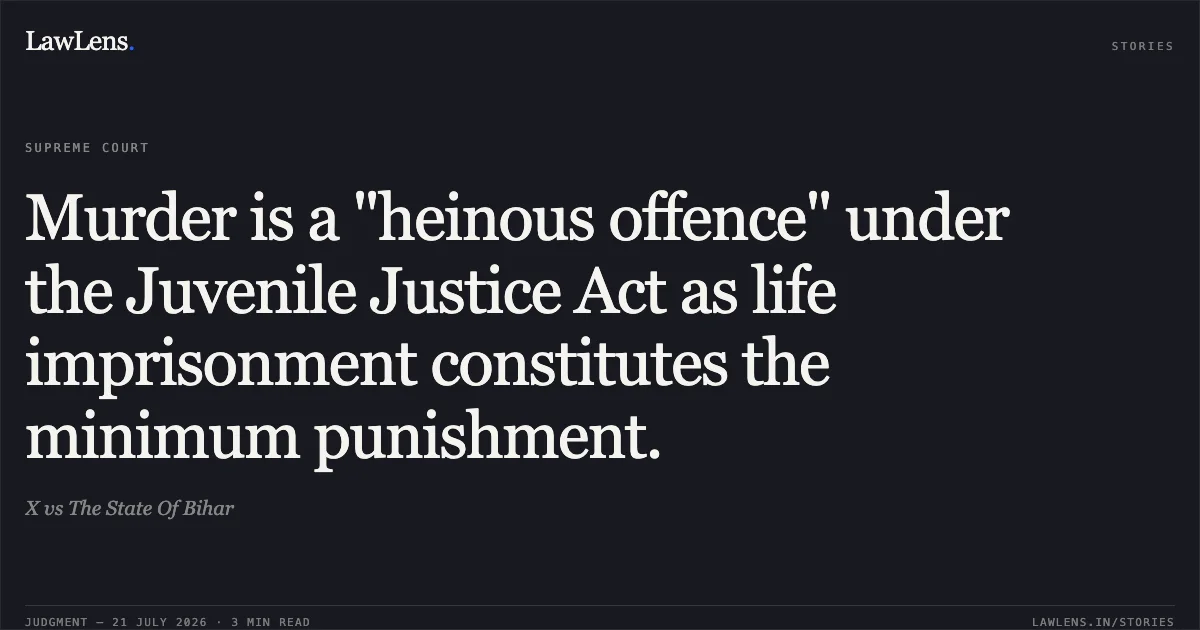
1. Whether an offence prescribing punishment of "death or imprisonment for life" (Section 302 IPC) constitutes a "heinous offence" or a "serious offence" under Section 2 of the JJ Act
Source reference: para. 21(a)2. Whether the expression "may" in Section 101(2) of the JJ Act, regarding the Sessions Court seeking assistance from experts, is mandatory or directory
Source reference: para. 21(b)3. What materials must the JJ Board consider when conducting a preliminary assessment under Section 15
Source reference: para. 21(c)Law Applied
The Court applied Section 2(33) and 2(54) of the JJ Act, distinguishing "heinous offences" (minimum punishment of 7 years or more) from "serious offences" (maximum more than 7 years but no minimum or minimum less than 7 years)
Source reference: para. 26-27It relied on Babasaheb Maruti Kamble v. State of Maharashtra to establish that life imprisonment is the de facto minimum for Section 302 IPC
Source reference: para. 32Regarding statutory interpretation, the Court applied the principle from Official Liquidator v. Dharti Dhan (P) Ltd. that "may" can be mandatory only if the context and object of the statute create such an obligation
Source reference: para. 53Furthermore, it clarified the application of Barun Chandra Thakur v. Bholu regarding expert assistance in preliminary assessments
Source reference: para. 43, 71Reasoning
The Court rejected the appellant's argument that Section 302 IPC is a "serious offence" due to the lack of the word "minimum" in the IPC. It reasoned that since a court cannot legally impose a sentence lower than life imprisonment for murder, that term serve as the statutory minimum, thus qualifying it as a "heinous offence"
Source reference: para. 32, 36Regarding Section 101(2), the Court distinguished the JJ Board's duty from the Appellate Court's power. While the JJ Board must seek expert help under Section 15 if it lacks a specialist member (as per Barun Chandra Thakur), the Sessions Court's power under Section 101(2) is discretionary ("may")
Source reference: para. 55-56The Appellate Court's role is to review the legality of the Board's assessment based on existing records, including the Social Investigation Report (SIR) and Social Background Report (SBR)
Source reference: para. 57-58The Court found the JJ Board had erred by ignoring the SIR/SBR and relying solely on a flawed majority view of "mental capacity," whereas the Sessions Court correctly weighed the gravity of the act and the child's circumstances
Source reference: para. 81, 84Holding
Section 302 IPC is a "heinous offence" under the JJ Act because the minimum prescribed punishment is life imprisonment; the word "may" in Section 101(2) is directory, giving the Sessions Court discretion to seek fresh expert opinion based on the facts of the case; and the JJ Board must independently evaluate the SIR, SBR, and expert reports collectively rather than mechanically following one
The appeal was dismissed, and the High Court’s order directing the trial of the appellant as an adult was upheld
Source reference: para. 86-87Acts & Sections Cited
16 provisions across 4 statutes referred to in this judgment. Each provision opens on LawLens.
Juvenile Justice (Care and Protection of Children) Act, 2015.
Indian Penal Code, 18603
Code of Criminal Procedure, 19731
Bharatiya Nyaya Sanhita, 20231
Original Court PDF
XvsThe State Of Bihar
Click to open original judgment
Original judgment, available to read, download and summarize on LawLens.in