01Facts
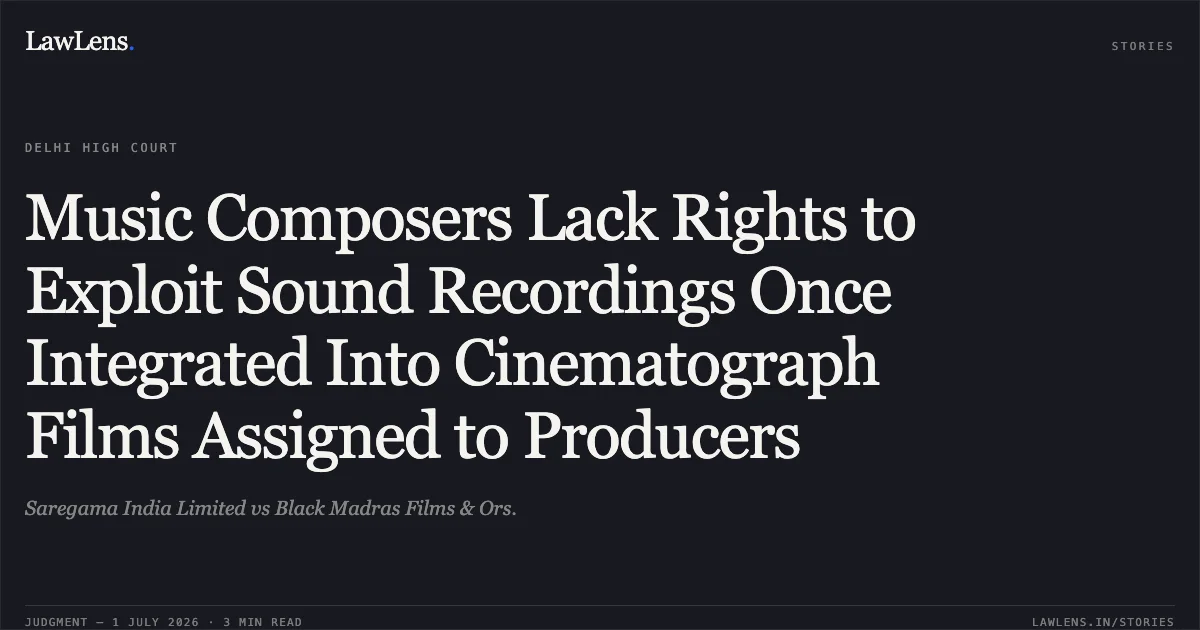
In CS(COMM) 143/2026, the Plaintiff alleged that the Defendant (Mr. Ilaiyaraaja, a renowned composer) unauthorizedly uploaded 134 films' sound recordings and musical works onto streaming platforms like Amazon Music and YouTube, claiming ownership
¶ 5.2-5.4In CS(COMM) 1310/2025, the Plaintiff alleged that Black Madras Films unauthorizedly used the song "Naguva Nayana" (from the film Pallavi Anupallavi) as a background score in their film "Mask" based on a purported license from Mr. Ilaiyaraaja
¶ 42.2-42.3Mr. Ilaiyaraaja challenged the Plaintiff's title, arguing that the assignment agreements from original producers were "contingent contracts" lacking the necessary written consent of authors and that as the composer, he retained rights over the musical works
¶ 6.8 / 6.1402Issues
i.1. Whether the assignment agreements executed by the original producers in favor of the Plaintiff were legally valid "concluded contracts" conferring ownership of sound recordings
¶ 6.8 / 28ii.2. Whether the composer (Mr. Ilaiyaraaja) holds copyright over the "sound recordings" incorporated within a cinematograph film
¶ 7.3 / 15iii.3. Whether the Plaintiff’s suit was barred by limitation or acquiescence due to the Defendant’s long-standing presence on YouTube
¶ 6.5 / 8.803Law Applied
The Court primarily applied Section 2(f) of the Copyright Act, 1957, which defines "cinematograph film" to include sound recordings, and Section 2(d)(v), which designates the "producer" as the author of such film
¶ 14 / 48Section 17(b) establishes that the producer is the first owner of the copyright in a cinematograph film unless an agreement to the contrary exists
¶ 7.4The Court further relied on Section 13(4), which clarifies that copyright in a film/sound recording does not affect the separate copyright in the underlying musical work
¶ 17Precedentially, the Court followed the Division Bench ruling in Mr. Ilaiyaraaja v. Saregama India Limited (2026:DHC:4556-DB), which held that a composer’s right is limited to the "musical work" (composition) and does not extend to the "sound recording" or "lyrics" once incorporated into a film
¶ 12 / 13Provisions in the judgment · 13 · Linked ones open on LawLens
Copyright Act, 1957 11 provisions
Section 2Section 13Section 14Section 17Section 18Section 31Section 33Section 35Section 51Section 52Section 55Code of Civil Procedure, 1908 Section 151
Indian Contract Act, 1872 Section 31
04Reasoning
The Court reasoned that under the Copyright Act, a "sound recording" incorporated into a film becomes part of the "cinematograph film," making the producer the statutory owner of the recording
¶ 16While Mr. Ilaiyaraaja, as the composer, remains the "author" of the musical composition under Section 2(p) and 13(4), this does not grant him rights to authorize the use of the actual sound recording or lyrics
¶ 15/47Regarding the "contingent contract" argument, the Court observed that the clauses requiring producer-author consents were for the Plaintiff’s protection and did not invalidate the transfer of title, especially since the original producers had never challenged the Plaintiff's 30-year exploitation of these rights
¶ 31-32On royalties, the Court found prima facie evidence from IPRS (Copyright Society) documents showing that the Defendant was receiving 25% "Composer" royalties while acknowledging the Plaintiff as "Owner," thereby negating the claim of non-payment and suggesting the Defendant’s knowledge of the Plaintiff’s rights
¶ 21-2205Holding
The Court held that the Plaintiff is the prima facie owner of the sound recordings by virtue of assignment deeds from the producers
¶ 49The Court affirmed that Mr. Ilaiyaraaja’s rights are strictly limited to musical compositions and do not extend to sound recordings
¶ 51The Court allowed I.A. 4116/2026, restraining Mr. Ilaiyaraaja from broadcasting the subject songs on online platforms, and made the ex-parte injunction in CS(COMM) 1310/2025 absolute, restraining the filmmakers from using the song "Naguva Nayana" without the Plaintiff’s license. All applications for vacation of injunctions were dismissed
¶ 53 / 53(A) / 53(B)Original Court PDF
Saregama India LimitedvsBlack Madras Films & Ors.
Click to open original judgment
Original judgment, available to read, download and summarize on LawLens.in