Facts
The plaintiff, Mozuammel Haque, alleged that he had agreed to sell 4 kathas 1 lecha of land to Defendant No. 1 for ₹23,000, subject to payment of the balance consideration within three months. According to him, the balance was not paid, the agreement was rescinded, no sale deed was executed, and possession was never delivered to the defendants.
Source reference: p.7, paras. 8–9The defendants asserted that the entire consideration had been paid, possession had been delivered in November 1989, and that the plaintiff had consented to mutation of the land in Defendant No. 2’s name.
Source reference: pp.9–12, paras. 14–18Criminal proceedings under Sections 107 and 145 CrPC were initiated concerning possession. Although the Executive Magistrate ultimately declared possession in favour of the defendants, the police report recorded that, when possession was allegedly delivered on 02.09.1998, the plaintiff’s house existed on the land and the delivery was merely symbolic.
Source reference: pp.7–10, paras. 10–12; p.18, para. 41The plaintiff instituted Title Suit No. 111/1998 seeking declaration of title and possession, a declaration that the criminal-court order was erroneous and unenforceable, and permanent injunction.
Source reference: p.9, para. 13The defendants filed a counter-claim seeking enforcement of the alleged agreement for sale, execution and registration of a sale deed, delivery of possession, and injunction.
Source reference: pp.10–12, paras. 16–19The Trial Court dismissed the suit and the counter-claim. The First Appellate Court decreed the plaintiff’s suit and affirmed dismissal of the counter-claim. The defendants filed the present second appeals under Section 100 CPC.
Source reference: pp.5–6, paras. 2–3Issues
Whether the plaintiff’s suit was barred by limitation?
Source reference: p.16, para. 36(i)Whether the suit was barred by the proviso to Section 34 of the Specific Relief Act, 1963, because the plaintiff had omitted to seek further relief concerning the agreement for sale?
Source reference: p.16, para. 36(ii)Whether the First Appellate Court erred in law in declaring the plaintiff’s title over the suit land?
Source reference: p.16, para. 36(iii)Whether the defendants had established a legally enforceable agreement, payment of the entire consideration, and delivery of possession so as to sustain their counter-claim for specific performance?
Source reference: pp.20–26, paras. 45–53Law Applied
The Court applied Section 100 CPC, under which a second appeal lies only on a substantial question of law.
Source reference: no citationIt applied Section 34 of the Specific Relief Act, 1963, holding that the proviso does not bar a suit where the plaintiff seeks consequential reliefs in addition to declaration.
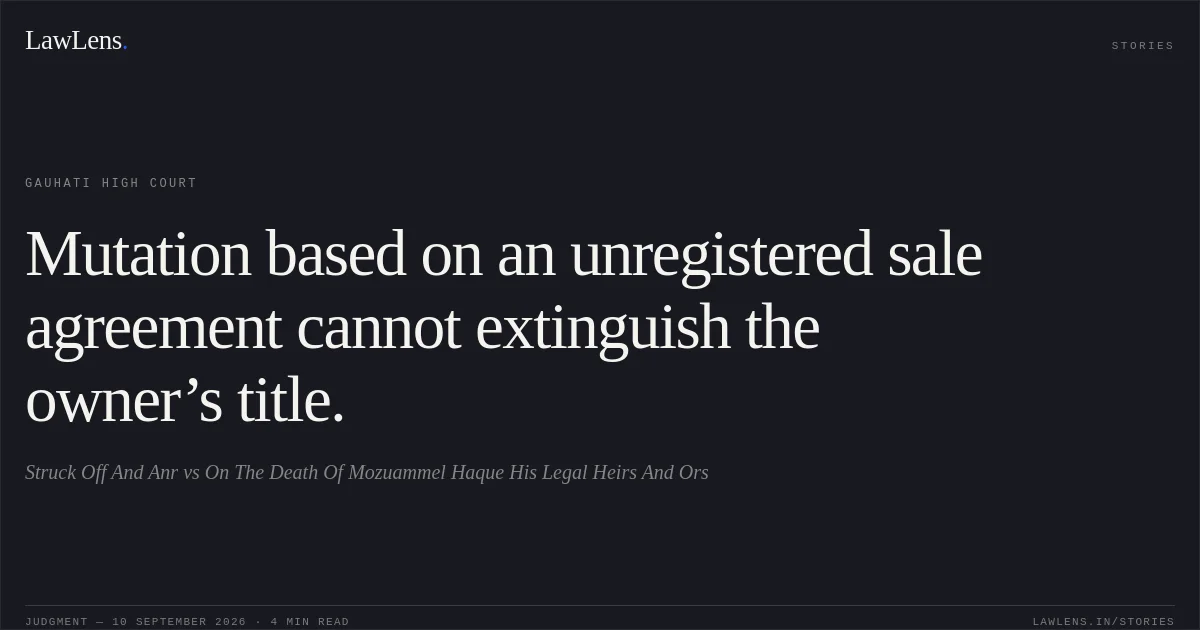
Source reference: pp.19–21, paras. 44–49The Court further applied the principle that an agreement for sale does not itself transfer title and that, in the absence of a registered sale deed, mutation in revenue records does not extinguish the original owner’s title or constitute proof of lawful transfer.
Source reference: pp.19–21, paras. 44–49The Court also applied the evidentiary principle that the party claiming specific performance must establish the agreement, payment of consideration, readiness and enforceability of the contract, and the alleged delivery of possession through reliable evidence.
Source reference: pp.24–26, paras. 49–53Reasoning
The Court held that the plaintiff’s suit was not merely declaratory because it also sought injunction and other consequential reliefs; therefore, the proviso to Section 34 did not apply.
Source reference: p.19, paras. 42–43On limitation, the Court found that the plaintiff’s title had not been extinguished by the unregistered transaction or the mutation in favour of Defendant No. 2. Since mutation did not establish a lawful transfer of ownership, the plaintiff could maintain a suit based on his title and possession.
Source reference: pp.26–27, para. 54(a)The defendants failed to establish actual possession. The police report referred to the plaintiff’s house and treated the alleged delivery to the defendants as symbolic, while the defendants’ own pleadings sought removal of the plaintiff and recovery of khas possession.
Source reference: pp.18–20, paras. 41–45Their evidence regarding payment was also materially inconsistent. The alleged agreement and receipts were either photocopies, varied in their contents, or were not proved in accordance with law. The evidence did not satisfactorily establish payment of the entire consideration or delivery of possession.
Source reference: pp.21–26, paras. 46–53Further, the alleged consent to mutation in favour of Defendant No. 2 differed from the original agreement with Defendant No. 1 and was not supported by a corresponding plea or relief concerning novation of the contract.
Source reference: p.24, para. 50Consequently, the defendants failed to prove an enforceable basis for specific performance or a superior title.
Source reference: no citationHolding
The Gauhati High Court answered all three substantial questions of law against the appellants. It held that the plaintiff’s suit was not barred by limitation, was not hit by the proviso to Section 34 of the Specific Relief Act, and that the First Appellate Court had correctly declared the plaintiff’s title.
The defendants’ counter-claim for specific performance and possession was unsustainable because no registered sale deed was executed, mutation did not confer title, and payment and delivery of possession were not proved.
Source reference: no citationBoth second appeals were dismissed, with costs awarded to the respondents.
Source reference: p.27, paras. 56–59Acts & Sections Cited
4 provisions across 3 statutes referred to in this judgment. Each provision opens on LawLens.
Code of Civil Procedure, 19081
Code of Criminal Procedure, 19732
Specific Relief Act, 19631
Original Court PDF
Struck Off And AnrvsOn The Death Of Mozuammel Haque His Legal Heirs And Ors
Click to open original judgment
Original judgment, available to read, download and summarize on LawLens.in