Facts
The petitioner (Sandhya) challenged the order dated 09.05.2023 passed by the First Additional Sessions Judge, Panna, which affirmed the Sub-Divisional Magistrate’s (SDM) order dated 05.04.2023 holding Respondent No. 1 (Shanti) to be in possession of house No. 644/A.
Source reference: para 1The petitioner claimed possession as the daughter of the original owners, asserting she resided there with their consent, while Respondent No. 1 contested this, claiming the petitioner had relinquished her rights via affidavit after receiving ₹1,50,000, leading to a municipal mutation in 2012.
Source reference: para 2The case saw multiple rounds of litigation and remands before the SDM finally concluded that Respondent No. 1 held possession.
Source reference: para 3Issues
1. Whether the lower courts exceeded their jurisdiction under Section 145 Cr.P.C. by relying on title and mutation entries rather than actual physical possession.
Source reference: para 42. Whether the concurrent findings of fact regarding possession were perverse or ignored material evidence (police/revenue reports) warranting interference under Section 482 Cr.P.C.
Source reference: para 4, 8Law Applied
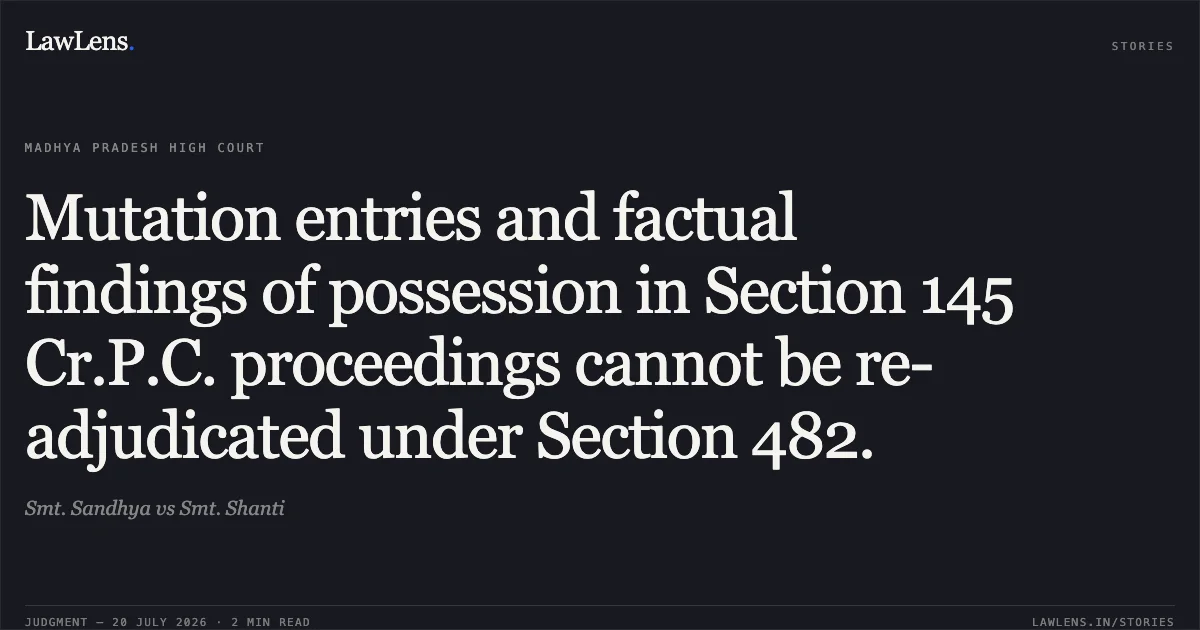
The court applied Section 145 and 146 of the Code of Criminal Procedure (Cr.P.C.), which are preventive measures intended to maintain peace by protecting the party in possession on the date of the preliminary order, without determining permanent title.
Source reference: para 1, 9The court further invoked the principles governing Section 482 Cr.P.C., emphasizing that inherent jurisdiction should not be used as a third forum for factual adjudication or to substitute concurrent findings of fact unless there is a jurisdictional error or gross perversity.
Source reference: para 5, 8, 10Reasoning
The High Court observed that the SDM and Revisional Court had engaged in a detailed appreciation of both oral and documentary evidence following multiple remands.
Source reference: para 7While the petitioner argued that mutation does not confer title, the court clarified that in Section 145 proceedings, long-standing mutation (since 2012) serves as a "relevant circumstance" to appreciate the question of possession.
Source reference: para 7The court rejected the petitioner's argument that the police and Patwari reports were ignored, noting that the existence of some conflicting evidence does not allow the High Court to overturn concurrent findings under Section 482.
Source reference: para 8The court reasoned that since Section 145 orders are temporary and do not settle civil rights, the petitioner’s remedy lies in a Civil Court where title and inheritance can be fully adjudicated.
Source reference: para 9Holding
The Court answered the issues in the negative, holding that the lower courts acted within their jurisdiction and their findings were not perverse.
The petition was dismissed, and the orders of the SDM and the First Additional Sessions Judge were affirmed, clarifying that the parties remain at liberty to establish their civil rights before a competent Civil Court independently of these proceedings.
Source reference: para 9, 11Acts & Sections Cited
3 provisions across 1 statute referred to in this judgment. Each provision opens on LawLens.
Code of Criminal Procedure, 19733
Original Court PDF
Smt. SandhyavsSmt. Shanti
Click to open original judgment
Original judgment, available to read, download and summarize on LawLens.in