Facts
Khatedari rights for 91 Bighas of land in Village Phutolao were granted to Respondent No. 1 (Madan Lal) via Mutation Entry No. 25 on 12.04.1961
Source reference: para. 2In 1995, based on the Beri Commission Report alleging that Madan Lal was a minor (10 years old) at the time of mutation and his father was a Patwari who influenced the entry, the State initiated cancellation proceedings under Rule 14(4) of the Rajasthan Land Revenue (Allotment of Agricultural Land) Rules, 1970
Source reference: para. 3-4The Additional Collector cancelled the mutation on 22.05.2002
Source reference: para. 4This was overturned by the Revenue Appellate Authority (RAA) on 24.10.2002, and the Board of Revenue (BoR) dismissed the State’s second appeal on 16.04.2013. The State challenged these orders via this writ petition.
Source reference: para. 5-6Issues
1. Whether the Revenue Appellate Authority lacked jurisdiction to hear the appeal on the grounds that the original order was passed by a Land Record Officer
Source reference: para. 7, 532. Whether the mutation entry of 1961 was void due to the alleged minority of the respondent and the official position of his father
Source reference: para. 34-363. Whether the State can cancel mutation entries after an inordinate delay of over 34 years
Source reference: para. 48-494. Whether Rule 14(4) of the Rules of 1970 applies to Khatedari rights acquired by operation of law under Section 15 of the Rajasthan Tenancy Act, 1955
Source reference: para. 52Law Applied
Section 15 and 19 of the Rajasthan Tenancy Act, 1955, which provide for the automatic conferment of Khatedari rights on tenants in possession at the commencement of the Act
Source reference: para. 33, 45Principle from Mala v. Board of Revenue, establishing that 'Khasra Girdawari' in the former Jaipur State serves as an annual register with a presumption of truth
Source reference: para. 41-42Principle from Joint Collector Ranga Reddy District v. D. Narsing Rao and the Full Bench decision in Tara v. State of Rajasthan, holding that even where no limitation is prescribed, statutory power must be exercised within a "reasonable time"
Source reference: para. 48-49Principle from Arjun Singh v. Mohinder Kumar that no additional pleadings/documents can be filed after a judgment is reserved
Source reference: para. 30Reasoning
The Court found that Respondent No. 1's actual date of birth (31.10.1941) proved he was a major (approx. 19.5 years) at the time of the 1961 mutation, debunking the State's primary allegation
Source reference: para. 35The Court noted that the State provided no evidence that the respondent's father was the Patwari of the specific Halka involved or that he exercised undue influence
Source reference: para. 36Legally, since the respondent was recorded as a tenant in the Khasra Girdawari prior to 1955, Khatedari rights vested automatically by operation of law under Section 15 of the 1955 Act; therefore, the Allotment Rules of 1970 (specifically Rule 14(4)) were inapplicable for cancellation
Source reference: para. 39-40, 52On the jurisdictional challenge, the Court ruled that since the State initiated the case under Rule 14(4) and participated in the RAA proceedings without objection, it could not later challenge the RAA's competence
Source reference: para. 53-54A delay of 34-40 years in seeking cancellation was deemed unreasonable and violative of the Rule of Law
Source reference: para. 48-51Holding
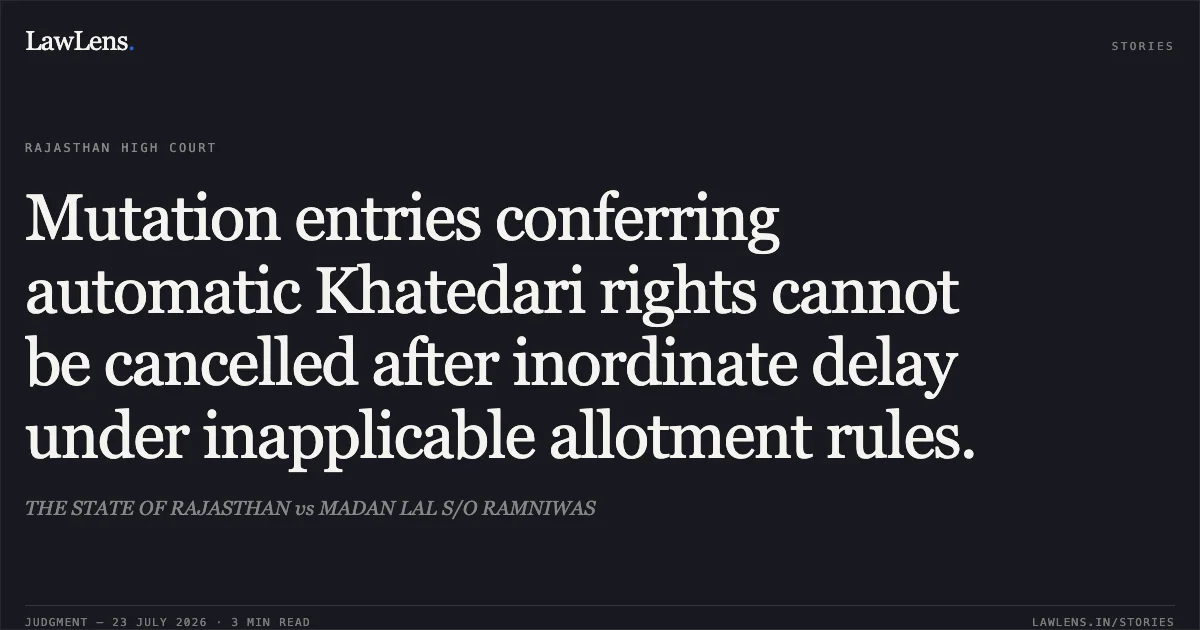
The Court held that the State cannot cancel long-standing Khatedari rights based on unsubstantiated recommendations of a Commission after decades
The Court dismissed the writ petition, upholding the concurrent findings of the Revenue Appellate Authority and the Board of Revenue and rejected the State's challenge to the RAA's jurisdiction as misconceived.
Source reference: para. 56The application to file additional documents after the judgment was reserved was dismissed as "malicious"
Source reference: para. 32Acts & Sections Cited
6 provisions across 3 statutes referred to in this judgment. Each provision opens on LawLens.
RAJASTHAN LAND REVENUE ACT, 19564
Code of Civil Procedure, 19081
rajasthan land reforms and resumption of jagirs act, 19521
Original Court PDF
THE STATE OF RAJASTHANvsMADAN LAL S/O RAMNIWAS
Click to open original judgment
Original judgment, available to read, download and summarize on LawLens.in