Facts
The petitioner was declared elected as Sarpanch of Gram Panchayat Kheriyasindh in 2022 by a margin of two votes
Source reference: p.1Respondent No. 2 filed an election petition under Section 122 of the M.P. Panchayat Raj Evam Gram Swaraj Adhiniyam, 1993, alleging counting irregularities and seeking a recount
Source reference: p.2Initially dismissed, the matter was remanded by the High Court for fresh adjudication with evidence
Source reference: p.2-3Post-remand, the Specified Officer/SDO passed an order on 27.11.2025, allowing the election petition and directing the Tehsildar to conduct a recount, primarily citing the narrow victory margin
Source reference: p.3The petitioner challenged this order under Article 226 of the Constitution of India
Source reference: p.3Issues
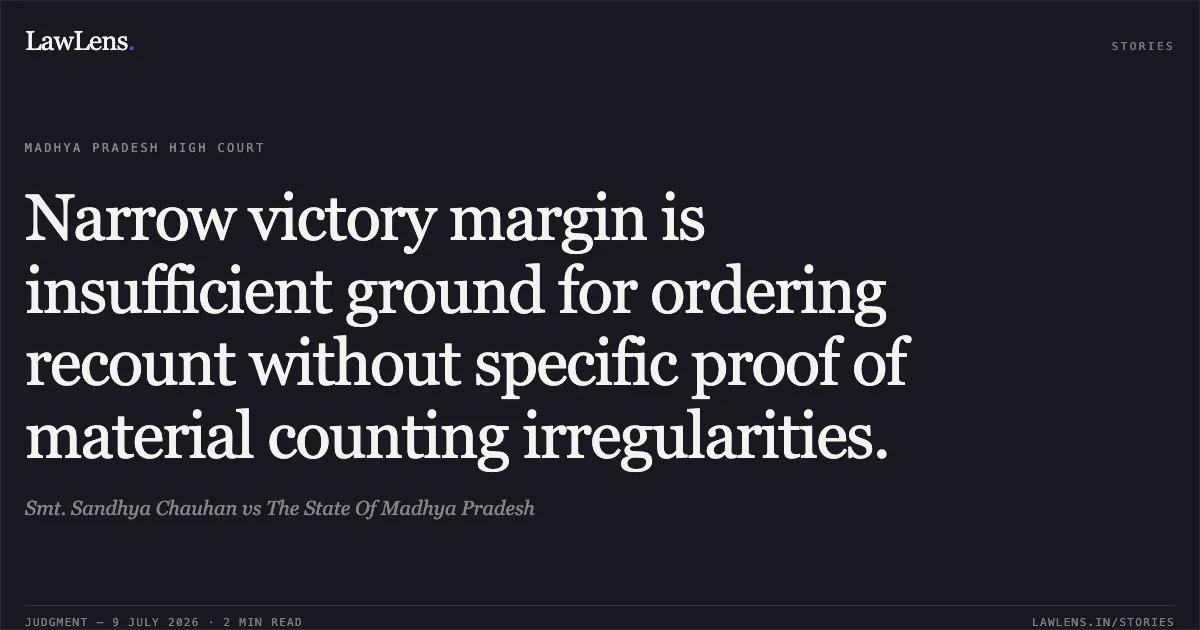
1. Whether a recount of votes can be directed by an Election Tribunal solely on the ground of a narrow margin of victory without specific findings of material irregularities
Source reference: p.142. Whether the Specified Officer can lawfully delegate the quasi-judicial function of recounting votes to a subordinate authority like the Tehsildar
Source reference: p.7-8, 153. Whether the respondent's failure to apply for a recount during the initial counting process as per Rule 80 of the M.P. Panchayat Nirvachan Niyam, 1995, bars the claim for recount in an election petition
Source reference: p.4-5, 16Law Applied
The Court applied the principles governing the sanctity of the ballot box and the stringent requirements for ordering a recount as established in Kattinokkula Murali Krishna v. Veeramalla Koteswara Rao (2010), which holds that a narrow margin does not per se justify a recount and that specific pleadings and proof of irregularities are mandatory
Source reference: p.5-6, 12-13It also considered Sohan Lal v. Babu Gandhi (2003) regarding the impact of failing to file a recount application before the Returning Officer
Source reference: p.10, 16the statutory framework of the M.P. Panchayat Raj Evam Gram Swaraj Adhiniyam, 1993, which vests quasi-judicial powers in the Specified Officer
Source reference: p.7, 15Reasoning
The Court reasoned that the secrecy of the ballot is sacrosanct and can only be breached upon proof of specific irregularities that materially affect the election result
Source reference: p.11-12It found that the Specified Officer failed to return findings on the ten framed issues and ignored that the Respondent produced no contemporaneous evidence (e.g., protest letters or testimony from counting staff) to substantiate claims of wrongful rejection of votes
Source reference: p.15-16The Court noted that the impugned order relied almost exclusively on the two-vote margin, which is legally insufficient under the Kattinokkula precedent
Source reference: p.14Furthermore, the Court held that the Specified Officer committed a jurisdictional error by delegating the recount to the Tehsildar, as a quasi-judicial duty cannot be abdicated to a subordinate in the absence of express statutory authorization
Source reference: p.7-8, 15Holding
The Court answered the issues by holding that the direction for a recount was illegal and lacked factual foundation
It held that the narrow margin of victory is not a valid ground for disturbing the secrecy of the ballot and that the delegation of recounting duties was an unauthorized abdication of jurisdiction
Source reference: p.14-15Consequently, the High Court allowed the writ petition and quashed the order dated 27.11.2025 passed by the Specified Officer, SDO Mehgaon
Source reference: p.17Acts & Sections Cited
1 provisions across 1 statute referred to in this judgment. Linked provisions open on LawLens.
M.P. Panchayat Raj Avam Gram Swaraj Adhiniyam, 19931
Original Court PDF
Smt. Sandhya ChauhanvsThe State Of Madhya Pradesh
Click to open original judgment
Original judgment, available to read, download and summarize on LawLens.in