Facts
The dispute concerns land classified in the revenue records as Natham land at M. Veerampatti, Madurai District.
Source reference: no citationEarlier orders in W.P.(MD) No. 19392 of 2019 and W.P.(MD) No. 5424 of 2021 had led to proceedings concerning alleged encroachments on the land.
Source reference: no citationIn review applications, the applicants contended that the land’s Natham classification precluded the Government from removing an alleged encroachment; the State submitted that the disputed land was used as a public pathway.
Source reference: pp. 8–9The Court considered the review applications alongside connected impleading and modification applications, contempt petitions, and a writ petition seeking removal of alleged encroachments.
Source reference: pp. 5–8Issues
1. Whether the earlier orders in W.P.(MD) No. 19392 of 2019 and W.P.(MD) No. 5424 of 2021 contained an error apparent on the face of the record warranting review, given the land’s Natham classification and the absence of material identifying it as a public road or pathway.
Source reference: pp. 9–102. Whether the nature and character of the disputed land, and the parties’ respective rights, required determination by a competent Civil Court.
Source reference: p. 10Law Applied
The Court relied on the Larger Bench decision in Kannan @ Kamatchi (Died) v. The District Collector, Dindigul District, W.P.(MD) Nos. 19720 of 2017 etc., decided 6 March 2026, which was cited in support of the proposition that the Government’s authority to remove an encroachment may depend on the land’s classification and ownership.
Source reference: p. 8The Court’s decision turned on the review principle that an error apparent on the face of the record may justify review, and on the principle that disputed questions concerning the nature of land and the parties’ rights may require adjudication by a competent Civil Court.
Source reference: pp. 9–10Reasoning
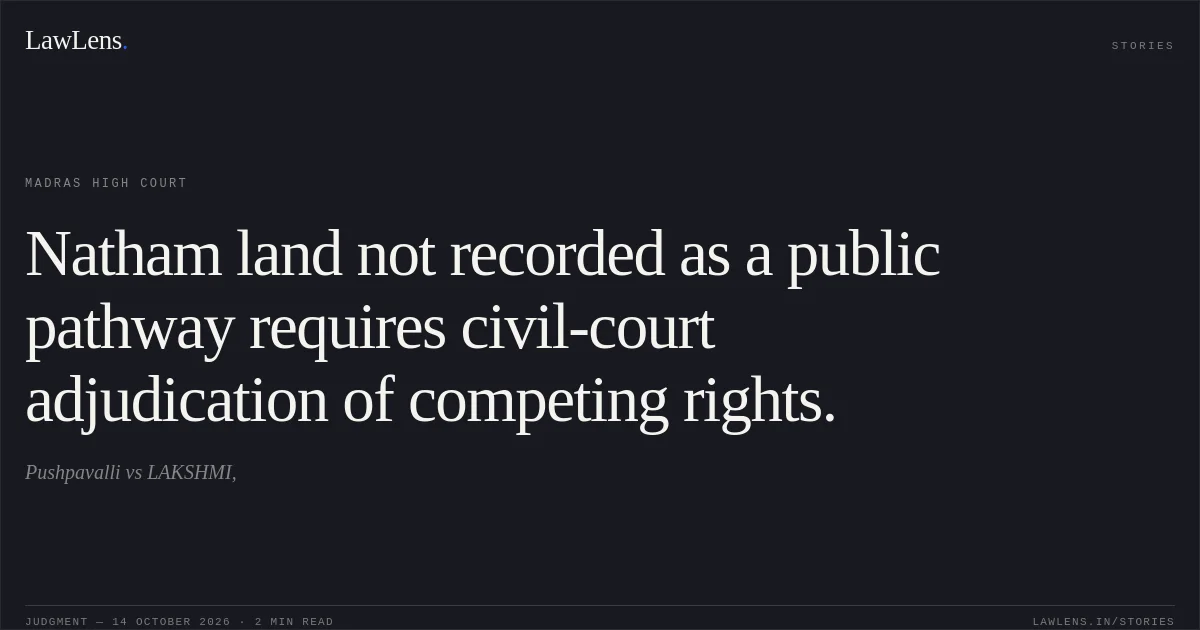
The Court accepted that the land was classified as Natham but treated the key question as whether it was also a public road or pathway.
Source reference: no citationThe revenue records showed the Natham classification and did not record the land as a road or pathway; the Court found no material establishing that it had been earmarked or recognised for public use.
Source reference: p. 9In those circumstances, the disputed land’s character and the parties’ rights could not be resolved on the record before the Court and required civil adjudication.
Source reference: no citationThe Court therefore found an apparent error in the earlier orders.
Source reference: pp. 9–10Holding
The Court allowed the review applications and set aside the orders dated 6 September 2019 in W.P.(MD) No. 19392 of 2019 and 24 August 2021 in W.P.(MD) No. 5424 of 2021.
It left the parties to pursue their remedies before the competent Civil Court, directed that court to decide the claims independently on their merits, and stated that the time spent pursuing the review applications would be excluded for limitation purposes subject to applicable law.
Source reference: p. 10The connected contempt petitions and writ petition were closed as infructuous.
Source reference: p. 11Acts & Sections Cited
1 provisions across 1 statute referred to in this judgment. Each provision opens on LawLens.
Contempt of Courts Act, 19711
Original Court PDF
PushpavallivsLAKSHMI,
Click to open original judgment
Original judgment, available to read, download and summarize on LawLens.in