Facts
The appellant’s land was acquired under the National Highways Act, 1956 (“NH Act”). The acquisition notification under Section 3A was published on 7 June 2011, followed by the declaration under Section 3D on 20 January 2012.
Source reference: p.13The Competent Authority determined the compensation under Section 3G(1) by order dated 11 July 2014, and the appellant received part of the compensation on 13 October 2014. Dissatisfied with the quantum, the appellant invoked arbitration under Section 3G(5); the Arbitrator passed an award dated 13 January 2016, which was subsequently challenged under Sections 34 and 37 of the Arbitration and Conciliation Act, 1996.
Source reference: p.14Issues
Whether solatium, interest, and interest on solatium payable in respect of land acquired under the NH Act are to be computed under the 1894 Act or the 2013 Act?
Source reference: pp.1–3, 9–10Whether the relevant “award” for determining applicability of the 2013 Act is the initial determination by the Competent Authority under Section 3G(1) of the NH Act or the subsequent determination by the Arbitrator under Section 3G(5)?
Source reference: pp.14–16, para. 19Whether the appellant could claim the benefit of the 2013 Act because the Arbitrator’s award was passed after 1 January 2015, or because compensation had allegedly not been paid to the majority of landowners by 31 December 2014?
Source reference: pp.3, 17–18, paras. 25–26Law Applied
Section 3J of the NH Act, which excluded the application of the 1894 Act to acquisitions under the NH Act, was declared unconstitutional in Union of India v. Tarsem Singh, 2019.
Source reference: pp.3–6Tarsem Singh-II, 2025 SCC OnLine SC 235, held that the benefit of solatium and interest could not be denied to landowners merely because their acquisitions occurred before 1 January 2015; however, it did not hold that the rates and computation under the 2013 Act applied retrospectively to awards made before that date.
Source reference: pp.8–10Section 105 of the 2013 Act initially excluded the enactments in the Fourth Schedule, including the NH Act, but the relevant compensation provisions were made applicable to NH Act acquisitions with effect from 1 January 2015 through the Ordinances and subsequent notification.
Source reference: pp.6–8Under Section 24(1)(a) of the 2013 Act, compensation is determined under the 2013 Act where no award had been made by the relevant commencement date; the principle was affirmed in Indore Development Authority v. Manoharlal, (2020) 8 SCC 129.
Source reference: pp.15–16For NH Act acquisitions, the initial compensation determination under Section 3G(1) is the equivalent of an award under Section 11 of the 1894 Act, while the Arbitrator’s determination under Section 3G(5) is analogous to a court’s determination on a reference under Section 18 of the 1894 Act.
Source reference: pp.14–15Accordingly, where the Section 3G(1) determination was made before 1 January 2015, solatium and interest are to be computed under the 1894 Act; where it was made on or after that date, the 2013 Act applies.
Source reference: p.16–17Reasoning
The Court distinguished between the entitlement to solatium and interest and the statutory basis for computing those benefits. Following Tarsem Singh-I and Tarsem Singh-II, the Court accepted that landowners whose lands were acquired under the NH Act could not be denied these benefits merely because the acquisition preceded 1 January 2015.
Source reference: pp.8–10However, the date and nature of the relevant award determined the applicable statute. The Competent Authority’s determination under Section 3G(1), dated 11 July 2014, was the initial award for this purpose; the later arbitral award merely adjudicated the appellant’s challenge to the quantum and did not constitute a fresh initial award.
Source reference: pp.14–16, paras. 19–23Since the Section 3G(1) determination preceded 1 January 2015, the 2013 Act was not applicable to the computation, notwithstanding that the arbitral award was made in 2016.
Source reference: pp.16–17, para. 24The Ministry’s notification did not assist the appellant because it referred to the majority of “land holdings,” not the majority of “landowners,” and the record showed that compensation for 1.700 hectares out of the total 3.080 hectares had been paid in 2014.
Source reference: p.17–18, paras. 25–26Holding
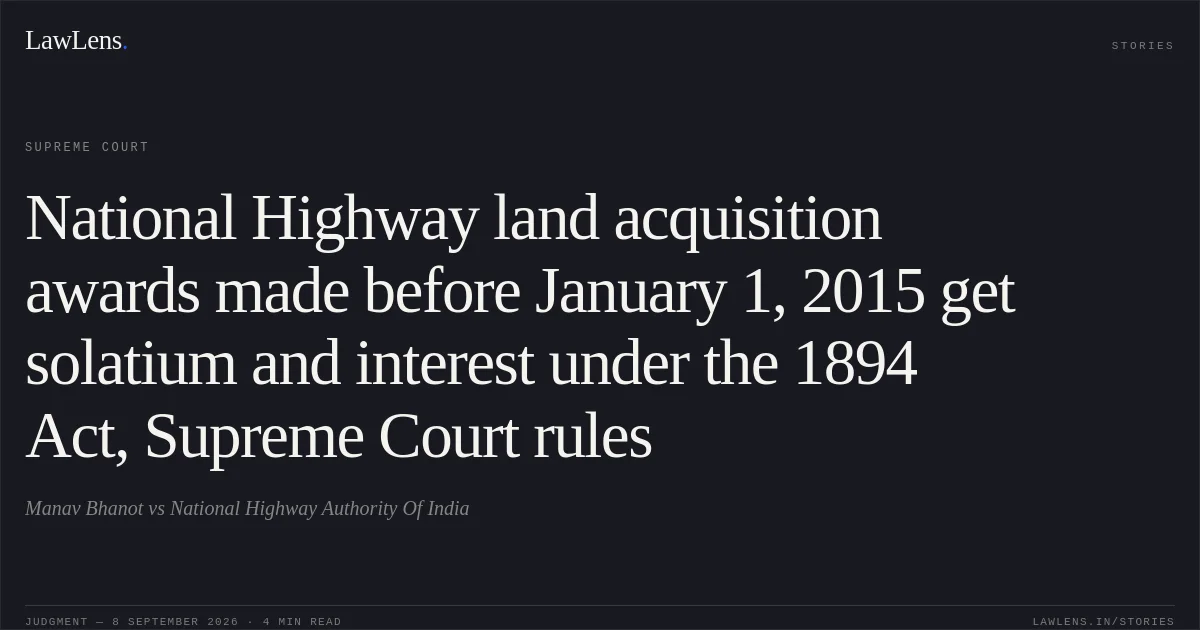
The Supreme Court held that the appellant was entitled to solatium, interest, and interest on solatium, but these benefits had to be computed under the Land Acquisition Act, 1894, because the Competent Authority had determined compensation under Section 3G(1) of the NH Act on 11 July 2014, before the 2013 Act became applicable to NH Act acquisitions from 1 January 2015.
The appeal was allowed to that limited extent, and the matter was remanded to the Competent Authority for computation and disbursal of the benefits under the 1894 Act.
Source reference: p.18, para. 27Acts & Sections Cited
8 provisions across 3 statutes referred to in this judgment. Each provision opens on LawLens.
National Highways Act, 19561
Right to Fair Compensation and Transparency in Land Acquisition, Rehabilitation and Resettlement Act, 20135
Arbitration and Conciliation Act, 19962
Original Court PDF
Manav BhanotvsNational Highway Authority Of India
Click to open original judgment
Original judgment, available to read, download and summarize on LawLens.in