Facts
The National Stock Exchange of India (NSEI) was incorporated as a private limited company in 1992
Source reference: para. 5(xviii)It sought recognition as a stock exchange under Section 4 of the Securities (Contracts) Regulations Act, 1956 (SCRA), which was granted by the Securities and Exchange Board of India (SEBI) acting as a delegate of the Central Government
Source reference: para. 5(xx)A learned Single Judge of the Delhi High Court, in a judgment dated 15 April 2010, ruled that NSEI is a "public authority" under Section 2(h) of the Right to Information Act, 2005 (RTI Act).
Source reference: no citationThe NSEI challenged this finding via Letters Patent Appeal, contending it is a private entity subject only to regulatory oversight, not governmental control
Source reference: para. 12-14Issues
1. Whether the National Stock Exchange of India (NSEI) constitutes a "public authority" within the meaning of Section 2(h) of the RTI Act, 2005
Source reference: para. 12. Whether the "control" exercised by the Government/SEBI over the NSEI is "deep and pervasive" enough to satisfy the requirements of Section 2(h)
Source reference: para. 27-28Law Applied
The Court applied Section 2(h) of the RTI Act, 2005, which defines "public authority" through both a functional-origin test (established/constituted by Constitution, Law, or Notification) and a control/funding test (owned, controlled, or substantially financed)
Source reference: para. 4It relied on the Supreme Court’s interpretation in Thalappalam Service Cooperative Bank Ltd v. State of Kerala, which categorized "public authorities" into six distinct types and clarified that "control" must be deep and pervasive
Source reference: para. 7, 28The Court further applied the precedent in K.C. Sharma v. Delhi Stock Exchange, affirmed by the Supreme Court, which established that recognized stock exchanges are subject to deep and pervasive governmental control due to their public functions and the statutory framework of the SCRA and SEBI Act
Source reference: para. 31-32Reasoning
The Court rejected the Appellant’s argument that regulatory oversight does not equate to "control." It held that under the SCRA, a stock exchange cannot function without a specific grant of recognition (Section 4), making its very identity dependent on a government order
Source reference: para. 49-50Applying the K.C. Sharma precedent, the Court noted that the Central Government/SEBI intervenes in the NSEI’s day-to-day business, margin money requirements, and board composition, which constitutes "deep and pervasive control"
Source reference: para. 31The Court found that NSEI falls under the first part of Section 2(h) as an "authority" constituted by an order (the recognition grant) issued by the Central Government's delegate, SEBI
Source reference: para. 41, 52Simultaneously, it satisfies the second part of Section 2(h)(i) as a body "controlled" by the appropriate government
Source reference: para. 39The Court emphasized a purposive interpretation, noting that stock exchanges perform public functions essential to the economy, as recognized in Binny Ltd v. V. Sadasivan
Source reference: para. 43-45Holding
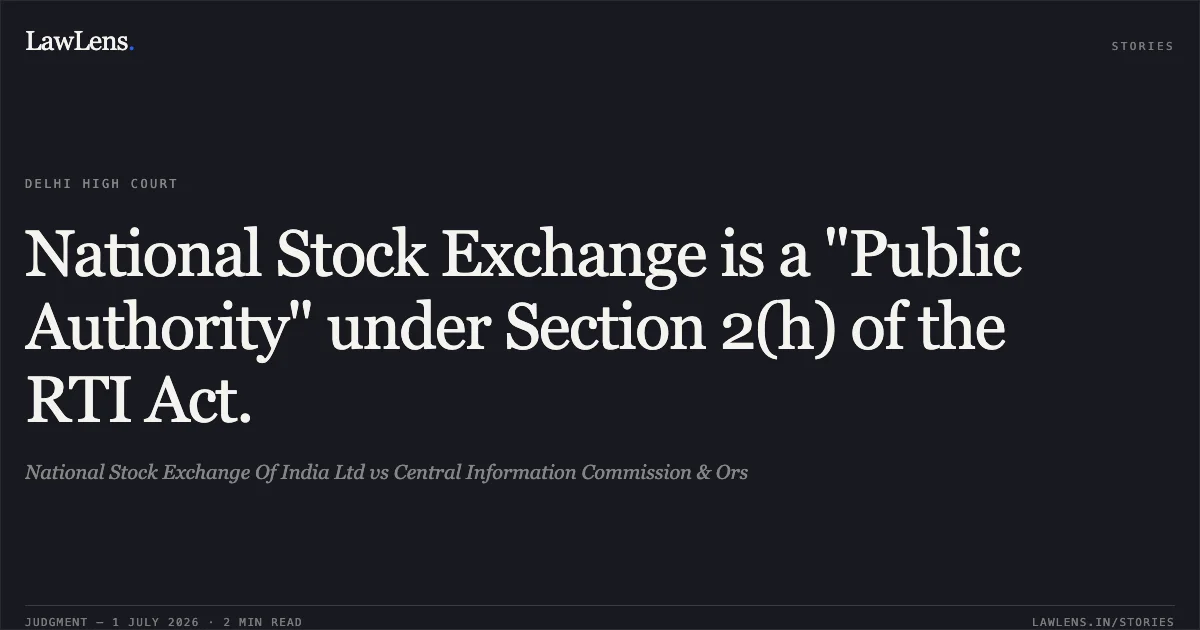
The High Court dismissed the appeal and upheld the Single Judge’s judgment, holding that the National Stock Exchange of India (NSEI) is a "public authority" under both the first and second parts of Section 2(h) of the RTI Act
The Court concluded that the statutory requirement of recognition for functional existence, coupled with the pervasive administrative and functional control exercised by SEBI, brings the NSEI within the ambit of the RTI Act
Source reference: para. 55-57No costs were ordered
Source reference: para. 57Acts & Sections Cited
2 provisions across 2 statutes referred to in this judgment. Each provision opens on LawLens.
Right to Information Act, 20051
Securities and Exchange Board of India Act, 19921
Original Court PDF
National Stock Exchange Of India LtdvsCentral Information Commission & Ors
Click to open original judgment
Original judgment, available to read, download and summarize on LawLens.in