Facts
The petitioner, Neetu Parmar, was declared elected as President of the Municipal Council, Multai, in an indirect election where 15 elected Councillors voted. She secured 9 votes against 6 votes for Respondent No. 1
Source reference: para 30Respondent No. 1 challenged the election before the Election Tribunal on two grounds: (i) that four ballots contained identification marks and (ii) that the petitioner engaged in "corrupt practice" by securing votes from Councillors of the Indian National Congress (INC) through illegal resources/promises
Source reference: para 31-32The Tribunal set aside the election, concluding that six ballots were invalid due to marks and that the subsequent appointment of two INC Councillors to Advisory Committees proved corrupt practice
Source reference: para 32, 69The petitioner filed a Civil Revision; however, the High Court initially dismissed it for a two-day delay in depositing security required under Rule 19(2) of the M.P. Municipalities (Election Petition) Rules, 1962. The Supreme Court subsequently remanded the matter for a hearing on the merits
Source reference: para 4-5Issues
1. Whether a Civil Revision is maintainable if the security deposit under Rule 19(2) of the 1962 Rules is made after the date of presentation
Source reference: para 9-102. Whether electors who were not parties to the original election petition can be considered "persons aggrieved" entitled to file a revision under Section 26(2) of the Act
Source reference: para 69-703. Whether ink blots or pen trails on ballot papers constitute "identification marks" rendering the votes void
Source reference: para 33, 404. Whether the procurement of votes from an opposing political party and the subsequent appointment of such voters to statutory committees constitutes "corrupt practice" in the absence of specific pleadings
Source reference: para 34, 48, 55Law Applied
The court applied Article 225 of the Constitution and Clause 27 of the Letters Patent of the Nagpur High Court, affirming the High Court's exclusive power to regulate its own procedure
Source reference: para 13-14Rule 19(2) of the 1962 Rules, being a delegated legislation in conflict with the parent M.P. Municipalities Act, 1961 and the M.P. High Court Rules, 2008, must give way
Source reference: para 16-17Regarding corrupt practices, the court relied on Manohar Joshi v. Damodar Tatyaba, establishing that such charges are quasi-criminal and require strict proof
Source reference: para 47It further applied the "material facts" doctrine from Anil Vasudev Salgaonkar v. Naresh Kushali Shigaonkar, which mandates that all basic facts constituting a corrupt practice must be specifically pleaded
Source reference: para 56Reasoning
The court first resolved the maintainability issue, ruling that the State Government lacks the authority to regulate High Court procedure; therefore, the mandatory dismissal clause in Rule 19(2) for late security deposits is inapplicable as it conflicts with Article 225 and the High Court Rules
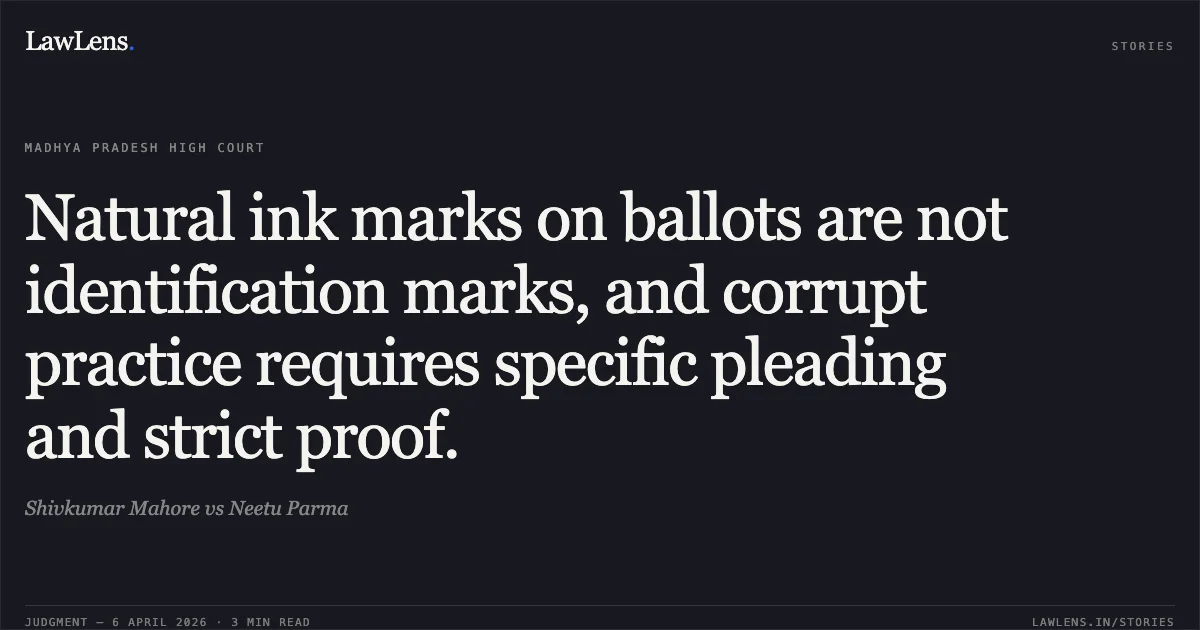
Source reference: para 16, 25-26On the merits, the court examined the disputed ballots (Exhibits D-25 to D-32) and found that the "marks" were merely natural ink blots or pen trails, which were also present on the respondent's ballots
Source reference: para 41-43Since no specific pattern existed to identify the voters, the Tribunal's finding was deemed perverse
Source reference: para 44The Tribunal’s inference of bribery based on the appointment of INC Councillors to Advisory Committees was legally flawed because these "material facts" were never pleaded in the election petition
Source reference: para 55, 68Furthermore, the court held that under Sections 70 and 71 of the Act, the President has the statutory right to appoint any Councillor to the President-in-Council or Advisory Committees, and such appointments do not permit an automatic inference of corrupt practice
Source reference: para 61-62, 67Holding
The court allowed Civil Revision No. 464/2023, setting aside the Election Tribunal's order and upholding Neetu Parmar’s election as President
The court held that (i) the revision was maintainable as Rule 19(2) cannot override High Court procedural rules; (ii) the alleged identification marks were natural ink flow issues and not grounds for invalidation; and (iii) corrupt practice cannot be inferred from statutory appointments without specific pleadings and strict proof. Civil Revisions Nos. 497 and 499 of 2023 filed by electors were dismissed as not maintainable, as they were not "aggrieved persons" within the meaning of Section 26
Source reference: para 70-71Acts & Sections Cited
10 provisions across 8 statutes referred to in this judgment. Each provision opens on LawLens.
Code of Civil Procedure, 19081
States Reorganisation Act, 19561
Representation of the People Act, 19513
Provincial Insolvency Act, 19201
Provincial Small Cause Courts Act, 18871
Unified Waqf Management, Empowerment, Efficiency and Development Act, 19951
Juvenile Justice (Care and Protection of Children) Act, 2015.1
Bharatiya Nagarik Suraksha Sanhita, 20231
Original Court PDF
Shivkumar MahorevsNeetu Parma
Click to open original judgment
Original judgment, available to read, download and summarize on LawLens.in