Facts
The applicant was appointed as a Chawkidar in 1972 and promoted to Motor Pump Attendant (MPA) in 1984 in the pay scale of Rs. 260-400
Source reference: p. 2, para. 3In 1988, the respondents issued an amendment treating the promotion as "Mate MPA" in a lower pay scale (Rs. 210-290), asserting the original scale was a clerical error
Source reference: p. 3, para. 6This reduction was implemented without prior notice or an opportunity for a hearing
Source reference: p. 3, para. 6The applicant further alleged delays in trade test promotions and the belated grant of the 3rd MACP in 2008 instead of 2006
Source reference: p. 2, para. 4Between 2012 and 2014, the applicant submitted various representations and a legal notice, all of which were rejected by the respondents through the impugned orders
Source reference: p. 2-3, para. 4-5The applicant sought the quashing of these orders and a direction for re-fixation of pay and arrears
Source reference: p. 1-2, para. 2Issues
1. Whether the Original Application was liable to be dismissed on the grounds of limitation and delay
Source reference: p. 4, para. 92. Whether the respondents could legally reduce the applicant’s pay scale and rank to rectify a clerical error without complying with the principles of natural justice
Source reference: p. 4, para. 10Law Applied
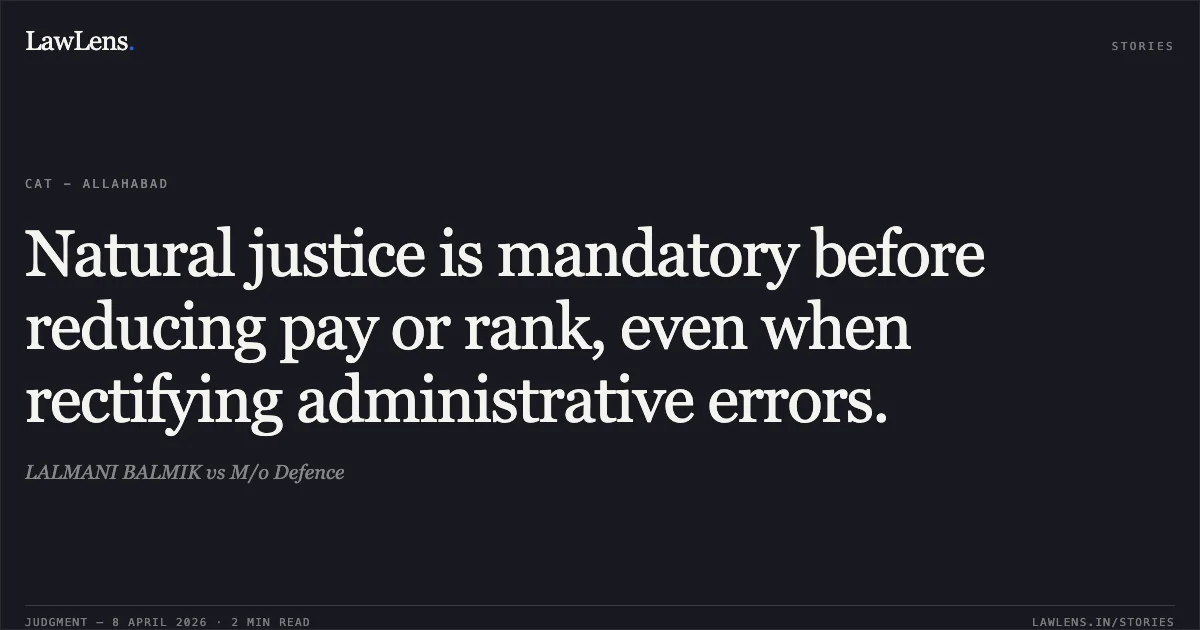
The Tribunal applied the Principles of Natural Justice, specifically the doctrine of audi alteram partem, which requires that no person should be condemned unheard when an administrative action results in "civil consequences" such as the reduction of rank or pay
Source reference: p. 5, para. 10The Tribunal relied on the precedent set by the Hon’ble Supreme Court in Shekhar Ghosh v. UOI & Ors (2007) 1 SCC 331, which established that while administrative mistakes can be rectified, such rectification requires compliance with natural justice unless the mistake is apparent on the face of the record and requires no subjective finding
Source reference: p. 5, para. 11Additionally, the Tribunal applied the principle that wrong pay fixation constitutes a "continuing cause of action," mitigating the rigors of the law of limitation
Source reference: p. 4, para. 9Reasoning
The Tribunal first addressed the respondents' objection regarding delay, holding that since the OA was admitted in 2014 and the matter concerned pay fixation—a continuing cause of action—the delay was deemed condoned
Source reference: p. 4, para. 9On the merits, the Tribunal noted the respondents' admission that no show-cause notice was provided to the applicant before his pay scale was downgraded from Rs. 260-400 to Rs. 210-290
Source reference: p. 4-5, para. 10The Tribunal reasoned that reducing an employee’s rank and re-fixing pay are actions with significant civil consequences; therefore, the respondents were duty-bound to provide an opportunity for a hearing
Source reference: p. 5, para. 10Applying the Shekhar Ghosh precedent, the Tribunal concluded that a different finding might have been reached had the applicant been heard, making the unilateral rectification legally unsustainable
Source reference: p. 5, para. 12Holding
The Tribunal allowed the Original Application and quashed the impugned orders dated 15.12.2012, 12.07.2013, and 09.01.2014
The respondents were directed to revise the applicant’s pay according to extant rules
Source reference: p. 5, para. 12The Tribunal granted the respondents liberty to issue a fresh show-cause notice to the applicant and decide the issue on merits after considering his reply, provided such an exercise is completed within three months
Source reference: p. 5, para. 12No costs were awarded
Source reference: p. 5, para. 12Original Court PDF
LALMANI BALMIKvsM/o Defence
Click to open original judgment
Original judgment, available to read, download and summarize on LawLens.in


