Facts
The petitioner was appointed as a teacher by the respondent on June 30, 1992, and confirmed as a permanent employee on June 30, 1993.
Source reference: para. 2Although appointed as a teacher, she was assigned librarian duties from May 14, 2011, until her termination on June 30, 2015.
Source reference: para. 2Her services were terminated without notice or a domestic enquiry.
Source reference: para. 2The petitioner approached the Labour Court, Gwalior, contending she was a "workman" under the Industrial Disputes Act due to her librarian duties.
Source reference: para. 2On March 22, 2017, the Labour Court rejected her claim, holding that as a teacher, she did not fall under the definition of a "workman".
Source reference: para. 2After withdrawing a previous writ petition with liberty to file afresh, the petitioner challenged the Labour Court’s award via this miscellaneous petition.
Source reference: para. 2Issues
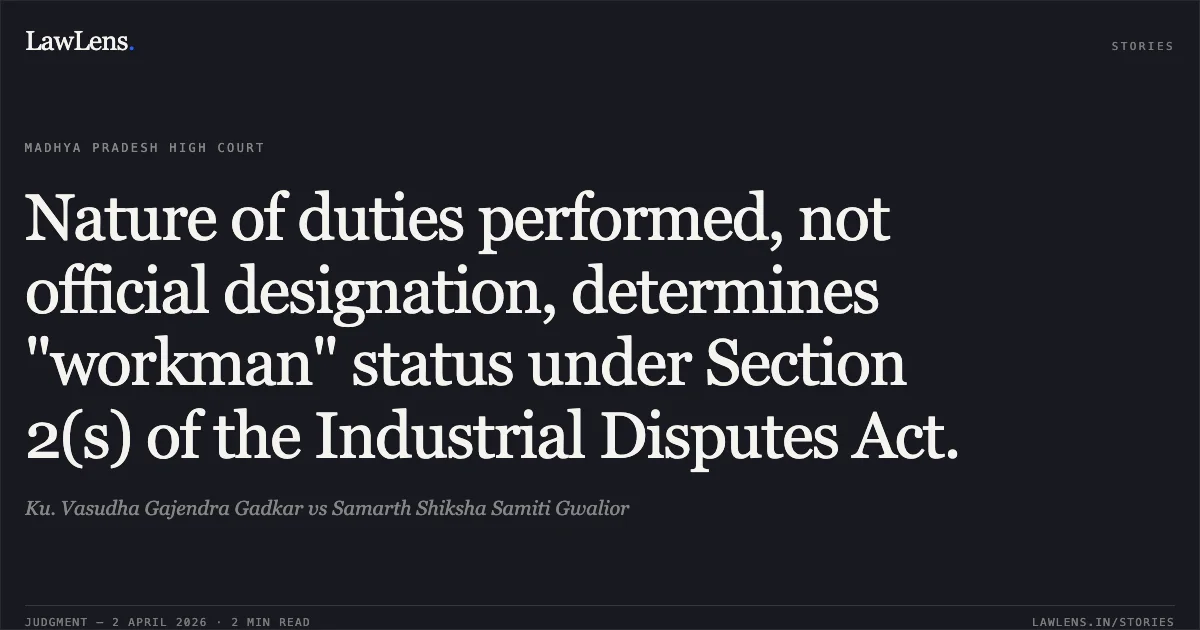
1. Whether the nature of duties performed, rather than the formal designation, is the determining factor for qualifying as a "workman" under Section 2(s) of the Industrial Disputes Act.
Source reference: para. 62. Whether the Labour Court erred in dismissing the petitioner’s claim solely based on her initial appointment as a teacher while ignoring her actual functions as a librarian.
Source reference: para. 7Law Applied
Section 2(s) of the Industrial Disputes Act, which defines a "workman."
Source reference: para. 6The determination of "workman" status depends on the principal nature of the duties and functions performed, rather than the designation of the post.
Source reference: para. 6Hon'ble Supreme Court’s decision in Lenin Kumar Ray vs. M/s Express Publications (Madurai) Ltd. [2024 INSC 802], which emphasizes that the actual nature of work is legally vital.
Source reference: para. 3, 6Reasoning
The High Court found that the Labour Court committed a reversible error by failing to assess the actual nature of the duties performed by the petitioner.
Source reference: para. 7While the petitioner was designated as a teacher, the evidence indicated she was assigned full-time duties as a librarian for several years prior to her termination.
Source reference: para. 2The Court reasoned that the designation is of secondary importance; the primary inquiry must be the employee's actual functions.
Source reference: para. 6By focusing exclusively on the petitioner’s initial appointment letter, the Labour Court ignored the evidence of her librarian duties, which would qualify her as a "workman" under Section 2(s) of the Industrial Disputes Act.
Source reference: para. 7Consequently, the Labour Court’s finding was deemed erroneous and arbitrary.
Source reference: para. 3, 7Holding
The High Court set aside the Labour Court’s award dated March 22, 2017.
It held that the petitioner falls within the definition of a "workman" under Section 2(s) of the Industrial Disputes Act based on the actual nature of her duties.
Source reference: para. 7The matter was remanded to the Labour Court to adjudicate the legality of her termination and determine appropriate relief, such as reinstatement, back wages, or compensation.
Source reference: para. 8The petition was disposed of with no order as to costs.
Source reference: para. 9Acts & Sections Cited
1 provisions across 1 statute referred to in this judgment. Linked provisions open on LawLens.
Industrial Disputes Act, 19471
Original Court PDF
Ku. Vasudha Gajendra GadkarvsSamarth Shiksha Samiti Gwalior
Click to open original judgment
Original judgment, available to read, download and summarize on LawLens.in


