Facts
The appellant, a juvenile and student of Class IX, was implicated in Baisi P.S. Case No. 381 of 2023 involving offences under Sections 302, 201, and 34 of the IPC after the recovery of a dead body.
Source reference: p. 1-2The implication was based on a confessional statement following a related kidnapping investigation.
Source reference: p. 2The Children’s Court, Purnea, rejected the appellant's regular bail petition on 20.11.2025, citing the serious nature of the offence and the possibility of the juvenile associating with criminals.
Source reference: p. 1The appellant has been in a Place of Safety since 22.07.2023.
Source reference: p. 3Issues
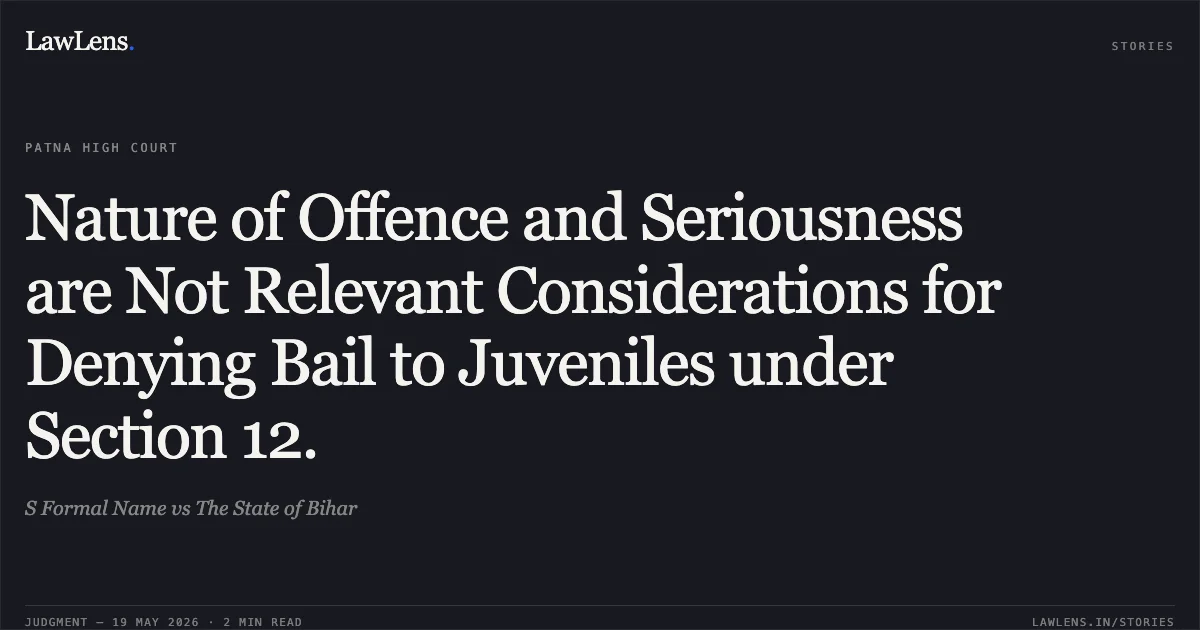
1. Whether the nature and seriousness of an alleged offence are valid grounds for denying bail to a juvenile under the Juvenile Justice (Care and Protection of Children) Act, 2015.
Source reference: p. 8 / para. 152. Whether the apprehension of "association with known criminals" can be invoked to deny bail without supporting material in the Social Investigation Report.
Source reference: p. 18 / para. 28(6)3. Whether the Children’s Court erred in applying the "ends of justice" exception under Section 12 of the Act.
Source reference: p. 12 / para. 18Law Applied
Section 12 of the Juvenile Justice (JJ) Act, 2015, which mandates that a juvenile "shall" be released on bail notwithstanding the CrPC, unless specific exceptions in the proviso (association with criminals, moral/physical danger, or defeating ends of justice) are met.
Source reference: p. 4-5The gravity of the offence is irrelevant to bail for a juvenile, as established in Lalu Kumar @ Lal Babu v. State of Bihar and Juvenile in Conflict with Law v. State of Rajasthan.
Source reference: p. 8, p. 5Section 3 of the JJ Act, emphasizing the "Principle of best interest" and "Principle of family responsibility," noting that institutionalization is a measure of last resort.
Source reference: p. 13-16Reasoning
The Court reasoned that Section 12 of the JJ Act overrides general criminal law, making bail the rule and refusal the exception.
Source reference: p. 5, 18The Court found the Children’s Court's reliance on the "seriousness of the offence" legally unsustainable, as the Act does not categorize bail eligibility based on the nature of the crime.
Source reference: p. 8, 19Regarding the proviso to Section 12, the Court observed that the Social Investigation Report (SIR) contained no evidence of the appellant associating with "known criminals"; thus, the lower court's finding was speculative and lacked a factual basis.
Source reference: p. 3, 20The Court interpreted "ends of justice" through the lens of juvenile welfare, concluding that the appellant’s reformation is best served by repatriation to his biological family—the primary institution for rehabilitation—rather than continued institutionalization.
Source reference: p. 12-16, 20Holding
The appellant is entitled to bail regardless of the gravity of the charges, provided no specific disqualifications under the Section 12 proviso are substantiated by material evidence.
The Court set aside the impugned order, allowed the appeal, and directed the appellant's release on a bail bond of Rs. 10,000, subject to an affidavit from his father undertaking to maintain vigil over his conduct.
Source reference: p. 21Acts & Sections Cited
8 provisions across 2 statutes referred to in this judgment. Each provision opens on LawLens.
Indian Penal Code, 18603
Juvenile Justice (Care and Protection of Children) Act, 2015.5
Original Court PDF
S Formal NamevsThe State of Bihar
Click to open original judgment
Original judgment, available to read, download and summarize on LawLens.in