Facts
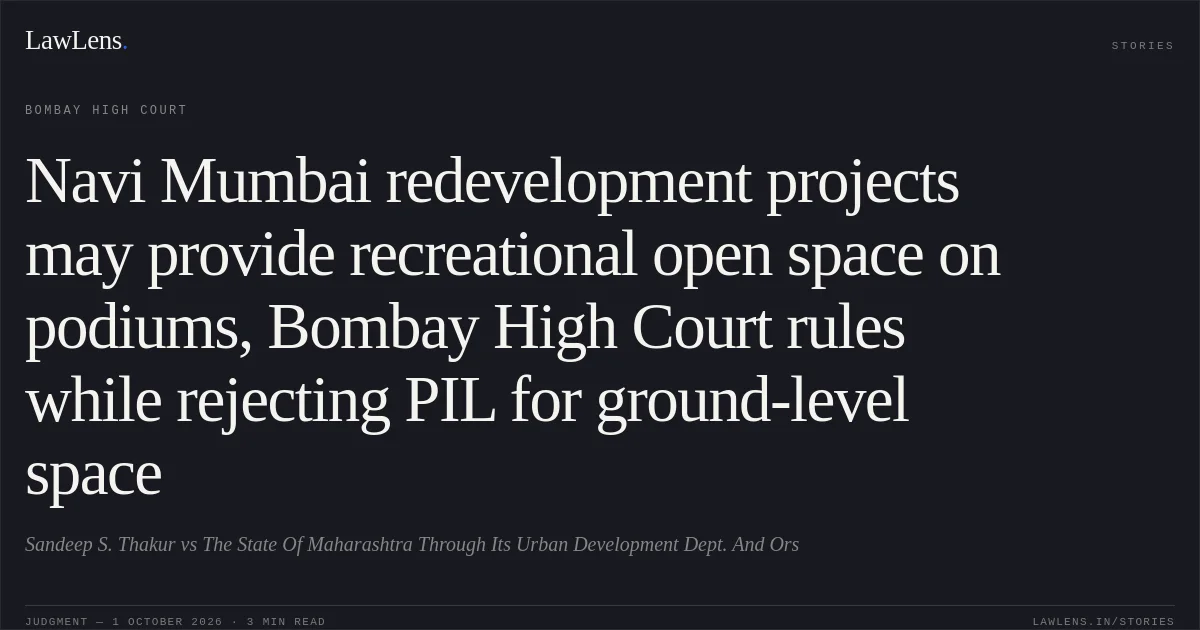
The petitioner filed a public interest petition under Article 226 seeking to set aside development permissions granted to Respondent Nos. 3–7 for redevelopment projects in Navi Mumbai.
Source reference: para. 1He contended that Regulation 10.10.2(3)(vi) of the Unified Development Control and Promotion Regulations, 2020 (UDCPR) required the prescribed recreational open space (ROS) to be provided on the ground, open to sky, over and above any podium garden; instead, NMMC had permitted the societies to provide ROS at podium level by granting relaxations under Regulation 2.4.
Source reference: paras. 4–7The societies relied on redevelopment constraints, including height limits, road setbacks, rehabilitation requirements and parking obligations, and submitted that the permissions and relaxations were justified.
Source reference: paras. 10–12, 25–26The petitioner also alleged that podium-level ROS would increase reliance on public open spaces.
Source reference: paras. 7, 31The Court considered the UDCPR provisions and the parties’ submissions.
Source reference: paras. 29–33Issues
1. Whether Regulation 10.10.2(3)(vi) requires the prescribed ROS to be provided at ground level, clearly open to sky, and over and above a podium garden, or permits ROS to be provided on a podium.
Source reference: paras. 33–362. Whether Regulation 10.10.2’s non obstante clause excludes the application of Regulations 2.4, 3.4.1, 3.4.7 and 9.13 of the UDCPR.
Source reference: paras. 40–443. Whether NMMC’s case-specific relaxations and the resulting development permissions were shown to be arbitrary or perverse so as to warrant interference under Article 226.
Source reference: paras. 38–49Law Applied
The Court applied UDCPR Regulation 10.10.2(3)(vi), which prescribes compulsory ROS for specified CIDCO/NMMC redevelopment plots; Regulation 3.4.1(iii), which permits ROS on a podium, including up to 100% where a 1.5-metre tree-planting strip is provided; Regulation 9.13, which permits ROS on a podium subject to Regulation 3.4.1(iii); Regulation 3.4.7, concerning structures permitted in open spaces; and Regulation 1.3(103), defining a podium to include recreational open space.
Source reference: paras. 33(c)–(h)Regulation 2.4 permits relaxation of prescribed dimensions or provisions in cases of clearly demonstrable hardship, provided health, safety, fire safety, structural safety and public safety are not compromised.
Source reference: para. 33(i)A non obstante clause ordinarily gives the provision overriding effect in the event of conflict, but should be construed harmoniously with other provisions; the Court relied on Mohd. Abdul Samad v. State of Telangana, (2025) 2 SCC 49, discussing the principles in Aswini Kumar Ghosh v. Arabinda Bose, (1952) 2 SCC 237.
Source reference: paras. 41–43The Court also held that limitations such as “mother earth” or “natural ground” cannot be read into the UDCPR’s ROS provisions where the text does not provide for them.
Source reference: para. 35Reasoning
Reading Regulations 10.10.2(3)(vi), 3.4.1(iii), 3.4.7 and 9.13 together with the definition of “podium,” the Court held that ROS may be provided at podium level if it is open to sky and the applicable podium-garden requirements are met; the regulations do not require ROS to be on natural ground or “mother earth”.
Source reference: paras. 34–35The non obstante clause in Chapter 10 did not displace the general UDCPR provisions in the absence of conflict, and Regulation 2.4 remained applicable.
Source reference: paras. 41–44, 49The petitioner produced no material showing that the stated redevelopment constraints were false or that NMMC’s exercise of discretion was perverse; nor did he substantiate the asserted effect on public open spaces.
Source reference: paras. 38–39, 46, 49The Court also noted that Regulation 10.10.2(3)(vi) referred to condominium/plot areas, whereas Respondent Nos. 3–7 were cooperative housing societies.
Source reference: para. 36Holding
The Court rejected the petitioner’s interpretation of the UDCPR and found no demonstrated perversity in NMMC’s exercise of discretion or sufficient basis to set aside the permissions.
It dismissed the PIL for want of merit and disposed of the interim application as no longer surviving.
Source reference: paras. 54–55Acts & Sections Cited
5 provisions across 2 statutes referred to in this judgment. Each provision opens on LawLens.
Maharashtra Municipal Corporations Act.2
Maharashtra Regional and Town Planning Act, 1966.3
Original Court PDF
Sandeep S. ThakurvsThe State Of Maharashtra Through Its Urban Development Dept. And Ors
Click to open original judgment
Original judgment, available to read, download and summarize on LawLens.in