Facts
The Appellant, an ex-director of Superfine Metals Pvt. Ltd. (“Corporate Debtor”), challenged the NCLT Mumbai Bench-II order admitting Central Bank of India’s application under Section 7 of the Insolvency and Bankruptcy Code, 2016 (“IBC”).
Source reference: para. 1The Bank originally filed the Section 7 application recording 29 November 2020 as the date of default, which fell within the Section 10A protected period. After the Corporate Debtor raised the Section 10A bar, the Bank amended its application and asserted that the defaults occurred earlier—on 10 March 2020 in respect of the Cash Credit facility and on 24 March 2020 in respect of the Ad Hoc facility.
Source reference: paras. 4–8, 83The Cash Credit facility involved interest debited on 29 February 2020, allegedly payable by 10 March 2020. The Bank relied on the sanction terms and contended that non-payment constituted default before the commencement of Section 10A on 25 March 2020. The Corporate Debtor relied on the Working Capital Consortium Agreement, under which the facility was “repayable only upon demand,” the RBI COVID-19 deferment circulars, the subsequent conversion of interest into a FITL, renewal of the facility, and the Bank’s classification of the account as an NPA only on 29 November 2020.
Source reference: paras. 41–45, 88–93The Ad Hoc facility of Rs. 3.70 crore was disbursed on 26 December 2019 and was required to be adjusted within 90 days from the date of availment. The Bank treated 26 December 2019 as the first day and alleged default on 24 March 2020. The Corporate Debtor contended that, applying Section 9 of the General Clauses Act, the date of availment had to be excluded; consequently, the 90-day period expired on 25 March 2020 and default could arise only on 26 March 2020, within the Section 10A period. The Bank’s letter dated 21 March 2020 also referred to 26 March 2020 as the closure date.
Source reference: paras. 46–47, 120–127The NCLT admitted the Section 7 application on 16 July 2026. The Appellant approached the NCLAT under Section 61 of the IBC.
Source reference: para. 1Issues
1. Whether the default under the Cash Credit facility occurred before 25 March 2020 or during the period protected by Section 10A of the IBC?
Source reference: paras. 82, 85, 87–1192. Whether the default under the Ad Hoc Cash Credit facility occurred on 24 March 2020, as pleaded by the Bank, or after commencement of the Section 10A period?
Source reference: paras. 82, 85, 120–1273. Whether the Bank could rely on amended dates of default and subsequent events to overcome the Section 10A bar, notwithstanding its original pleading and Information Utility record showing 29 November 2020 as the date of default?
Source reference: paras. 128–141Law Applied
The NCLAT applied Section 3(12) of the IBC, under which “default” means non-payment of a debt when the whole or part of it has become “due and payable” and remains unpaid.
Source reference: para. 94Section 7(3) and Section 7(4) require the financial creditor to furnish evidence of default and the Adjudicating Authority to ascertain the existence of default from the Information Utility record or other evidence.
Source reference: paras. 129–130Section 10A permanently bars initiation of CIRP for a default arising on or after 25 March 2020 during the protected period, ultimately extending to 24 March 2021; it does not apply to defaults committed before 25 March 2020.
Source reference: paras. 103–106, 133–135In Ramesh Kymal v. Siemens Gamesa Renewable Power (P) Ltd., (2021) 3 SCC 224, the Supreme Court held that Section 10A operates by reference to the date of default and creates an absolute bar for defaults arising during the protected period.
Source reference: para. 104The NCLAT relied on J.C. Flowers Asset Reconstruction Pvt. Ltd. v. Laxmi Oil and Vanaspati Pvt. Ltd., as affirmed by the Supreme Court, for the principle that a debt must be both due and presently payable, and that COVID-19 regulatory relief is relevant to determining whether an actionable default had arisen.
Source reference: paras. 111–114It also applied Sections 9 and 10 of the General Clauses Act, 1897, particularly the rule that where a period runs “from” a specified day, that day is excluded from computation.
Source reference: paras. 122–125While Dena Bank v. C. Shivakumar Reddy, (2021) 10 SCC 330, permits amendment of a Section 7 application before final adjudication, the amendment must still be supported by reliable facts and evidence.
Source reference: para. 130The NCLAT distinguished Laxmi Pat Surana v. Union Bank of India, (2021) 8 SCC 481, holding that it did not authorise a lender to select an earlier date merely to avoid Section 10A.
Source reference: paras. 137–140Reasoning
For the Cash Credit facility, the NCLAT held that the Bank failed to establish that the alleged amount was presently payable and recoverable on 10 March 2020. The Working Capital Consortium Agreement provided that the facility was repayable “only upon demand,” but no demand had been made before the alleged date of default.
Source reference: paras. 91–93, 116–119Further, the interest was subject to the RBI’s COVID-19 deferment regime, under which recovery of interest on CC/OD facilities was deferred until 31 August 2020. Applying the “due and payable” requirement in Section 3(12), the Tribunal held that the deferred interest could not constitute an actionable default on 10 March 2020.
Source reference: paras. 96–101, 109, 119The Bank’s own conduct—treating the account as regular, renewing the facility in November 2020 and January 2021, and recording the NPA date as 29 November 2020—was inconsistent with its subsequently asserted earlier default date.
Source reference: paras. 95, 115, 119For the Ad Hoc facility, the Tribunal excluded 26 December 2019 from the computation under Section 9 of the General Clauses Act. The 90-day period therefore commenced on 27 December 2019 and expired on 25 March 2020. Since the facility could become overdue only upon non-payment after expiry of that day, the default arose on 26 March 2020, within the Section 10A period.
Source reference: paras. 121–127The Bank’s contemporaneous letter dated 21 March 2020, which identified 26 March 2020 as the closure date, further undermined the amended date of 24 March 2020.
Source reference: para. 126Although amendment of a Section 7 application is permissible, the Tribunal held that the amended dates could not be accepted merely because the amendment had been allowed. The dates had been substituted only after the Section 10A objection was raised, contradicted the original Form-1 and NeSL record, and lacked adequate documentary support. Subsequent notices and alleged continuing non-payment could not cure the failure to establish the specific defaults pleaded in the amended Form-1 or create a new, unpleaded basis for admission.
Source reference: paras. 129–141Holding
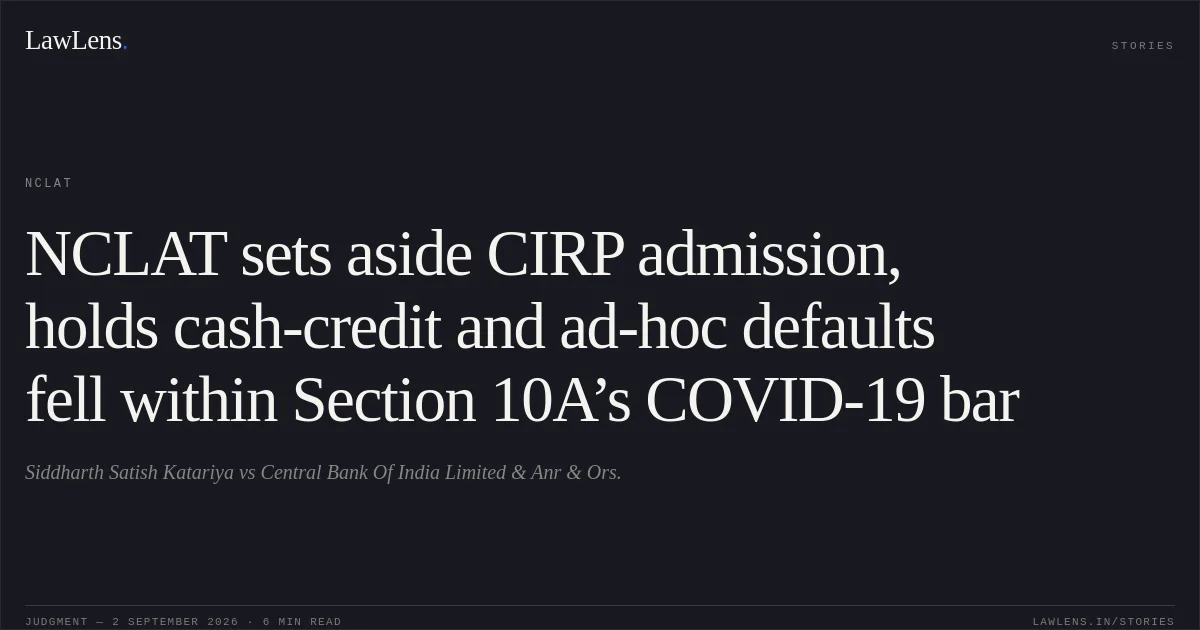
The NCLAT allowed the appeal and set aside the NCLT’s order admitting the Section 7 application.
It held that the Bank failed to prove a Cash Credit default on 10 March 2020 and that the Ad Hoc facility default arose only on 26 March 2020; both defaults were therefore either protected by Section 10A or otherwise incapable of sustaining the CIRP application.
Source reference: para. 145The Bank’s amendment of the Section 7 application did not establish dates of default outside the protected period.
Source reference: para. 145The Tribunal clarified that the underlying debt was not extinguished and that the Bank could pursue other remedies, including proceedings under the IBC based on any fresh default arising in accordance with law.
Source reference: para. 145Acts & Sections Cited
11 provisions across 4 statutes referred to in this judgment. Each provision opens on LawLens.
Insolvency and Bankruptcy Code, 2016.7
Code of Civil Procedure, 19081
Securitisation and Reconstruction of Financial Assets and Enforcement of Security Interest Act, 20021
General Clauses Act, 18972
Original Court PDF
Siddharth Satish KatariyavsCentral Bank Of India Limited & Anr & Ors.
Click to open original judgment
Original judgment, available to read, download and summarize on LawLens.in