01Facts
The National Company Law Appellate Tribunal (NCLAT) heard two consolidated appeals involving BSE Limited (Appellant) challenging orders passed by the Adjudicating Authority (NCLT, Mumbai).
In the first case (CA 1786/2025), the demat account of the Corporate Debtor (CD), Future Corporate Resources Pvt. Ltd., was frozen by BSE due to non-payment of Annual Listing Fees (ALF) by its group company, Future Retail Ltd
¶ 9In the second case (CA 1862/2024), the demat account of Liz Traders and Agents Pvt. Ltd. (under liquidation) was frozen because the CD was a promoter of non-compliant listed entities
¶ 17In both instances, the Resolution Professional (RP) or Liquidator sought to de-freeze the accounts to take custody of shares belonging to the CDs.
¶ 10, 17BSE refused, asserting that de-freezing required compliance with Securities and Exchange Board of India (SEBI) regulations and payment of outstanding fines
¶ 10, 17The NCLT ordered BSE to de-freeze the accounts, leading to these appeals
¶ 2, 1202Issues
i.1. Whether the Adjudicating Authority (NCLT) has jurisdiction under Section 60(5) of the Insolvency and Bankruptcy Code (IBC), 2016, to order the de-freezing of demat accounts frozen under the Securities Law Framework
¶ 22, 74ii.2. Whether the provisions of the IBC, particularly the moratorium and the duties of the RP/Liquidator, override the recovery and enforcement powers of Stock Exchanges under SEBI regulations and the Securities Contracts (Regulation) Act (SCRA), 1956
¶ 26, 7603Law Applied
The court primarily applied Section 60(5)(c) of the IBC, which vests the NCLT with residuary jurisdiction to decide any question of law or fact arising out of or in relation to insolvency proceedings
¶ 69, 71It invoked Section 238 of the IBC, which ensures the Code overrides any inconsistent provisions in other laws
¶ 70The court relied on the Supreme Court's decisions in Embassy Property Developments Pvt. Ltd. v. State of Karnataka, which distinguished between matters of public law and crystallized dues
¶ 43, 77Gujarat Urja Vikas Nigam Ltd. v. Amit Gupta, which affirmed NCLT’s jurisdiction over disputes with a nexus to the CD’s insolvency
¶ 44, 71It also considered Regulation 14 of the SEBI (LODR) Regulations regarding the payment of fees to stock exchanges
¶ 33Provisions in the judgment · 35 · Linked ones open on LawLens
Tea Act, 1953 Section 16
Companies Act, 2013 Section 408Section 410Section 420Section 424
Electricity Act, 2003 Section 173Section 174
Negotiable Instruments Act, 1881 Section 138Section 141
Insolvency and Bankruptcy Code, 2016. 25 provisions
Section 5Section 7Section 9Section 10Section 13Section 14Section 15Section 16Section 17Section 18Section 19Section 20Section 21Section 22Section 25Section 28Section 29Section 32Section 33Section 35Section 36Section 52Section 53Section 60Section 238Securities and Exchange Board of India Act, 1992 Section 32
04Reasoning
The NCLAT observed that while SEBI and Stock Exchanges have the power to regulate listed entities and freeze accounts for non-compliance, such powers are not absolute once insolvency proceedings commence
¶ 38, 75The Tribunal distinguished this case from others by noting that the ALF and fines were "crystallized" dues
¶ 77, 79Following the Embassy Property doctrine, once a statutory authority's claim is finalized and only recovery remains, the claim becomes an "operational debt" to be dealt with under the IBC framework rather than through independent enforcement by the regulator
¶ 77-78Since the ownership of the shares was undisputed and the de-freezing was essential for the RP/Liquidator to perform their statutory duties under Sections 18, 25, and 35 of the IBC, the issue had a direct nexus with the insolvency process
¶ 74, 79Consequently, Section 238 of the IBC overrides the recovery mechanisms of the SEBI Act/SCRA during the moratorium or liquidation process
¶ 76, 8005Holding
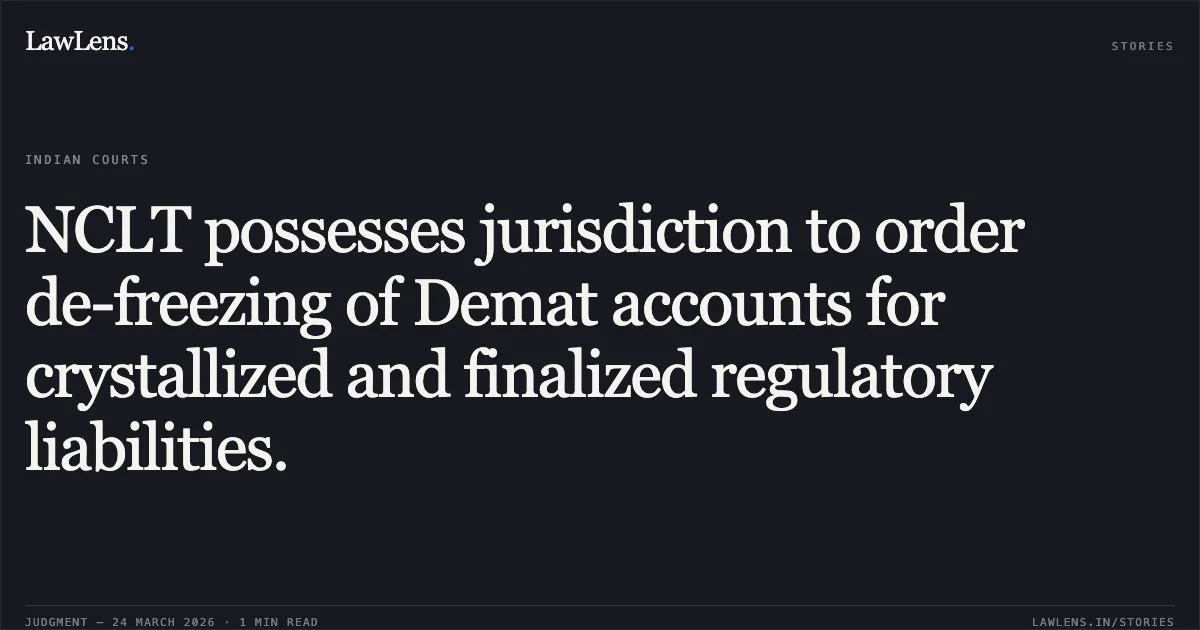
The NCLAT dismissed both appeals, holding that the NCLT validly exercised its jurisdiction under Section 60(5) of the IBC
¶ 79, 82The Tribunal affirmed that the de-freezing of the demat accounts was a question arising out of and in relation to the insolvency resolution and liquidation proceedings of the CDs
¶ 74, 79It concluded that once dues are crystallized, the regulator cannot bypass the IBC's collective resolution process by maintaining a debit freeze on the CD's assets
¶ 77-78The orders directing the de-freezing of the accounts were upheld
¶ 81Original Court PDF
Bse LimitedvsMrudula Brodie & Ors. & Ors.
Click to open original judgment
Original judgment, available to read, download and summarize on LawLens.in