Facts
The Appellant (63 Moons) challenged an order dated September 17, 2019, passed by the Appellate Tribunal for PMLA, which directed the Appellant to furnish an indemnity bond of ₹1095,27,17,055/- and an undertaking to deposit the same if attached properties were later found to be "proceeds of crime" (PoC).
Source reference: para. 2Upon compliance, the Tribunal ordered the quashing of provisional attachments on the Appellant's movable properties (DEMAT accounts/bonds).
Source reference: para. 2The Directorate of Enforcement (ED) also appealed against the lifting of these attachments.
Source reference: para. 3Concurrently, the National Spot Exchange Limited (NSEL) obtained sanction from the National Company Law Tribunal (NCLT) for a settlement scheme to compensate investors.
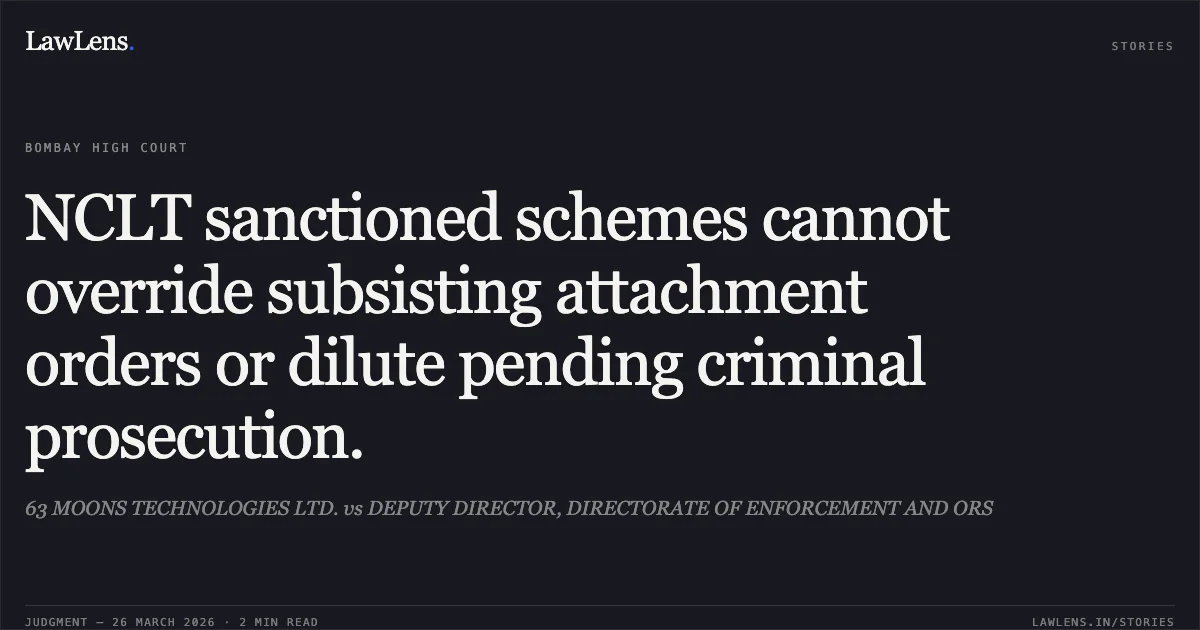
Source reference: para. 5The NCLT clarified that this sanction would not override subsisting attachment orders or terminate pending criminal proceedings.
Source reference: para. 5The Appellant sought the implementation of this NCLT-sanctioned scheme to distribute funds to creditors through a court-appointed Monitoring Authority.
Source reference: para. 8Issues
1. Whether the provisional attachment of assets under the PMLA can be lifted to facilitate a settlement scheme sanctioned by the NCLT for the benefit of investors.
Source reference: para. 9-122. Whether a settlement scheme between private parties and creditors can legally result in the quashing or compounding of serious criminal offences under investigation by agencies like the ED.
Source reference: para. 10-11Law Applied
The Court considered the provisions of the Prevention of Money Laundering Act, 2002 (PMLA) regarding the attachment of "proceeds of crime" and the jurisdiction of the Appellate Tribunal.
Source reference: para. 1-2It applied the principle that criminal prosecution for serious offences is independent of civil settlements; specifically, a Civil Court (or NCLT) cannot determine or dilute the consequences of criminal prosecution through consent-based schemes.
Source reference: para. 11The court also upheld the NCLT’s proviso that a scheme of arrangement under the Companies Act/IBC framework cannot override subsisting criminal proceedings or statutory attachments unless specifically ordered by the relevant competent court.
Source reference: para. 5Reasoning
The Court balanced the need to provide relief to thousands of defrauded NSEL investors with the necessity of maintaining the integrity of criminal proceedings.
Source reference: para. 9While it acknowledged the NCLT’s sanction of the settlement scheme, the Court expressed strong disapproval of Clause 24.6 of said scheme, which contemplated that parties would jointly apply for the quashing/compounding of criminal proceedings upon settlement.
Source reference: para. 10The Court reasoned that such clauses are an indirect attempt by accused persons to secure exoneration for serious offences through civil mechanisms.
Source reference: para. 11It held that criminal law must reach its logical conclusion independently and cannot be "countenanced" or "diluted" by a consent-based civil settlement.
Source reference: para. 11Consequently, the Court allowed the distribution of funds to victims but strictly de-linked this action from the status of the criminal charges.
Source reference: para. 13Holding
The High Court allowed Interim Application No. 4604 of 2025, permitting the implementation of the settlement scheme for the distribution of amounts to specified creditors.
The lifting of the attachment and the disbursement of funds shall not be construed as a dilution of criminal charges against the accused.
Source reference: para. 13The Court ordered that criminal prosecution must proceed independently and be taken to its logical end by the prosecuting agencies.
Source reference: para. 13All connected appeals and petitions were disposed of in view of these directions.
Source reference: para. 12Original Court PDF
63 MOONS TECHNOLOGIES LTD.vsDEPUTY DIRECTOR, DIRECTORATE OF ENFORCEMENT AND ORS
Click to open original judgment
Original judgment, available to read, download and summarize on LawLens.in


