Facts
The Petitioner, a running educational institution, applied for the transition of its B.A. B.Ed. / B.Sc. B.Ed. courses to the 4-year Integrated Teacher Education Programme (ITEP) for the 2026-27 session
Source reference: p.13The Respondent (NCTE) issued two successive Show Cause Notices (SCNs) dated 19.12.2025 and 03.02.2026, alleging various deficiencies in teaching staff and infrastructure
Source reference: p.13Despite the Petitioner’s replies, the Respondent issued a Refusal Order on 11.03.2026 without conducting a physical inspection of the premises
Source reference: p.13The Petitioner challenged this order, arguing it was arbitrary and violated NCTE Regulations
Source reference: p.14Issues
1. Whether the Writ Petition is maintainable under Article 226 given the existence of an alternative statutory appellate remedy under Section 18 of the NCTE Act
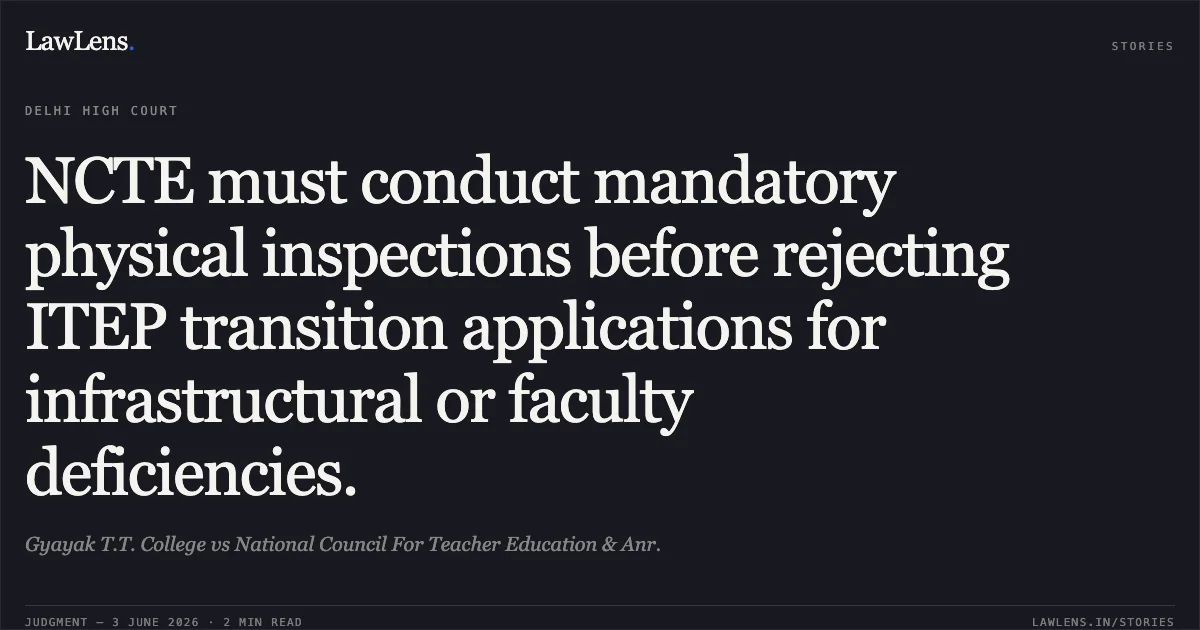
Source reference: p.14, 212. Whether the NCTE can issue a refusal order based on substantive deficiencies like infrastructure and staff without conducting a physical inspection as per Regulation 7
Source reference: p.21Law Applied
Regulation 7 of the NCTE (Recognition Norms & Procedure) Regulations, 2014, which mandates that applications can only be rejected at the preliminary stage if they are incomplete or lack requisite documents; substantive deficiencies regarding infrastructure must be assessed post-inspection
Source reference: p.17-21The existence of an alternative remedy is a self-imposed restriction and not an absolute bar, especially in cases of jurisdictional error or violation of natural justice (Rikhab Chand Jain v. Union of India (2025))
Source reference: p.21-22Strict adherence to academic timelines (Maa Vaishno Devi Mahila Mahavidyalaya v. State of U.P. (2013))
Source reference: p.23Reasoning
The Court observed that under Regulation 7(1), rejection at the threshold is limited to "incomplete applications"
Source reference: p.17, 21The SCNs issued by the NCTE pointed to deficiencies such as shortage of teaching staff and lack of physical infrastructure, which the Court reasoned could only be accurately determined through a physical inspection and the subsequent issuance of a Letter of Intent (LOI)
Source reference: p.21The Court held that issuing a refusal order without inspection was a violation of the prescribed regulatory procedure and the principles of natural justice
Source reference: p.21, 23The Court rejected the Respondent's plea regarding the alternative remedy, noting that the NCTE's actions were vitiated by law, and the time-sensitive nature of academic sessions required immediate judicial intervention to prevent the petitions from becoming infructuous
Source reference: p.23Holding
The Court allowed the writ petitions and set aside the Refusal Order dated 11.03.2026
It directed the Respondents to conduct a physical inspection of the Petitioner’s institute within three weeks
Source reference: p.23The Court ordered that the entire process—including any fresh SCNs, replies, and final adjudication—must be completed by 30.06.2026 to ensure the Petitioner could participate in the 2026-2027 academic session
Source reference: p.24This holding was applied mutatis mutandis to all connected matters
Source reference: p.25Acts & Sections Cited
1 provisions across 1 statute referred to in this judgment. Each provision opens on LawLens.
National Council for Teacher Education Act, 19931
Original Court PDF
Gyayak T.T. CollegevsNational Council For Teacher Education & Anr.
Click to open original judgment
Original judgment, available to read, download and summarize on LawLens.in