Facts
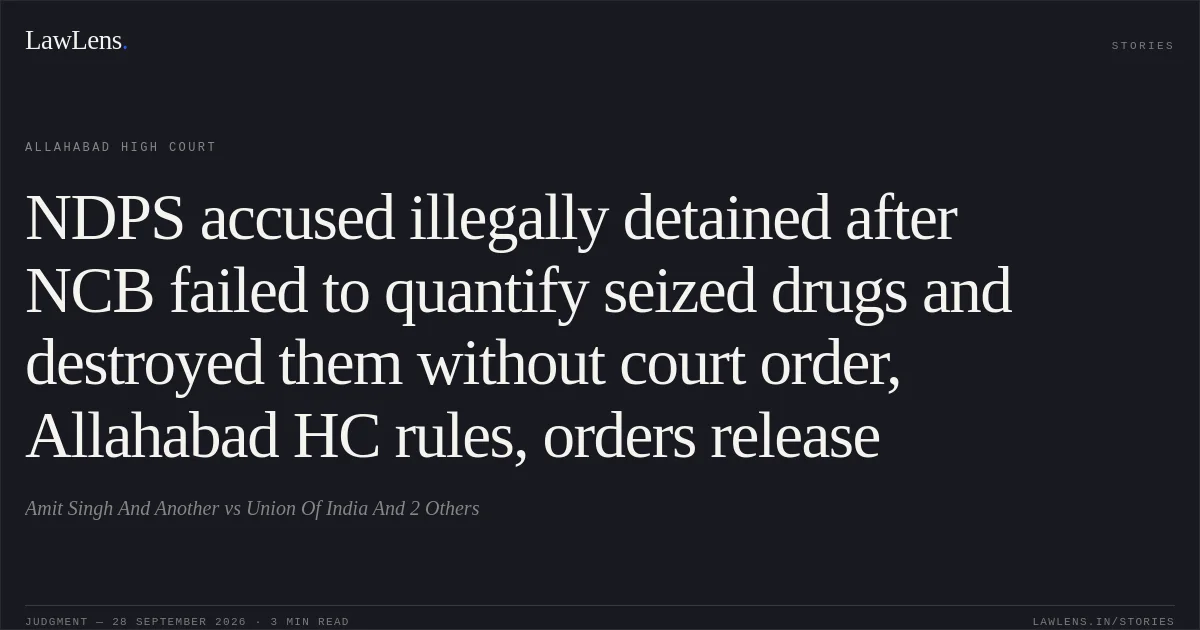
On 25 October 2024, the Narcotics Control Bureau (NCB) raided premises in Gautam Budh Nagar and seized 95.501 kg of alleged methamphetamine. The petitioners were arrested the next day and remanded to custody.
Source reference: para. 4–5The NCB’s application for certification under Section 52-A of the NDPS Act, filed on 28 October 2024, was allowed on 26 April 2025.
Source reference: para. 6, 33The Special Court had extended the investigation period by 60 days, but the High Court set that extension aside on 26 August 2025 and permitted the NCB to seek a fresh extension. No fresh extension was obtained; the NCB filed its complaint on 20 June 2025, and the Special Court took cognizance on 25 June 2025.
Source reference: para. 7–9, 18–19, 34The petitioners alleged that no quantitative analysis was conducted and that the seized contraband was destroyed without judicial permission or notice. The NCB disputed the legal effect of those allegations and maintained that they were matters for trial.
Source reference: para. 21–22The FSL’s qualitative test identified mephedrone, whereas the NCB’s field test had identified amphetamine.
Source reference: para. 32The petitioners’ default-bail applications had been rejected; they sought release by habeas corpus on the ground that their continued detention was unlawful.
Source reference: para. 10, 16–19Issues
1. Whether the petitioners’ continued detention was lawful where the extension of the investigation period had been set aside, no fresh extension was obtained, and the complaint was filed after the statutory period.
Source reference: para. 34–352. Whether the alleged failures in quantitative testing, sampling, certification and disposal of the seized contraband further undermined the legal basis for detention.
Source reference: para. 21–22, 27–33Law Applied
Section 36-A(4) of the NDPS Act extends the ordinary investigation period to 180 days for specified offences, including those involving commercial quantity, and permits a Special Court to extend it, on the Public Prosecutor’s report, up to one year.
Source reference: no citationSection 52-A provides for the Magistrate’s role in certifying seized material and its disposal.
Source reference: para. 27The Court relied on Rules 13 and 14 of the NDPS (Seizure, Storage, Sampling and Disposal) Rules, 2022, treating them as requiring samples to be sent through the Magistrate for chemical analysis and quantitative results to be provided within the prescribed period, subject to the Rule 14 proviso.
Source reference: para. 27, 30–31It also relied on Bharat Aambale v. State of Chhattisgarh for the proposition that substantial compliance with Section 52-A is required and deviations may support an adverse inference depending on the facts.
Source reference: para. 27–28Union of India v. Jarooparam was cited for the risk to the prosecution case where bulk contraband is destroyed without a Magistrate’s order and without notice to the accused.
Source reference: para. 26The Court considered Hira Singh v. Union of India, which holds that the entire weight of a mixture is considered in determining quantity, but held that Rules 13 and 14, framed later, affected the application of that principle in this case.
Source reference: para. 30Reasoning
The Court found no quantitative analysis report and no evidence that the contraband had been destroyed with judicial authorisation or notice to the petitioners.
Source reference: para. 22, 29–33It considered the absence of quantitative testing especially significant because the seized material had been disposed of, making later analysis impossible; it also noted that the samples were allegedly sent directly by NCB officials rather than through the Magistrate and that the field test and FSL test identified different substances.
Source reference: para. 22, 29–33Separately, the Court held that the Special Court’s extension order had been set aside, no fresh extension was obtained, and the complaint was therefore filed beyond the applicable statutory period.
Source reference: para. 34It concluded that the complaint could not support valid cognizance and that the petitioners’ detention consequently lacked lawful authority.
Source reference: para. 34Holding
The High Court allowed both habeas corpus petitions, held the petitioners’ arrest and detention illegal, and directed their release forthwith on furnishing personal bonds of ₹2 lakh each with two sureties in the like amount to the satisfaction of the court concerned.
Acts & Sections Cited
13 provisions across 2 statutes referred to in this judgment. Each provision opens on LawLens.
Narcotic Drugs and Psychotropic Substances Act, 19857
Code of Criminal Procedure, 19736
Original Court PDF
Amit Singh And AnothervsUnion Of India And 2 Others
Click to open original judgment
Original judgment, available to read, download and summarize on LawLens.in