01Facts
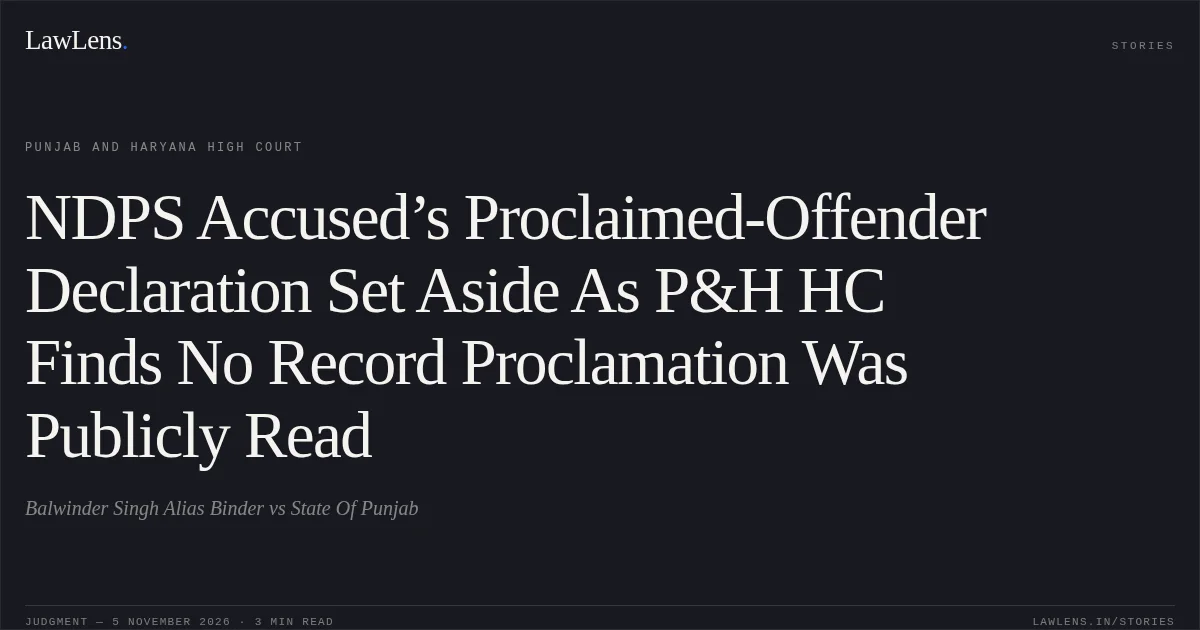
The petitioner, an accused in an NDPS case, had been released on bail and appeared before the Trial Court until 21 January 2025, after which he remained absent. Following cancellation and forfeiture of his bail and surety bonds, and issuance of arrest warrants, the Trial Court ordered proclamation proceedings on 30 August 2025 and declared him a proclaimed offender on 13 October 2025.
pp. 1–2The petitioner challenged that declaration, contending that the serving official’s statement did not record that the proclamation had been publicly read at a conspicuous place in the village and was dated before the order directing issuance of the proclamation. The State opposed the petition, relying on the petitioner’s non-appearance and the proclamation having been returned as duly effected.
pp. 2–302Issues
i.Whether the declaration of the petitioner as a proclaimed offender could stand when the record did not establish compliance with every prescribed mode of publication under Section 82(2) Cr.P.C.
p. 3, 6ii.Whether the procedural defect warranted setting aside the declaration despite the petitioner’s prior non-appearance.
pp. 6–703Law Applied
Section 82 Cr.P.C. (corresponding to Section 84 BNSS) requires a proclamation to be published through the prescribed modes, including publicly reading it at a conspicuous place in the town or village where the person ordinarily resides, affixing it at the person’s residence or a conspicuous place in that town or village, and affixing a copy at the courthouse; these modes are conjunctive and mandatory.
pp. 3–6A court’s written statement that publication occurred in the prescribed manner is conclusive evidence of compliance, but a general recital cannot replace material establishing that compliance.
pp. 3–6The Court relied on Sonu v. State of Haryana, 2021 (1) RCR (Criminal) 319, which summarised the requirements of Section 82 and held that non-compliance with its mandatory publication requirements renders the proclamation and subsequent proceedings a nullity.
pp. 4–6The petition was brought under Section 528 BNSS, the successor provision to Section 482 Cr.P.C.
p. 1Provisions in the judgment · 4 · Linked ones open on LawLens
Code of Criminal Procedure, 1973 Section 482Section 82
Narcotic Drugs and Psychotropic Substances Act, 1985 Section 22
Bharatiya Nagarik Suraksha Sanhita, 2023 Section 84
04Reasoning
The serving official’s statement recorded that copies were affixed outside the petitioner’s house, at a common place in the village, and outside the Court, but did not state that the proclamation had been publicly read in a conspicuous place in the village.
p. 6Because public reading is one of the mandatory, conjunctive modes under Section 82(2) Cr.P.C., the record did not establish valid publication. The Trial Court’s general statement that the proclamation had been duly effected could not cure that omission.
p. 6The Court also noted that the serving official’s statement was dated 9 August 2025, before the 30 August 2025 order directing issuance of the proclamation, reinforcing the need for scrutiny.
p. 7The petitioner’s prior absence did not dispense with compliance with the statutory procedure; however, his obligation to attend the criminal proceedings remained, and costs were appropriate in light of his conduct.
pp. 7–805Holding
The Court allowed the petition and set aside the 13 October 2025 order declaring the petitioner a proclaimed offender in FIR No. 149 dated 3 August 2023.
p. 8It imposed costs of ₹25,000, payable to the Punjab and Haryana High Court Legal Services Committee within six weeks.
p. 8The order was confined to the legality of the declaration: the petitioner remained obliged to appear at the Trial Court and participate in the proceedings, and the Trial Court could initiate fresh proclamation proceedings in accordance with law.
p. 8Original Court PDF
Balwinder Singh Alias BindervsState Of Punjab
Click to open original judgment
Original judgment, available to read, download and summarize on LawLens.in