Facts
On 4 May 2014, the appellant and his brother were intercepted in a Tata Safari on a public road. Ten plastic bags containing approximately 200 kg of poppy husk were allegedly recovered from beneath a tarpaulin at the rear of the vehicle.
Source reference: paras. 4–9, 12–14A further recovery of eight bags from a room in their house was made pursuant to disclosure statements, but the Special Court discarded that recovery for non-compliance with the requirements applicable to house searches. The appellant and his brother were convicted under Section 15(c) of the Narcotic Drugs and Psychotropic Substances Act, 1985, and sentenced to ten years’ rigorous imprisonment, a fine of ₹1,00,000, and one year’s further rigorous imprisonment in default. The High Court affirmed the conviction and sentence, holding that there was substantial compliance with Section 42, that Section 50 did not apply to the vehicle search, and that the recovery from the vehicle was independently sustainable. The appellant appealed to the Supreme Court under Article 136 of the Constitution.
Source reference: paras. 2, 14–17Issues
1. Whether the failure to formally record the secret information and separately forward it to the superior officer constituted total non-compliance with Section 42 of the NDPS Act, vitiating the conviction?
Source reference: paras. 18, 25–342. Whether Section 50 of the NDPS Act was violated because the appellant’s personal search was conducted before an officer allegedly holding only current duty charge as Deputy Superintendent of Police?
Source reference: paras. 19, 35–373. Whether the delay in forwarding the samples to the Chemical Examiner, and the alleged non-compliance with Section 52A and Standing Order 1/88, rendered the recovery and conviction unreliable?
Source reference: paras. 20, 38–414. Whether the non-association of independent witnesses, discrepancies in police testimony, and the rejection of the house recovery required rejection of the vehicle recovery as well?
Source reference: paras. 20, 42–465. Whether the prosecution established the appellant’s conscious possession of the contraband despite the vehicle being registered in the name of a third party and the appellant being seated beside the driver?
Source reference: paras. 47–486. Whether the concurrent findings of the courts below and the sentence imposed warranted interference under Article 136 of the Constitution?
Source reference: paras. 24, 49–51Law Applied
The Court applied Section 42 of the NDPS Act, under which prior information received from another person must ordinarily be recorded in writing and communicated to the immediate superior; however, under Karnail Singh v. State of Haryana, urgent information received while an officer is on patrol or in transit may be recorded and communicated within a reasonable period after immediate action, though total non-compliance remains impermissible.
Source reference: paras. 25–27An FIR or ruqa cannot, by itself, be assumed to constitute compliance with Section 42, as recognised in Darshan Singh v. State of Haryana, although it may be considered with the other circumstances to determine whether the statutory purpose was substantially fulfilled.
Source reference: paras. 28–32Section 50 applies to personal searches and not to searches of vehicles, bags, containers or other articles; a subsequent personal search yielding no contraband is a separate transaction, as held in State of Himachal Pradesh v. Pawan Kumar, State of Haryana v. Ranbir and State of Punjab v. Baljinder Singh.
Source reference: paras. 35–37Delay in forwarding samples is not automatically fatal where the integrity of the samples is independently established through intact and matching seals and judicial verification, as recognised in Narcotics Control Bureau v. Kashif.
Source reference: paras. 38–40Chemical Examiner reports are admissible under Section 293 CrPC without formal examination of the expert, unless the accused seeks such examination and establishes a basis for it.
Source reference: paras. 40–41Section 100(4) CrPC applies to searches of premises but not to the interception and search of a vehicle on a public road.
Source reference: paras. 42–43Under Section 54 of the NDPS Act, possession of illicit articles raises a rebuttable presumption against the accused, and evidence may be accepted in part by separating a reliable recovery from an unreliable or legally defective one.
Source reference: paras. 43–48Concurrent findings of fact are ordinarily not interfered with under Article 136 absent perversity or absurdity.
Source reference: para. 51Reasoning
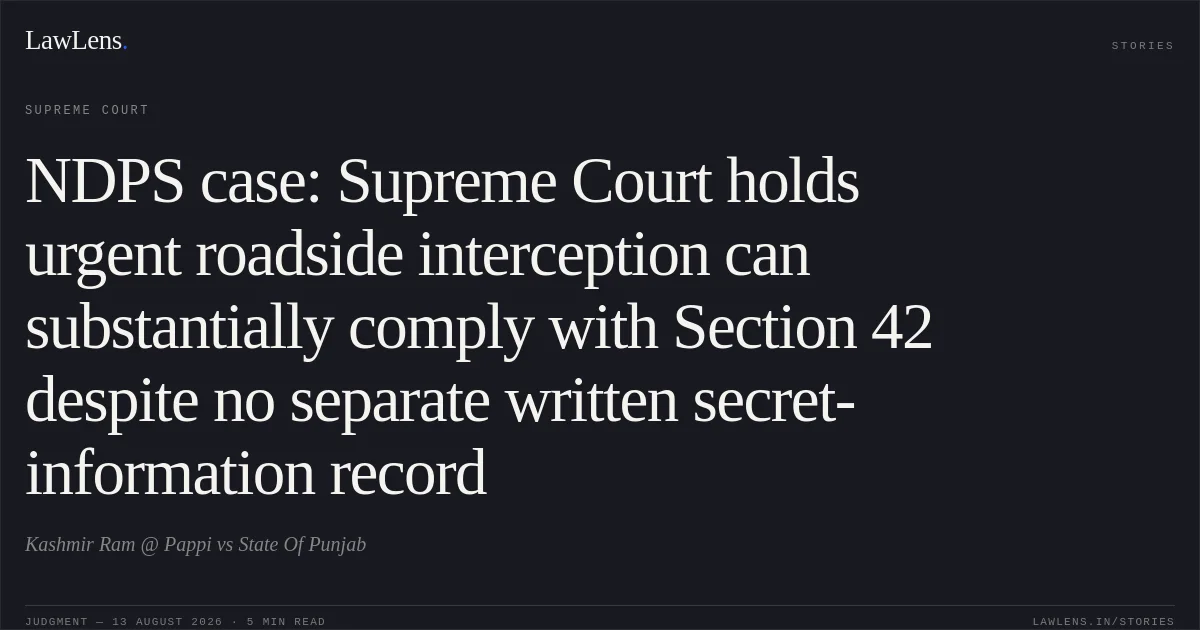
The Court held that the case did not involve total non-compliance with Section 42. Although the Investigating Officer neither made a formal register entry nor separately sent the information to his superior, the information was received while he was conducting a naka on a public road and concerned a vehicle expected imminently, creating an urgent situation contemplated by Karnail Singh.
Source reference: paras. 30–33The officer immediately prepared and dispatched the ruqa before interception, informed the Deputy Superintendent of Police by telephone, and conducted the search under that officer’s supervision; these circumstances substantially served the purpose of Section 42.
Source reference: paras. 30–34Section 50 was not attracted because the conviction was based solely on the contraband recovered from the vehicle, not from the personal searches, which yielded nothing.
Source reference: paras. 35–37The sixteen-day interval before laboratory receipt was treated as a procedural irregularity rather than a fatal defect because the property was produced before the Magistrate the next day, the seals were recorded as intact, and the laboratory confirmed that the seals matched the specimen impressions.
Source reference: paras. 38–41The absence of independent witnesses did not invalidate the vehicle recovery, since Section 100(4) CrPC was relevant to the house search but not to a vehicle intercepted on a public road; the two recoveries were separately documented and scientifically supported, permitting the Court to accept the vehicle recovery while rejecting the house recovery.
Source reference: paras. 42–44The discrepancies in police testimony concerned collateral matters and did not undermine the interception, recovery, sealing, judicial production or forensic identification of the contraband.
Source reference: paras. 45–46Finally, ownership of the vehicle was not determinative: the appellant’s presence beside the driver, the contraband’s location immediately behind them, and the unrebutted presumption under Section 54 established possession sufficient for conviction.
Source reference: paras. 47–48Holding
The Supreme Court dismissed the appeal and upheld the appellant’s conviction under Section 15(c) of the NDPS Act.
It held that there was substantial compliance with Section 42; Section 50 did not apply to the vehicle search; the delay in sample dispatch did not compromise the prosecution case; the Chemical Examiner’s reports were admissible; and the vehicle recovery was independently reliable despite the discarded house recovery and absence of independent witnesses.
Source reference: para. 50The sentence of ten years’ rigorous imprisonment, a fine of ₹1,00,000, and one year’s rigorous imprisonment in default was affirmed as the minimum sentence prescribed for possession of a commercial quantity.
Source reference: paras. 49, 52Acts & Sections Cited
9 provisions across 2 statutes referred to in this judgment. Each provision opens on LawLens.
Narcotic Drugs and Psychotropic Substances Act, 19856
Code of Criminal Procedure, 19733
Original Court PDF
Kashmir Ram @ PappivsState Of Punjab
Click to open original judgment
Original judgment, available to read, download and summarize on LawLens.in