Facts
On August 6, 2022, the appellants, Ramsakha and Yogendra Kumar Sen, were apprehended by the Raipur police near Pujari Park.
Source reference: para. 2Ramsakha was found in possession of 4.300 kg of ganja, and Yogendra was found with 4.600 kg of ganja.
Source reference: para. 2Following an investigation and trial involving 12 prosecution witnesses and 59 documents, the Special Judge (NDPS Act), Raipur, convicted the appellants on November 4, 2025.
Source reference: para. 1, 3They were sentenced to five years of Rigorous Imprisonment (R.I.) and a fine of ₹50,000 each.
Source reference: para. 1The appellants challenged this order but confined their prayer to the reduction of the sentence, not contesting the conviction itself.
Source reference: para. 5At the time of the High Court's judgment, the appellants had served a total of 8 months and 15 days in custody.
Source reference: para. 5, 10Issues
1. Whether the conviction of the appellants under Section 20(b)(ii)(B) of the NDPS Act was legally sustainable based on the evidence on record.
Source reference: para. 82. Whether the sentence of five years R.I. should be reduced to the period already undergone in light of the reformative theory of punishment and the specific circumstances of the offenders.
Source reference: para. 9, 10Law Applied
Section 20(b)(ii)(B) of the Narcotic Drugs and Psychotropic Substances (NDPS) Act, which penalizes the possession of intermediate quantities of cannabis.
Source reference: para. 1, 8The court relied on the principles of reformative justice established by the Supreme Court in Mohammad Giasuddin v. State of Andhra Pradesh (1977) 3 SCC 287.
Source reference: para. 9This precedent posits that the focus of penology should be on the individual's rehabilitation rather than retribution, emphasizing that "men are not improved by injuries" and that sentencing should serve as a process of reshaping a person who has deteriorated into criminality.
Source reference: para. 9Reasoning
The High Court affirmed the conviction, noting that the testimonies of 12 witnesses, including the investigating officers, and the FSL report (Ex. P-56) conclusively established the illegal possession of ganja.
Source reference: para. 8The Court looked at the socio-economic profile of the appellants—both were laborers with minimal education and no prior criminal antecedents.
Source reference: para. 10Applying the reformative doctrine from Mohammad Giasuddin, the Court reasoned that the goal of the state is to rehabilitate rather than avenge.
Source reference: para. 9Given that the quantity seized was relatively small (intermediate quantity) and the appellants had already served over eight months, the Court determined that the ends of justice would be met by a reduced sentence, provided the fine remained as a deterrent.
Source reference: para. 10, 11Holding
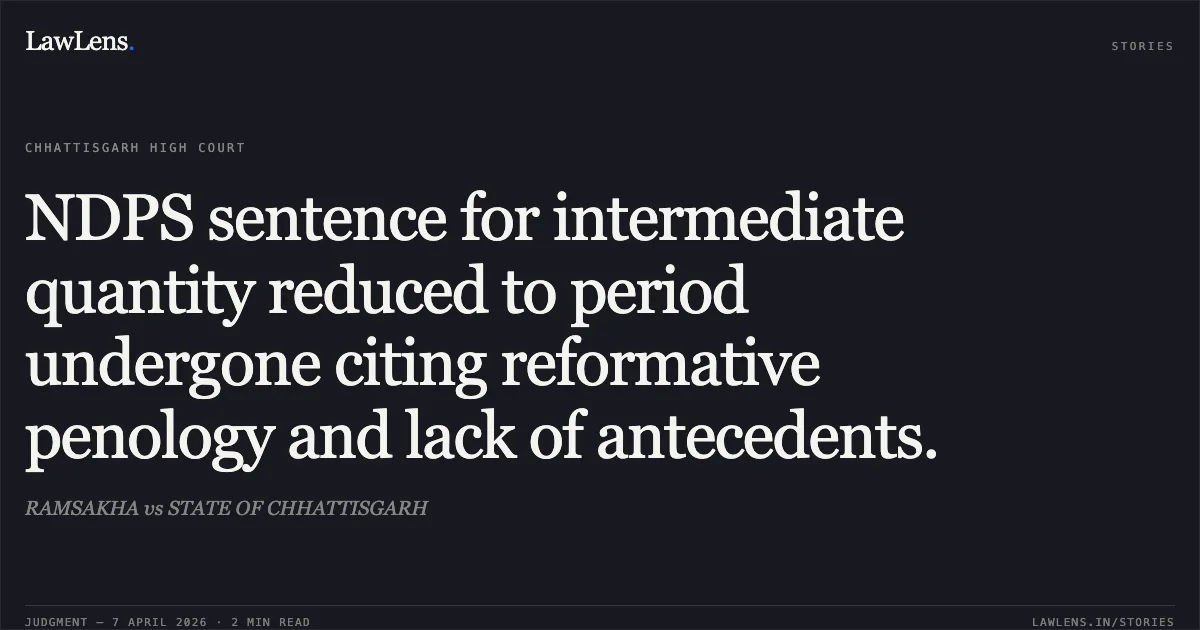
The High Court partly allowed the appeal. While it maintained the conviction under Section 20(b)(ii)(B) of the NDPS Act, it modified the order of sentence.
The period of Rigorous Imprisonment was reduced from five years to the period already undergone (8 months and 15 days).
Source reference: para. 11The fine of ₹50,000 each and the corresponding default stipulation were kept intact.
Source reference: para. 11The Court ordered the immediate release of the appellants, provided the fines were paid and they were not required in any other case.
Source reference: para. 12Acts & Sections Cited
2 provisions across 2 statutes referred to in this judgment. Each provision opens on LawLens.
Narcotic Drugs and Psychotropic Substances Act, 19851
Code of Criminal Procedure, 19731
Original Court PDF
RAMSAKHAvsSTATE OF CHHATTISGARH
Click to open original judgment
Original judgment, available to read, download and summarize on LawLens.in


