Facts
The dispute concerns the ownership of land originally belonging to Sukhu Oraon (the grandfather), who had three sons: Dhungru, Ledura, and Bhoula
Source reference: p. 2The Plaintiff (Sukhu, son of Dhungru) claimed ownership of the entire family estate after the deaths of his uncles and cousins
Source reference: p. 2-3This claim was contested by Budhain (daughter of Bhoula) and her husband Punai (original Defendants), asserting that Ledura—who was childless—had adopted Punai as a ghardamad (resident son-in-law) and partitioned the property via a 1975 deed
Source reference: p. 2-3The parties are governed by Oraon customary law, where daughters generally have no right of inheritance
Source reference: p. 2The Trial Court and First Appellate Court concurrently dismissed the Plaintiff’s suit, validating the ghardamad relationship and the partition
Source reference: p. 2, 14Issues
1. Whether the Defendants established a valid custom allowing an uncle-in-law (Ledura) to adopt his niece’s husband as a ghardamad?
Source reference: p. 14-152. Whether the High Court erred in upholding concurrent findings of fact despite a misapplication of customary law and evidence?
Source reference: p. 5-7, 153. Whether the Plaintiff, as the nearest male agnate, was entitled to the property of the issueless uncles under Oraon custom?
Source reference: p. 13-15Law Applied
The Court applied the essential attributes of a valid 'custom,' requiring it to be immemorial, reasonable, certain, and continuous
Source reference: p. 3It relied on Section 48 of the Evidence Act, 1872, regarding the opinion of persons likely to know of a custom's existence
Source reference: p. 4Heavily citing S.C. Roy’s The Oraons of Chotanagpur, the Court noted that while a ghardamad may inherit Rajhas lands, the Bhuinhari (ancestral) lands must go to the nearest male agnate if there is no direct male issue
Source reference: p. 14On the scope of Article 136 of the Constitution, the Court applied principles from Srinivas Ram Kumar v. Mahabir Prasad and Ramachandran v. Vijayan, holding that concurrent findings can be set aside if they are perverse, ignore material evidence, or result from a misinterpretation of law
Source reference: p. 5-7Reasoning
The Supreme Court found that the lower courts misdirected themselves by incorrectly interpreting S.C. Roy’s treatise
Source reference: p. 14The Court observed that the Defendants failed to prove any custom allowing an uncle-in-law to adopt a niece’s husband as a ghardamad to the exclusion of male agnates
Source reference: p. 15Furthermore, the evidence regarding partition was inconsistent; since daughters do not inherit under this custom, no valid partition could have occurred between Ledura and Budhain
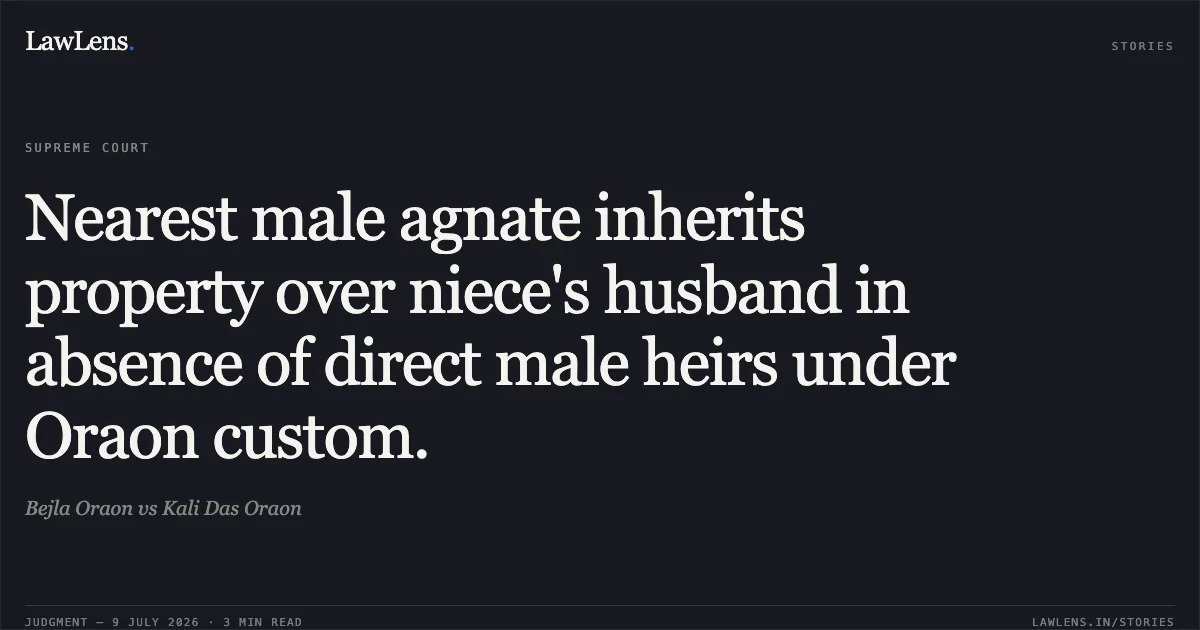
Source reference: p. 12-13The Court held that even if Punai was a ghardamad, ancestral Bhuinhari land must revert to the nearest male agnate (the Plaintiff) upon the death of the last male owner without a son
Source reference: p. 14The High Court’s refusal to interfere solely because of "concurrent findings" was deemed an error of law, as it failed to address the substantial question of the uncle's legal capacity to adopt under custom
Source reference: p. 15Holding
The Supreme Court allowed the appeal and set aside the judgments of the High Court, First Appellate Court, and Trial Court
The Court answered the issues by holding that the Defendants failed to prove the specific custom of adoption by an uncle-in-law and that the Plaintiff, as the nearest male agnate, is the rightful heir under Oraon customary law
Source reference: p. 15The Plaintiff’s suit was decreed in full, and all necessary consequences regarding title and possession were ordered to follow
Source reference: p. 15Acts & Sections Cited
1 provisions across 1 statute referred to in this judgment. Each provision opens on LawLens.
Code of Civil Procedure, 19081
Original Court PDF
Bejla OraonvsKali Das Oraon
Click to open original judgment
Original judgment, available to read, download and summarize on LawLens.in