Facts
Respondent No. 1 (plaintiff) instituted a civil suit for declaration of title and permanent injunction regarding agricultural land measuring 1.10 hectares and 0.35 hectares in District Bhind
Source reference: para. 2The petitioner (Defendant No. 3-A) contested the suit and filed a counter-claim asserting title via an oral sale agreement dated 10.06.2008
Source reference: para. 2After both parties concluded their evidence and the matter was posted for final arguments, the plaintiff filed an application under Order I Rule 10 of the CPC to implead his two sisters as co-plaintiffs
Source reference: para. 2The plaintiff cited "legal ignorance" regarding the ancestral nature of the property as the reason for the delay
Source reference: para. 2, 6The Trial Court (Civil Judge, Junior Division, Mehgaon) allowed the application on 06.03.2026, subject to a cost of Rs. 500/-, prompting the petitioner to challenge the order under Article 227
Source reference: para. 1, 6Issues
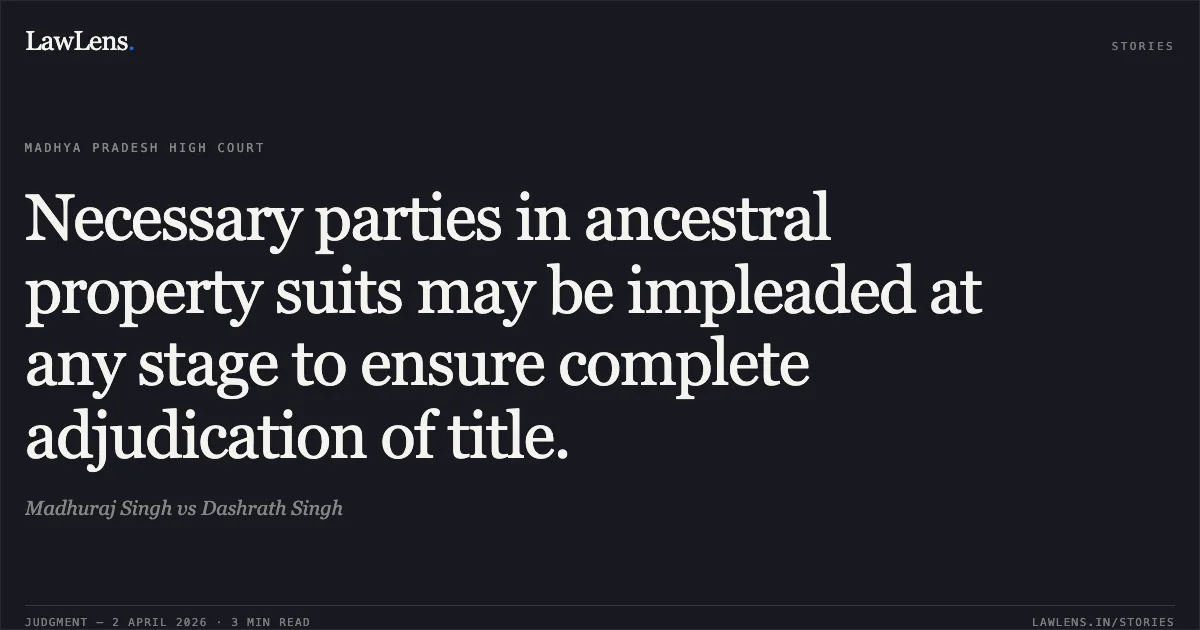
1. Whether an application for impleadment of necessary parties under Order I Rule 10 of the CPC can be entertained at the stage of final arguments
Source reference: para. 7, 82. Whether the sisters of a plaintiff are necessary parties in a suit for declaration of title concerning ancestral property
Source reference: para. 73. Whether the Trial Court’s exercise of discretion under Order I Rule 10 CPC warranted interference under the supervisory jurisdiction of Article 227 of the Constitution
Source reference: para. 8Law Applied
The Court applied Order I Rule 10 of the Code of Civil Procedure (CPC), which permits the impleadment of any person whose presence is necessary for the effective and complete adjudication of all questions involved in the suit at any stage of the proceedings
Source reference: para. 7It relied on the principle that in suits for declaration of title regarding ancestral property, all co-sharers or legal heirs are necessary parties to prevent suit dismissal on technical grounds of non-joinder
Source reference: para. 7Furthermore, the Court interpreted the scope of Article 227 of the Constitution of India, holding that supervisory jurisdiction is limited to correcting patent illegalities or gross miscarriages of justice, rather than acting as a court of appeal for mere errors of law or fact
Source reference: para. 8Reasoning
The Court noted that under Order I Rule 10 CPC, the court maintains wide discretion to add parties "at any stage" if their presence is essential to settle the dispute
Source reference: para. 7The Court found that because the suit property was claimed to be ancestral, the sisters held an inherent interest; thus, their exclusion could lead to a multiplicity of proceedings or the suit's failure due to non-joinder
Source reference: para. 6, 7While acknowledging the petitioner’s objection regarding the extreme delay (final argument stage), the Court observed that the Trial Court balanced the equities by imposing costs and strictly limiting the scope of subsequent proceedings to "consequential amendments"
Source reference: para. 6The Court reasoned that the Trial Court’s decision was not arbitrary or perverse but was aimed at a just adjudication on the merits rather than technicalities
Source reference: para. 8Holding
The High Court dismissed the petition and upheld the Trial Court’s order dated 06.03.2026
The Court held that the impleadment was necessary for a final adjudication of the ancestral title and that the Trial Court did not commit any jurisdictional error or patent illegality that necessitated interference under Article 227
Source reference: para. 8, 9No order was made as to costs for the miscellaneous petition
Source reference: para. 9Original Court PDF
Madhuraj SinghvsDashrath Singh
Click to open original judgment
Original judgment, available to read, download and summarize on LawLens.in