Facts
On 17 November 2020, at approximately 11:00–11:30 a.m., the deceased was riding a motorcycle when it collided with the rear portion of a stationary Innova car bearing registration No. GJ-23-M-2052. The deceased sustained serious injuries and subsequently died. An FIR was lodged by the Innova driver against the deceased, and the police papers indicated that the motorcycle had struck the stationary vehicle from behind
Source reference: p.2, para. 3The deceased’s legal heirs filed a claim petition under Section 164 of the Motor Vehicles Act, 1988, seeking compensation on a no-fault liability basis. The Motor Accident Claims Tribunal, Kheda at Nadiad, dismissed the claim petition in MACP No. 16 of 2021, holding that the deceased was solely negligent in causing the accident
Source reference: p.1, para. 2; p.3, para. 4.2The claimants challenged that decision under Section 173 of the Motor Vehicles Act, 1988
Source reference: p.1, para. 2Issues
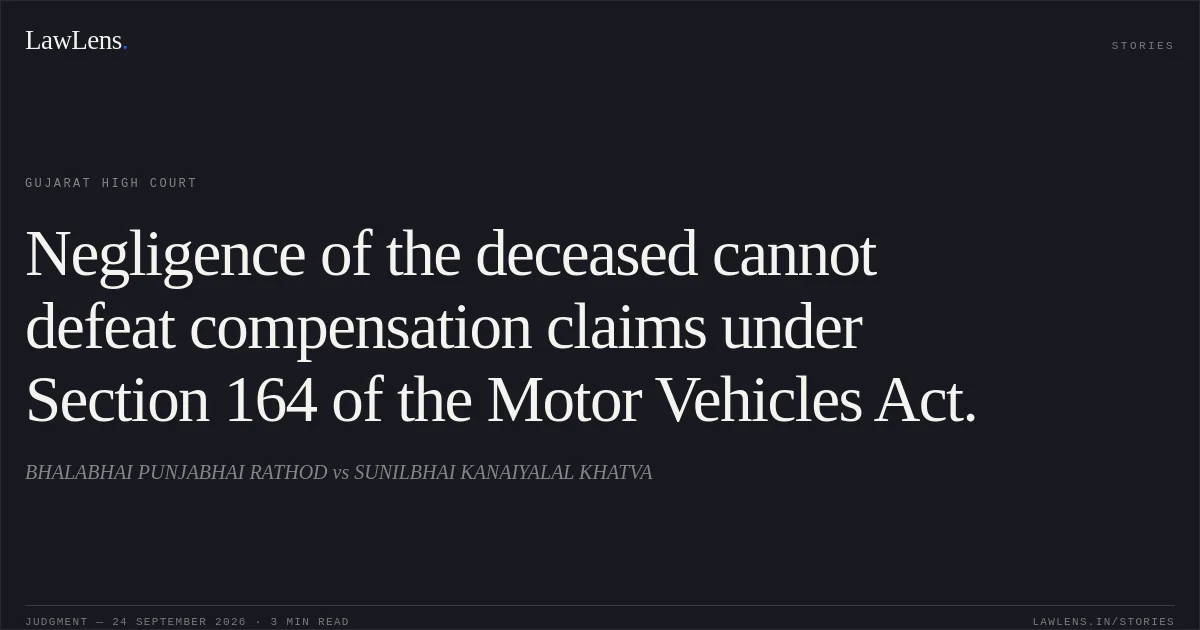
Whether a claim under Section 164 of the Motor Vehicles Act can be dismissed on the ground that the deceased was negligent in causing the accident?
Source reference: p.2, paras. 4–4.2Whether the claimants were entitled to fixed compensation of ₹5,00,000 under Section 164(1) of the Motor Vehicles Act despite the deceased’s alleged negligence?
Source reference: pp.2–5, paras. 4.1–5Law Applied
The Court applied Sections 164(1) and 164(2) of the Motor Vehicles Act, 1988. Section 164(1) imposes liability on the owner or authorised insurer to pay fixed compensation of ₹5,00,000 in cases of death arising from an accident caused by the use of a motor vehicle, while Section 164(2) dispenses with the requirement that the claimant plead or establish any wrongful act, neglect, or default of the vehicle owner, vehicle, or any other person
Source reference: p.2, para. 4.1The Court also relied, by analogy, on United India Insurance Co. Ltd. v. Sunil Kumar, 2018 ACJ 1, wherein the Supreme Court held that proceedings under Section 163-A are based on a no-fault principle and that the insurer cannot defend the claim by alleging negligence on the part of the victim
Source reference: pp.3–4, para. 4.3The Court treated the same principle as applicable to the statutory no-fault compensation scheme under Section 164.
Source reference: no citationReasoning
The Tribunal treated the FIR, panchnama, and police summary report as establishing that the deceased had negligently collided with the stationary Innova and therefore dismissed the claim
Source reference: p.3, para. 4.2The High Court held that this approach ignored the nature of the claim, which had been specifically filed under Section 164 for no-fault compensation
Source reference: p.2, paras. 4–4.1Under Section 164(2), the claimants were not required to prove negligence on the part of the vehicle owner or driver, and the alleged negligence of the deceased could not defeat the statutory entitlement.
Source reference: no citationApplying the reasoning in Sunil Kumar, the Court concluded that introducing a negligence-based defence into a no-fault proceeding would defeat the legislative purpose of providing fixed compensation without adjudication of fault
Source reference: pp.3–4, paras. 4.3–4.4Holding
The High Court partly allowed the appeal, quashed and set aside the Tribunal’s judgment and award dated 18 February 2025, and approved the claim under Section 164(1) of the Motor Vehicles Act
The claimants were awarded fixed compensation of ₹5,00,000 with interest at 9% per annum from the date of filing of the claim petition until realization.
Source reference: p.5, para. 5All opponents were held jointly and severally liable, and Opponent No. 2—the insurance company—was directed to deposit the amount before the Tribunal within eight weeks.
Source reference: p.5, para. 5The Tribunal was directed to disburse the amount among the claimants after deposit
Source reference: p.5, para. 5Acts & Sections Cited
5 provisions across 1 statute referred to in this judgment. Each provision opens on LawLens.
Motor Vehicles Act, 19885
Original Court PDF
BHALABHAI PUNJABHAI RATHODvsSUNILBHAI KANAIYALAL KHATVA
Click to open original judgment
Original judgment, available to read, download and summarize on LawLens.in