Facts
On February 14, 2024, the claimant, Mitesh Uttambhai Patel, fell into a platform gorge at Utran Railway Station while traveling from Utran to Surat.
Source reference: para. 3The incident resulted in the amputation of his left leg above the knee and his right leg below the knee.
Source reference: para. 3The claimant sought compensation under Section 16 of the Railway Claims Tribunal Act, 1987.
Source reference: no citationThe Railway Administration contested the claim, alleging the claimant was not a bona fide passenger and that the injuries were "self-inflicted" due to his negligence in attempting to alight from/board a moving train.
Source reference: para. 3.3A DRM Report filed nearly a year later suggested the claimant lacked a valid ticket for that specific route.
Source reference: para. 3.4The Tribunal awarded Rs. 8,00,000/- plus interest, a decision the Union of India challenged in this appeal.
Source reference: para. 2Issues
1. Whether the claimant was a 'bona fide passenger' despite the Railway's claim of ticketless travel.
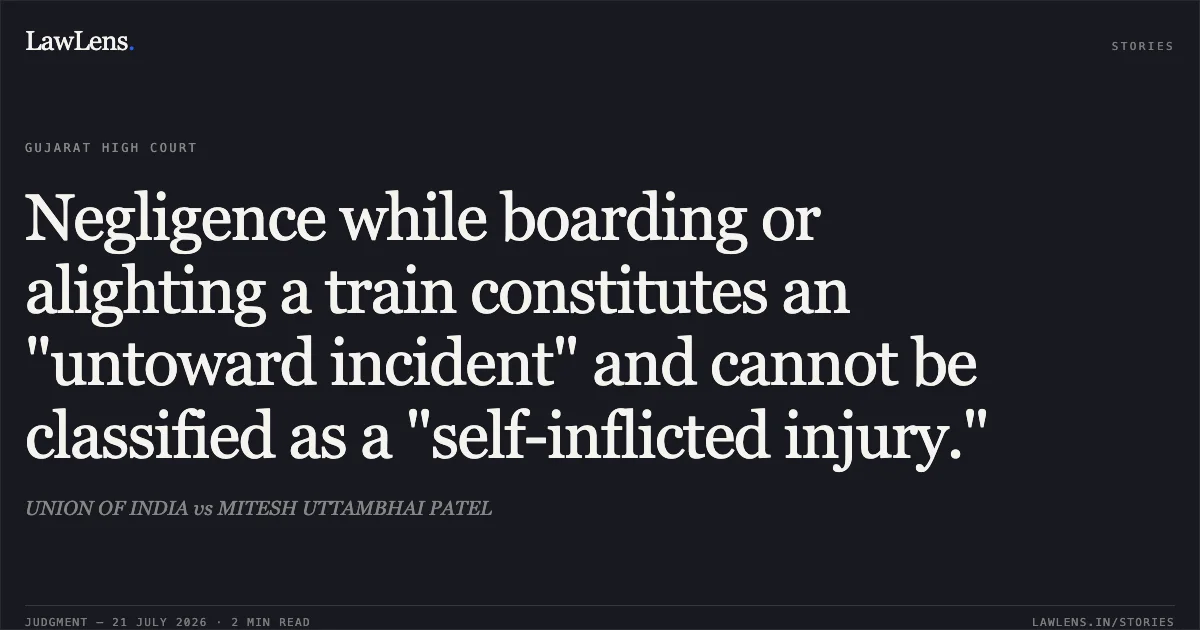
Source reference: para. 42. Whether the injury sustained while boarding/alighting a moving train constitutes a "self-inflicted injury" under the proviso to Section 124-A of the Railways Act, 1989.
Source reference: para. 4Law Applied
Section 124-A of the Railways Act, 1989, which establishes "strict liability" or "no-fault liability" for railway accidents.
Source reference: para. 10Supreme Court precedent in Union of India v. Rina Devi (2019), which clarifies that "self-inflicted injury" requires intentional harm, not merely negligence, and that the initial burden of proof for being a bona fide passenger is met by the claimant's affidavit.
Source reference: para. 10Rule 27 of the Railway Passenger (Manner of Investigation of untoward incidents) Rules, 2003, regarding the 60-day deadline for DRM Reports.
Source reference: para. 6The principle from Jameela v. Union of India (2010), which states that standing at an open door or boarding a moving train is negligence but not a criminal act or self-inflicted injury.
Source reference: para. 9Reasoning
The High Court rejected the Railway's defenses by applying the "no-fault liability" framework of Section 124-A.
Source reference: no citationRegarding passenger status, the Court noted that the claimant's affidavit shifted the burden to the Railway; however, the Railway's DRM Report was filed beyond the statutory 60-day period under Rule 27, making it unreliable.
Source reference: para. 6, 10On the issue of negligence, the Court held that even if the claimant acted rashly by alighting from a moving train, such "contributing negligence" does not escape the Railway's liability unless there was a malicious intent to cause self-harm (Rina Devi and Shrikumar Gupta principles).
Source reference: para. 9, 10The Court observed that no sane person deliberately attempts to lose limbs, thus the incident remained an "untoward incident" under Section 123(c)(2).
Source reference: para. 9, 11Holding
The Court held that the incident was an "untoward incident" and the claimant was a bona fide passenger entitled to compensation.
The Court dismissed the First Appeal, affirming the Tribunal’s judgment.
Source reference: para. 11The Railway Administration was directed to disburse the remaining compensation amount to the claimant immediately.
Source reference: para. 13Acts & Sections Cited
6 provisions across 3 statutes referred to in this judgment. Each provision opens on LawLens.
Railway Claims Tribunal Act, 19872
Railways Act, 19893
Motor Vehicles Act, 19881
Original Court PDF
UNION OF INDIAvsMITESH UTTAMBHAI PATEL
Click to open original judgment
Original judgment, available to read, download and summarize on LawLens.in


