Facts
The appellants sought compensation for the death of their son, who allegedly fell from a crowded EMU train on 3 April 2013 and died on 8 May 2013.
Source reference: paras. 1–4They claimed that he was a bona fide passenger and that his ticket was lost when his blood-soaked shirt was torn.
Source reference: paras. 1–4The Railway Claims Tribunal dismissed the claim. The appellants challenged that decision under Section 23 of the Railway Claims Tribunal Act, 1987.
Source reference: paras. 1–4The Railways disputed bona fide passenger status and asserted that the deceased had been hanging outside the train and suffered self-inflicted injuries.
Source reference: paras. 1–4The Station Master’s memo recorded that a passenger had fallen from the train.
Source reference: para. 7Issues
Whether the appellants established that the deceased was a bona fide passenger, despite the absence of a ticket.
Source reference: para. 5Whether the deceased’s fall was an “untoward incident” under Section 123(c)(2) of the Railways Act, 1989, or whether the Railways established an exception under the proviso to Section 124-A.
Source reference: paras. 6–7Law Applied
Section 123(c)(2) of the Railways Act, 1989 includes the accidental falling of a passenger from a train within the definition of an “untoward incident”; Section 124-A imposes liability for such incidents, subject to its specified exceptions.
Source reference: para. 6Under Union of India v. Rina Devi, the absence of a ticket, by itself, does not defeat a claim; the claimant’s initial burden is not onerous and may be discharged through relevant facts and circumstances, after which the burden shifts to the Railways to rebut the claim with cogent evidence.
Source reference: para. 5The Court also relied on Lata v. Union of India and Sukhabhai Nanjibhai Makwana & Anr. v. Union of India for the preponderance-of-probabilities standard and the principle that ticket absence alone is insufficient to defeat a claim.
Source reference: para. 5Under Union of India v. Prabhakaran Vijaya Kumar & Ors., Section 124-A is beneficial legislation imposing strict liability.
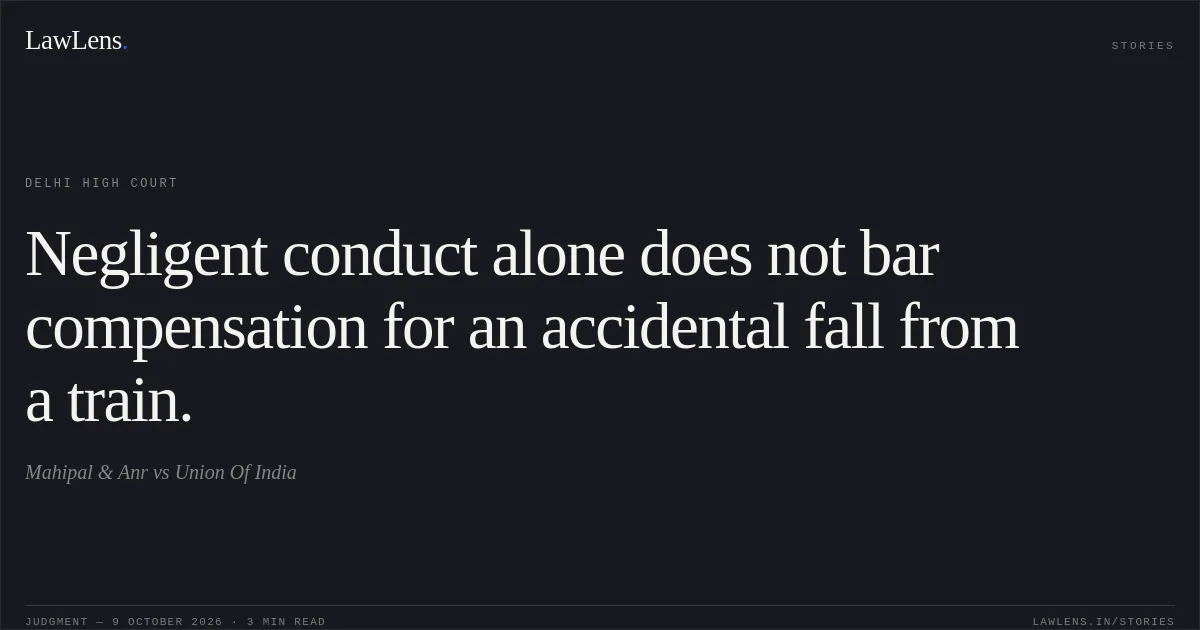
Source reference: para. 6Under Jameela v. Union of India, negligent or rash conduct, such as standing at the open door of a moving train, does not by itself constitute a “criminal act” under Section 124-A; that exception requires an element of malicious intent or mens rea.
Source reference: para. 9Reasoning
The father’s evidence and the attending circumstances—including the explanation that the ticket was lost when the deceased’s shirt was torn and soaked in blood—discharged the appellants’ initial burden.
Source reference: para. 5The Railways produced no booking records or oral evidence to rebut that account.
Source reference: para. 5The fall itself was recorded in the Station Master’s memo, while the departmental inquiry material was not proved through witnesses and could not establish the manner of the fall conclusively.
Source reference: paras. 7–8Even assuming the deceased had been leaning out of the train, that conduct would not, without evidence of malicious intent or mens rea, establish the “criminal act” exception; nor was an applicable exception otherwise proved.
Source reference: paras. 8–9Holding
The Court held that the deceased was a bona fide passenger and that his death resulted from an “untoward incident” under Section 123(c)(2), with no exception to Section 124-A established by the Railways.
It set aside the Tribunal’s judgment and remanded the matter to the Tribunal to assess compensation and direct its disbursement within two months of receiving the order.
Source reference: paras. 11–12The appeal was allowed and disposed of accordingly.
Source reference: paras. 11–12Acts & Sections Cited
2 provisions across 2 statutes referred to in this judgment. Each provision opens on LawLens.
Railway Claims Tribunal Act, 19871
Railways Act, 19891
Original Court PDF
Mahipal & AnrvsUnion Of India
Click to open original judgment
Original judgment, available to read, download and summarize on LawLens.in