Facts
Respondent No. 5 (the student) applied for admission into a pre-primary class for the academic year 2024-25 under the procedure prescribed by the UP RTE Rules, 2011
Source reference: p. 2The student was selected and allotted to the petitioner school by the Basic Education Department, but the school refused admission, citing "uncertainty about the student’s eligibility"
Source reference: p. 2The student filed a writ petition in the High Court, which directed the school to grant admission, ruling that schools cannot sit in appeal over Government decisions
Source reference: p. 2The petitioner school subsequently challenged this order before the Supreme Court via Special Leave Petition
Source reference: p. 1Issues
1. Whether a ‘neighbourhood school’ is mandated to grant immediate admission to students forwarded by the State Government under the RTE framework, notwithstanding any internal disagreements regarding eligibility
Source reference: p. 1, 9Law Applied
Section 12 of the Right of Children to Free and Compulsory Education Act, 2009, which mandates that neighbourhood schools reserve 25% of class strength for children from weaker and disadvantaged sections
Source reference: p. 1, 7Article 21A of the Constitution of India, establishing education as a fundamental right
Source reference: p. 1, 3Rule 8 of the U.P. RTE Rules, 2011, which stipulates that admission processes must be transparent and that Government-prescribed processes are binding on schools
Source reference: p. 4Principle of "co-relative duties" from Dinesh Biwaji Ashtikar v. State of Maharashtra & Ors. (2026 INSC 56), identifying five duty bearers—the Government, local authorities, schools, parents, and teachers—responsible for ensuring the Right to Education
Source reference: p. 6-8Reasoning
The Court reasoned that the "neighbourhood school" concept is a deliberate constitutional strategy to foster social integration and substantive justice during a child's formative years
Source reference: p. 5, 8Under Rule 8 of the UP RTE Rules, once the Government scrutinizes an application and forwards a list to the school, the school lacks the legal standing to veto or delay the admission
Source reference: p. 4The Court clarified that while a school might have a disagreement with the Government's selection, it is legally bound to grant admission in the interregnum while any representation is pending
Source reference: p. 9-10Delaying admission on the pretext of eligibility concerns undermines the "letter and spirit" of Article 21A and treats a fundamental right as an "empty promise"
Source reference: p. 3The Court emphasized that judicial bodies and schools must act with "immediacy" to ensure the statutory policy remains transformative
Source reference: p. 9-10Holding
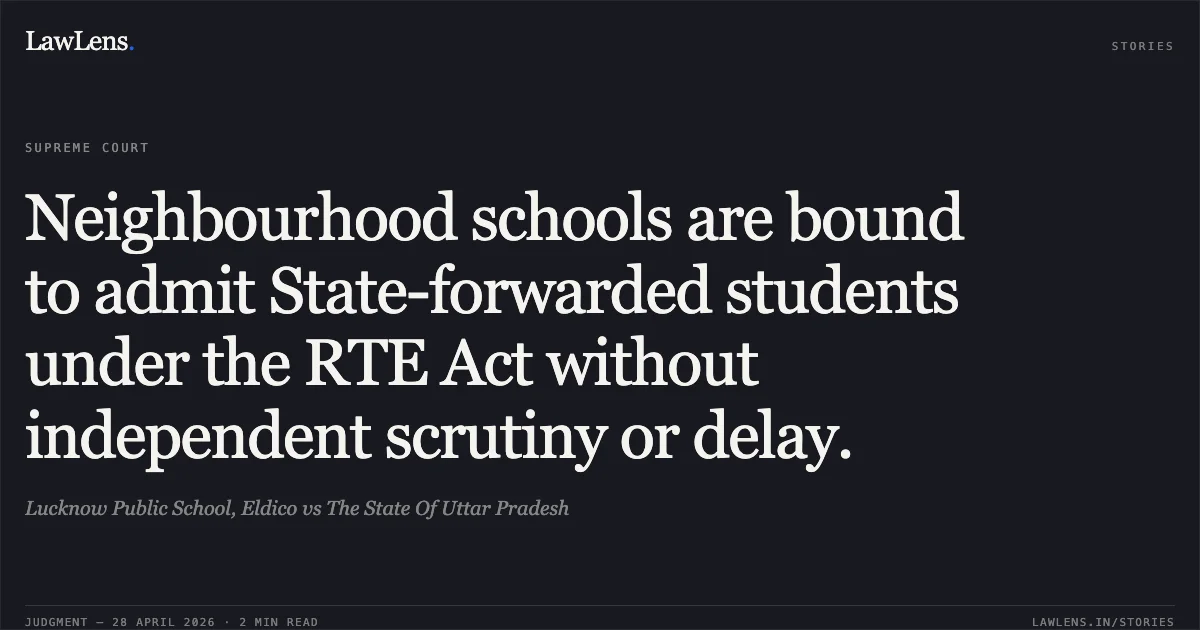
The Supreme Court affirmed the High Court’s judgment, holding that a school designated as a ‘neighbourhood school’ is under a constitutional and statutory obligation to admit students forwarded by the State without delay
The Court held that schools cannot independently stall admissions based on eligibility doubts once the State has made an allocation
Source reference: p. 9Consequently, the Special Leave Petition was dismissed, and the school was mandated to grant the student admission immediately
Source reference: p. 10Acts & Sections Cited
8 provisions across 1 statute referred to in this judgment. Each provision opens on LawLens.
Right of Children to Free and Compulsory Education Act, 20098
Original Court PDF
Lucknow Public School, EldicovsThe State Of Uttar Pradesh
Click to open original judgment
Original judgment, available to read, download and summarize on LawLens.in