Facts
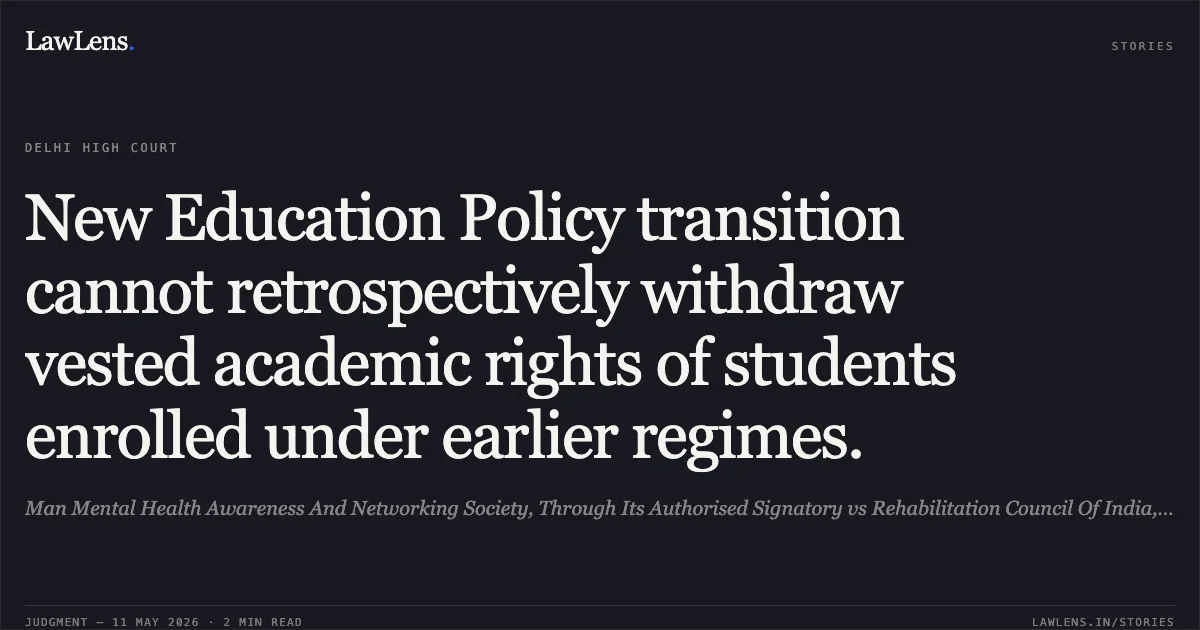
The Petitioner, a society providing mental health training, challenged the sudden discontinuation of the M.Phil in Clinical Psychology and the restructuring of psychology education following the National Education Policy (NEP) 2020
Source reference: p. 2-3Under the new regime notified by the UGC and RCI, the M.Phil programme was prohibited
Source reference: para. 4new academic pathways (4-year B.A./B.Sc. and 2-year M.A. Clinical Psychology) were established for professional registration in the Central Rehabilitation Register (CRR)
Source reference: para. 5This change rendered students currently enrolled in traditional 3-year B.A./B.Sc. or M.A. Psychology programmes ineligible for the professional pathway unless they repeated undergraduate or postgraduate years to satisfy the new criteria
Source reference: para. 10Issues
1. Whether the abrupt implementation of the new educational framework without a transitional policy for existing students is arbitrary and discriminatory
Source reference: p. 6/142. Whether students currently pursuing degrees under the previous regime have a "vested right" or "legitimate expectation" to complete their professional qualification pathway
Source reference: p. 15/17Law Applied
The Court primarily applied Article 226 of the Constitution of India regarding the judicial review of administrative actions
Source reference: para. 1principle of "Legitimate Expectation" and protection against the "retrospective withdrawal of a valuable vested right," as articulated in Prabhroop Kaur Kapoor v. Union of India
Source reference: para. 19standard of "reasonableness and proportionality" in administrative policy-making to ensure that education shifts do not cause irreversible prejudice to existing cohorts
Source reference: para. 21Reasoning
The Court observed that while the State has the authority to reform education policy via NEP 2020, the lack of a transitional mechanism created a legal vacuum for current students
Source reference: para. 20The Court reasoned that students who enrolled in B.A., B.Sc., or M.A. programmes under the old regime did so with the expectation that they could progress to an M.Phil and RCI registration
Source reference: para. 20Forcing these students to retrace their academic steps (potentially losing several years and financial resources) was deemed "manifestly unreasonable and disproportionate"
Source reference: para. 21The Court found that applying the new regime to the current cohort amounted to an arbitrary retrospective withdrawal of rights, violating principles of fairness
Source reference: para. 21-22Holding
The Court held that the new RCI/UGC regime shall not apply to students currently enrolled in B.A., B.Sc. (any discipline), or M.A. (Clinical Psychology) programmes
The Court issued a mandamus protecting the existing cohort from being barred by the new eligibility criteria, thereby allowing them to complete their qualifications under the previous pathway
Source reference: para. 25Acts & Sections Cited
1 provisions across 1 statute referred to in this judgment. Each provision opens on LawLens.
University Grants Commission Act, 19561
Original Court PDF
Man Mental Health Awareness And Networking Society, Through Its Authorised SignatoryvsRehabilitation Council Of India, Ministry Of Social Justice A Empowermentnd & Ors.
Click to open original judgment
Original judgment, available to read, download and summarize on LawLens.in