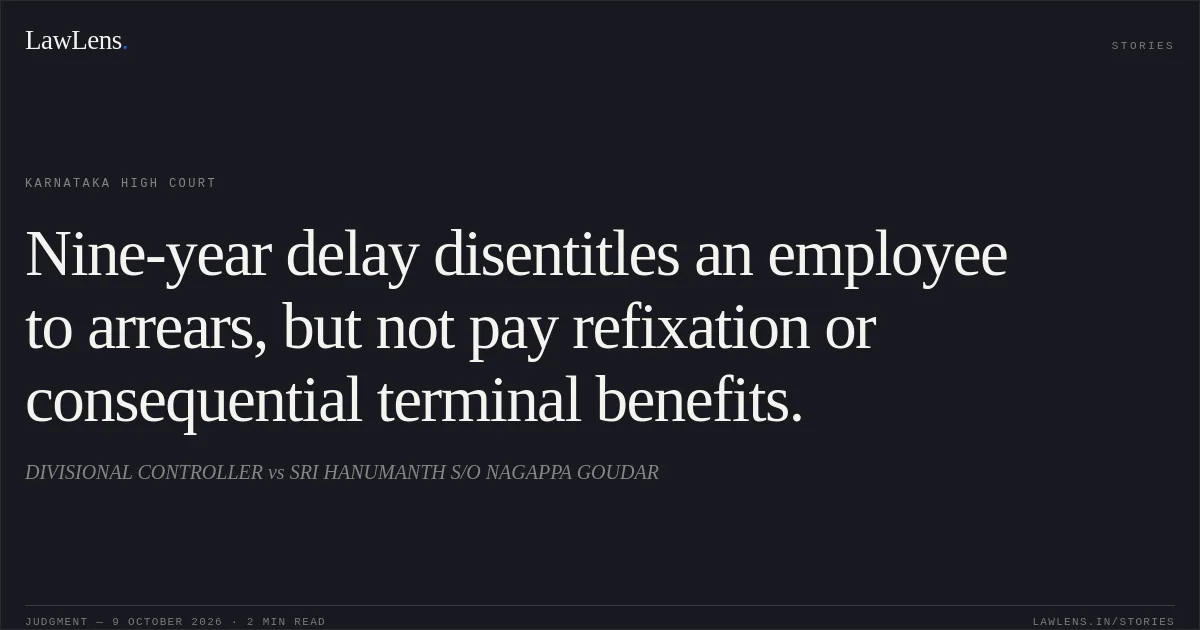
Facts
The respondent, a driver with NWKRTC, faced disciplinary proceedings after a bus accident on 20 April 1998.
Source reference: p. 2On 24 January 2003, the Corporation reduced his basic pay to the minimum of the driver’s scale and ordered recovery of one month’s salary.
Source reference: p. 2The respondent raised an industrial dispute approximately nine years later; the Industrial Tribunal rejected his claim.
Source reference: p. 2–4The Single Judge set aside the Tribunal’s decision and the punishment, reasoning that the Corporation had stated before the Motor Accidents Claims Tribunal (MACT) that the driver was not rash or negligent.
Source reference: p. 2–4The Division Bench also noted that the respondent had not challenged the penalty for nine years.
Source reference: p. 2–4, 9Issues
Whether the Corporation could maintain disciplinary findings against the driver while having taken the position before the MACT that he was not rash or negligent in causing the same accident.
Source reference: p. 4–6Whether, given the respondent’s nine-year delay in challenging the penalty, relief should be moulded to exclude arrears of wages while preserving other consequential benefits.
Source reference: p. 6, 9–10Law Applied
The Court applied the principle that a party cannot approbate and reprobate, or “blow hot and cold,” by taking inconsistent positions concerning the same incident.
Source reference: p. 5–8It relied on the Division Bench decision in The Managing Director, KKRTC v. Sunita W/o Late Vinod Kumar Mane and Others, MFA No. 201877/2025, decided 23 April 2026, which held that a transport corporation that had fixed responsibility on its employees through disciplinary proceedings could not take a contradictory position in the related MACT proceedings.
Source reference: p. 5–8The Court also applied its discretion to mould relief in light of the respondent’s prolonged delay in challenging the penalty.
Source reference: p. 9–10Reasoning
The Single Judge had set aside the punishment because the Corporation’s position before the MACT—that the driver was not rash or negligent—was inconsistent with the disciplinary action arising from the same accident.
Source reference: p. 3–4The Division Bench relied on the Sunita decision to support the principle against taking contradictory positions.
Source reference: p. 5–8However, it considered that the respondent had waited nine years to challenge the penalty, a circumstance the Single Judge had not addressed, and held that he should not receive arrears of wages as a windfall from that delay.
Source reference: p. 6, 9–10It therefore preserved pay refixation and consequential benefits, including the restoration of increments for calculating terminal benefits, while excluding arrears of wages.
Source reference: p. 6, 9–10Holding
The writ appeal was disposed of with the relief moulded.
The respondent remained entitled to pay refixation and consequential benefits, including restoration of increments for calculating terminal benefits, but not arrears of wages.
Source reference: p. 9–10The Court further directed that the amount recovered—recorded in its order as ₹6,811—be refunded within four weeks.
Source reference: p. 9–10Pending interlocutory applications were disposed of.
Source reference: p. 9–10Acts & Sections Cited
1 provisions across 1 statute referred to in this judgment. Each provision opens on LawLens.
KARNATAKA HIGH COURT ACT, 19611
Original Court PDF
DIVISIONAL CONTROLLERvsSRI HANUMANTH S/O NAGAPPA GOUDAR
Click to open original judgment
Original judgment, available to read, download and summarize on LawLens.in
![Authorities must consider employees’ claims under cited precedents, subject to similarity and applicable rules.. Anwar Ul Hassan Chesti vs D/o Health And Medical Education Ut Of Jammu & Kashmir. CAT - ['Srinagar']. LawLens](/stories/thumbnails/authorities-must-consider-employees-claims-under-cited-precedents-subject-to-similarity-an-ea3a30d13510422ca1f750e161753fd2.webp)