Facts
The Appellants, elected heads of local bodies in Bihar, challenged a Full Bench judgment of the Patna High Court dated May 16, 2024.
Source reference: para 2The High Court had addressed a reference to resolve a conflict between two prior decisions: Sarita Kumari v. State of Bihar (2008), which held that a no-confidence motion requires a majority of the total elected members [para 3.1], and Dharamsheela Kumari v. Hemant Kumar (2021), which held that a majority of those "present and voting" was sufficient.
Source reference: para 3.2The Full Bench upheld the Dharamsheela Kumari view, ruling that under Sections 44(3) and 70(4) of the Bihar Panchayat Raj Act, 2006 ("Panchayat Act"), the motion succeeds if supported by a majority of members present at the meeting, and that no quorum is required for such meetings.
Source reference: para 4The Appellants contended this interpretation led to undemocratic outcomes where a minority could remove an elected head.
Source reference: para 5Issues
1. Whether a no-confidence motion brought under Sections 44(3) and 70(4) of the Panchayat Act is carried by a majority of the total number of directly elected members or by a majority of those present and voting at the special meeting.
Source reference: para 3.52. Whether the statutory "no-quorum" requirement for special meetings influences the calculation of the "majority" required to pass a no-confidence motion.
Source reference: para 19Law Applied
The Court interpreted Sections 44(3) and 70(4) of the Bihar Panchayat Raj Act, 2006, which stipulate that an elected official is deemed to have vacated office if a resolution is passed by a "majority of the total number of elected members... at a meeting specially convened for the purpose".
Source reference: para 11The Court applied the principle of literal construction, holding that plain language must be followed unless it results in absurdity.
Source reference: para 15It further relied on the "Basic Structure" doctrine, identifying representative democracy as a fundamental constitutional value, and Part IX of the Constitution, which mandates grassroots democratic stability.
Source reference: para 30-35Reasoning
The Court rejected the High Court’s finding that the phrase "at a meeting specially convened" qualified the denominator for the majority.
Source reference: para 14-15It clarified that the "thrust" of this expression is merely to ensure the motion is not considered in an ordinary meeting, rather than to restrict the "total number" to only those present.
Source reference: para 16Regarding the "no-quorum" provision, the Court reasoned that its purpose is procedural—to prevent tactical postponements and ensure efficiency—and is entirely "disjointed" from the substantive requirement of a majority of total members.
Source reference: para 22-24The Court warned that the High Court’s interpretation created a "danger to democracy" by allowing a "minuscule number" of members to surreptitiously remove elected heads (e.g., 11 members removing a head in a house of 80 if only 20 attend).
Source reference: para 26-28Such an outcome would incentivize mischief and undermine the sanctity of the electoral mandate.
Source reference: para 29-32Holding
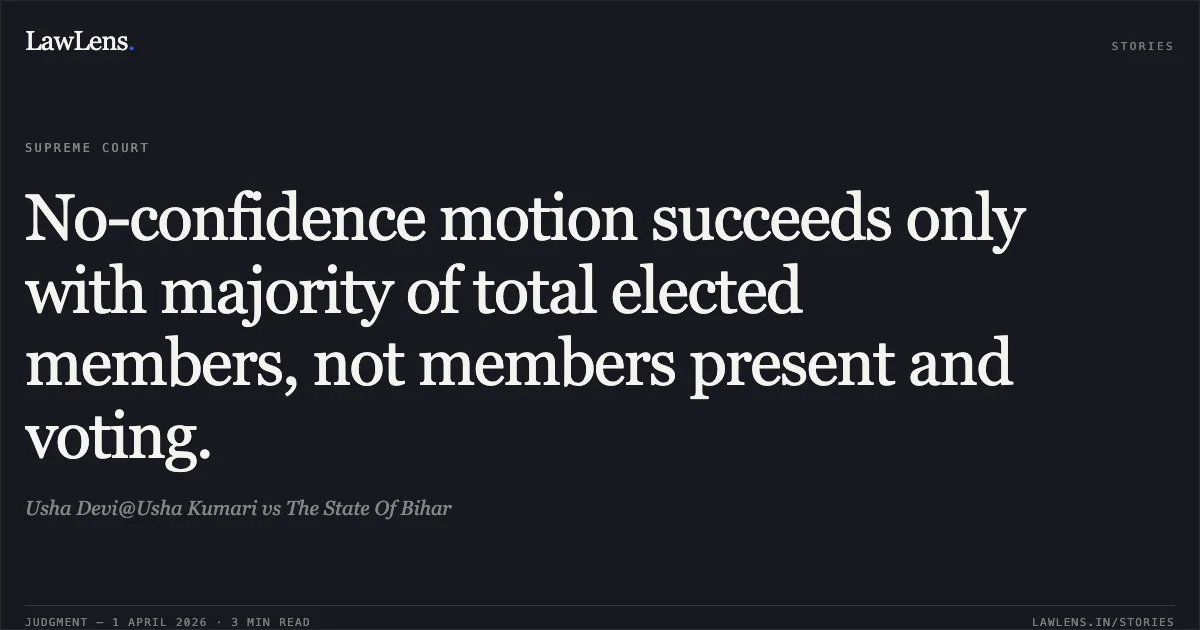
The Court held that an Adhyaksha, Up-Adhyaksha, Pramukh, or Up-Pramukh can only be removed if the no-confidence resolution is supported by more than half of the total number of elected members of the body.
The Court set aside the Full Bench judgment of the High Court [para 47(i)], affirmed the ratio in Sarita Kumari [para 47(ii)], and directed that all pending or future motions in Bihar must adhere to this absolute majority threshold [para 47(iii)]. It further ordered that the special meeting processes initiated under this Court's interim orders be concluded by May 31, 2026.
Source reference: para 47(i)-(iv)Acts & Sections Cited
4 provisions across 1 statute referred to in this judgment. Each provision opens on LawLens.
BIHAR PANCHAYAT RAJ ACT, 20064
Original Court PDF
Usha Devi@Usha KumarivsThe State Of Bihar
Click to open original judgment
Original judgment, available to read, download and summarize on LawLens.in


