Facts
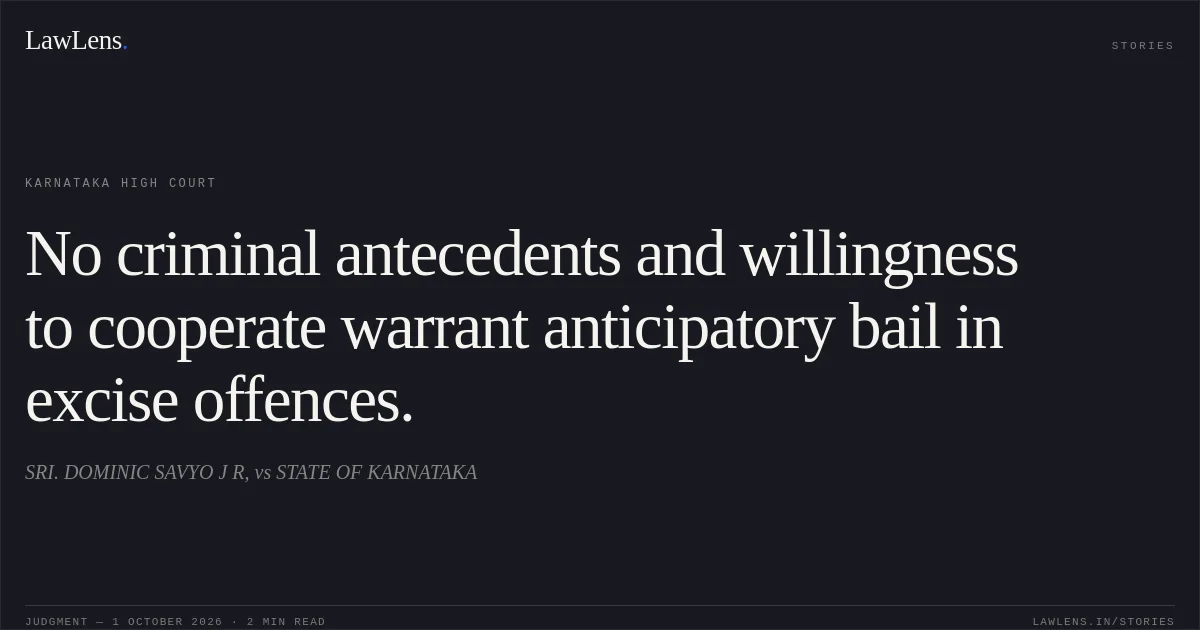
The petitioners sought anticipatory bail in two excise cases arising from a raid on a logistics company’s parcel godown at Yeshwanthpur Railway Station, where officers seized liquor allegedly stocked without a licence.
Source reference: p. 4–5The prosecution alleged that the liquor had been transported to Bengaluru from Delhi and Haryana without permission; the petitioners received notices from the Investigating Officer during the investigation.
Source reference: p. 4–5The Sessions Court dismissed their anticipatory-bail applications by a common order dated 24 August 2026.
Source reference: p. 4–5The person said to own the liquor had been arrested and released on regular bail.
Source reference: p. 4–5Issues
Whether the petitioners were entitled to anticipatory bail in the two cases registered under the Karnataka Excise Act.
Source reference: p. 3–6Whether anticipatory bail should be granted subject to conditions, having regard to the seizure, the allegations, the petitioners’ lack of criminal antecedents, and their undertaking to cooperate with the investigation.
Source reference: p. 5Law Applied
The petitions were considered under the anticipatory-bail provision identified in the judgment as Section 482 of the Bharatiya Nagarik Suraksha Sanhita, 2023 (the petition headings also refer to Section 438 Cr.P.C.).
Source reference: p. 3, 5–6The alleged offences were under Sections 11, 12, 14, 15, 32(1) and 43 of the Karnataka Excise Act, 1965.
Source reference: p. 3, 5–6The Court applied its discretion to grant anticipatory bail subject to appropriate conditions, taking account of the nature of the allegations, the punishment prescribed, the petitioners’ criminal antecedents, and their willingness to cooperate with the investigation.
Source reference: p. 3, 5–6No precedent was cited.
Source reference: p. 3, 5–6Reasoning
The Court noted that the liquor had already been recovered and seized, and that the petitioners had no other criminal antecedents.
Source reference: p. 4–6It also considered that the person alleged to own the liquor had been released on regular bail and that the petitioners undertook to cooperate with the investigation.
Source reference: p. 4–6Having regard to these circumstances, the nature of the allegations and the maximum punishment for the alleged offences, the Court concluded that anticipatory bail was warranted, subject to conditions securing the petitioners’ participation in the investigation and trial.
Source reference: p. 4–6Holding
The Court allowed both petitions and directed that the petitioners be released in the event of arrest in the two specified cases.
Each petitioner must, within 15 days of receiving the order, appear before the Investigating Officer and execute a personal bond of ₹1,00,000 with two sureties for the like sum; they must attend the Trial Court unless exempted, cooperate with the investigation, appear when called, refrain from tampering with prosecution witnesses, and not commit similar offences.
Source reference: p. 6–7Acts & Sections Cited
2 provisions across 2 statutes referred to in this judgment. Each provision opens on LawLens.
Code of Criminal Procedure, 19731
Bharatiya Nagarik Suraksha Sanhita, 20231
Original Court PDF
SRI. DOMINIC SAVYO J R,vsSTATE OF KARNATAKA
Click to open original judgment
Original judgment, available to read, download and summarize on LawLens.in