Facts
The investigation arose from a complaint by the Veterinary Department of Assam concerning an alleged loss of ₹5,97,200 caused by false RCC bills for medicines that were never supplied, with payments made to a fictitious firm.
Source reference: p.2Seven persons were charge-sheeted; four were convicted by the trial court and three were acquitted. The appellant, who was the store-in-charge, and the storekeeper were alleged to have participated in the preparation and certification of false store-register entries showing receipt of medicines.
Source reference: p.2–3The appellant was charged under Sections 420, 471, 465, 477A read with Section 120B of the IPC and Sections 13(1)(d) and 13(2) of the Prevention of Corruption Act, 1988.
Source reference: p.2–3The High Court acquitted the accused under the IPC offences but sustained their convictions under Sections 13(1)(d) and 13(2) of the Prevention of Corruption Act read with Section 120B IPC, despite recording that there was no evidence that either accused obtained any valuable thing or pecuniary advantage.
Source reference: p.3–4Issues
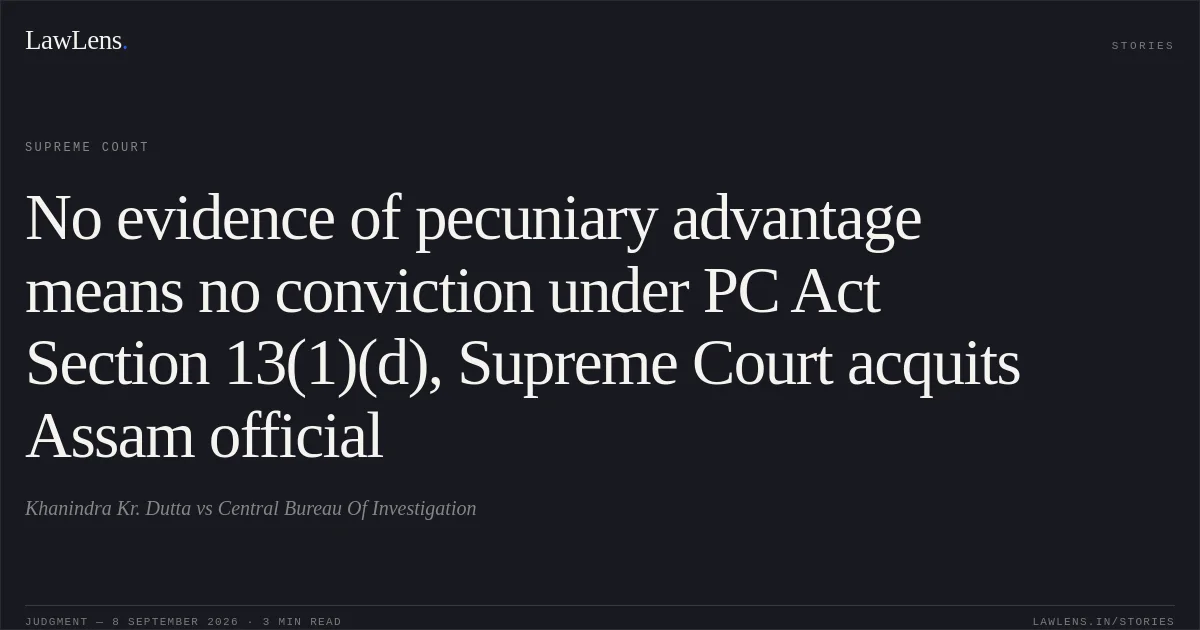
Whether a conviction under Section 13(1)(d) of the Prevention of Corruption Act, 1988 can be sustained where the court has found that the accused obtained no valuable thing or pecuniary advantage.
Source reference: p.1–2, p.4Whether the appellant’s conviction under Sections 13(1)(d) and 13(2) of the Prevention of Corruption Act read with Section 120B IPC could stand after his acquittal of the charged IPC offences and in the absence of a demonstrated money trail or pecuniary benefit.
Source reference: p.4–5Law Applied
The Court applied Section 13(1)(d) of the Prevention of Corruption Act, 1988, which criminalises a public servant obtaining, by corrupt or illegal means or by abuse of position, for himself or another person, any valuable thing or pecuniary advantage, and obtaining such advantage for any person without public interest.
Source reference: p.3–4Section 13(2) prescribes punishment for the offence under Section 13(1), while Section 120B IPC concerns criminal conspiracy.
Source reference: p.2–3The governing rule was that obtaining a valuable thing or pecuniary advantage is an essential ingredient of Section 13(1)(d); therefore, where the court records that no such advantage was obtained, conviction under that provision cannot be sustained.
Source reference: p.4The Court also observed that the High Court’s acquittal under the IPC provisions, which was not challenged by the CBI, necessarily operated to the appellant’s benefit.
Source reference: p.1–2, p.4Reasoning
The High Court found that the storekeeper made entries in the store register and that the appellant certified receipt of medicines that had not been supplied. However, it also categorically found no evidence that either accused obtained any valuable thing or pecuniary advantage.
Source reference: p.3–4Since the existence of such advantage is indispensable to an offence under Section 13(1)(d), the factual finding of its absence was inconsistent with the conviction under that provision.
Source reference: p.4The Supreme Court further noted that the evidence might have supported prosecution for certain IPC offences, particularly Sections 420 and 477A, but the High Court had acquitted the accused of those offences and the CBI had not challenged that part of the judgment.
Source reference: p.4The Court also criticised the absence of any investigation into the money trail despite the alleged disbursement of departmental funds.
Source reference: p.5Holding
The Supreme Court held that, in the absence of proof that the appellant obtained any valuable thing or pecuniary advantage, his conviction under Section 13(1)(d) read with Section 120B IPC, and consequently under Section 13(2) of the Prevention of Corruption Act, could not be sustained.
The appeal was allowed and the appellant was acquitted. If he was in custody, he was directed to be released forthwith unless required in another case; if already on bail, his bail bonds were cancelled.
Source reference: p.5–6Acts & Sections Cited
4 provisions across 2 statutes referred to in this judgment. Each provision opens on LawLens.
Prevention of Corruption Act, 19881
Indian Penal Code, 18603
Original Court PDF
Khanindra Kr. DuttavsCentral Bureau Of Investigation
Click to open original judgment
Original judgment, available to read, download and summarize on LawLens.in