Facts
The dispute concerns land at Survey No. 440, Village Shela, Sanand, exclusively owned by Defendant No. 2 (father) following a partition in 2000
Source reference: p. 3In 2016, Defendant No. 2 publicly boycotted his son, Defendant No. 1, removing him from any interest in his properties
Source reference: p. 3-4Despite having no title, Defendant No. 1 executed an agreement to sell (ATS) for a 1/5th "undivided share" in the land to the Plaintiff on 07.05.2019 for ₹38 lakhs
Source reference: p. 6Subsequently, on 14.07.2020, the Appellant (Defendant No. 5/another son) purchased the entire land from Defendant No. 2 via a registered sale deed for ₹2.52 crores and took possession
Source reference: p. 4, 10The Plaintiff filed a suit for specific performance and sought an interim injunction. The Trial Court (Special Civil Suit No. 9 of 2020) granted the injunction, restraining the defendants from disturbing the Plaintiff’s possession and alienating the property, while directing the Plaintiff to deposit ₹15 lakhs
Source reference: p. 4-5Issues
1. Whether the Trial Court was justified in granting an interim injunction against a registered owner based on an agreement to sell executed by a party (Defendant No. 1) who lacked title or authority over the property
Source reference: p. 11-122. Whether the Trial Court erred in restraining the defendants from "disturbing possession" when the Plaintiff neither pleaded possession in the plaint nor provided evidence of occupying the land
Source reference: p. 10-113. Whether the direction to deposit 50% of the sale consideration was legally sound in the absence of pleadings regarding the Plaintiff’s readiness and willingness to perform the contract
Source reference: p. 12-13Law Applied
The court applied the fundamental principles governing interim injunctions under Order 39, Rules 1 and 2 of the Code of Civil Procedure (CPC), requiring the concurrent existence of a prima facie case, balance of convenience, and irreparable injury
Source reference: p. 5, 12It relied on the principle that an agreement to sell does not, by itself, create any right, title, or interest in the property, but is merely an intention to transfer title in the future
Source reference: p. 11Furthermore, the court applied the legal presumption that "possession follows title" in the case of open land, favoring the holder of a valid registered sale deed over a claimant under an unregistered or unauthorized agreement
Source reference: p. 11Reasoning
The High Court found that the Trial Court's findings were "without any base" and "misinterpreted" the evidence
Source reference: p. 10Firstly, the revenue records proved Defendant No. 2 was the sole owner; therefore, Defendant No. 1 had no 1/5th share to sell, and the ATS was inherently weak
Source reference: p. 9, 12The ATS itself was conditional upon a future partition that had never occurred
Source reference: p. 9Secondly, the High Court criticized the Trial Court for protecting the Plaintiff's possession despite the Plaintiff failing to pray for such relief or prove occupation
Source reference: p. 11Since the Appellant held a registered sale deed for open land, the legal presumption of possession rested with him, not the Plaintiff
Source reference: p. 11Finally, the Court held that directing a deposit of ₹15 lakhs to "test bonafides" was uncalled for, as the Plaintiff had failed to establish the basic requirements of readiness and willingness in his pleadings
Source reference: p. 13Holding
The High Court allowed the Appeal from Order and quashed the Trial Court’s order dated 12.05.2023
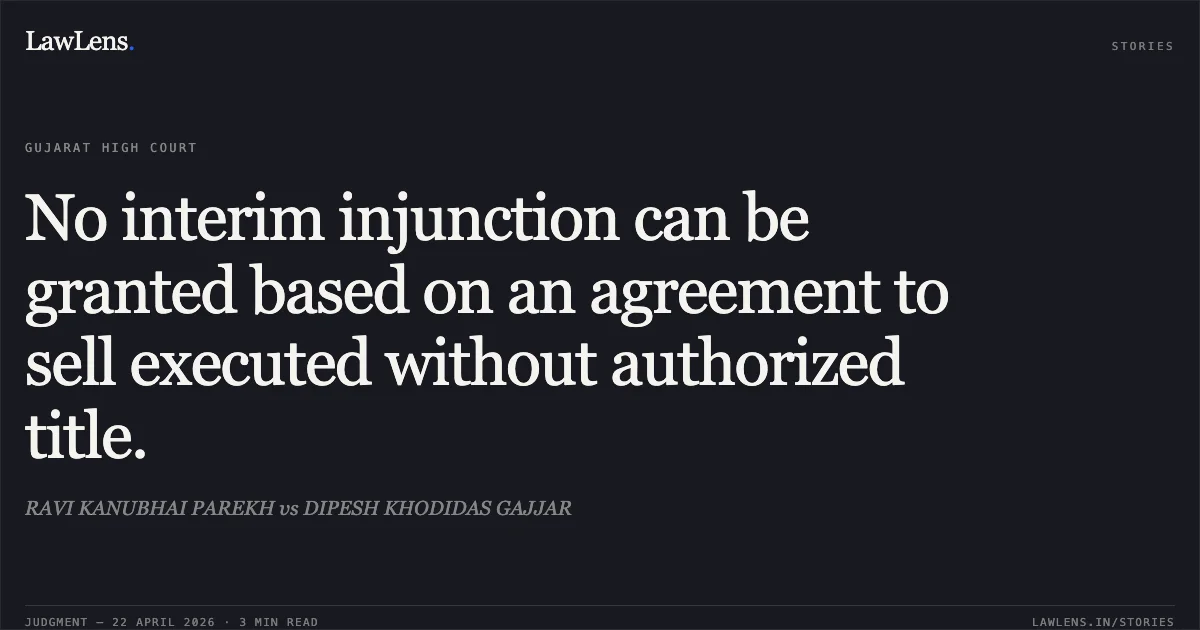
The Court held that a rightful owner cannot be injuncted based on a "fancy claim" arising from an unauthorized agreement
Source reference: p. 12The interim relief was set aside, and the Trial Court was directed to return the ₹15 lakh deposit to the Plaintiff
Source reference: p. 13The suit was ordered to be decided on its merits based on evidence, uninfluenced by the observations in this judgment
Source reference: p. 14Acts & Sections Cited
2 provisions across 1 statute referred to in this judgment. Each provision opens on LawLens.
Indian Penal Code, 18602
Original Court PDF
RAVI KANUBHAI PAREKHvsDIPESH KHODIDAS GAJJAR
Click to open original judgment
Original judgment, available to read, download and summarize on LawLens.in