Facts
The Appellant, a public financial institution, sanctioned a term loan and capital term loan totaling Rs. 11 lakhs to respondents 2 to 4 (trading as M/s. Sri Chakra Leather Garments) in 1995-1996
Source reference: p. 3The Appellant alleged that the fifth respondent (deceased R1 in appeal) had mortgaged immovable property and deposited title deeds as security on 28.02.1996
Source reference: p. 3Following a default in repayment and the removal of hypothecated machinery, the Appellant initially invoked Section 29 of the State Financial Corporation Act, 1951, but withdrew the action after the Supreme Court ruled that Section 29 cannot be used against guarantors
Source reference: p. 4The Appellant then filed O.P. No. 625 of 2010 under Sections 31 and 31(aa) of the Act to recover Rs. 1,76,25,535/-
Source reference: p. 4The fifth respondent denied executing any documents, alleging that his title deeds were obtained fraudulently by a third party and that the loan documents featured a stranger’s photograph
Source reference: p. 5The Single Judge decreed the petition only against the principal borrowers (R1-R4) and absolved the fifth and sixth respondents due to a lack of evidence
Source reference: p. 6Issues
Whether the fifth respondent (and his legal representatives) could be held liable for the loan transaction as a mortgagor or guarantor based on the documents produced by the Appellant
Source reference: p. 2-3, para 1; p. 8, para 11Law Applied
The Court considered Sections 29, 31, and 31(aa) of the State Financial Corporation Act, 1951, which govern the recovery of dues and the enforcement of liabilities of sureties
Source reference: p. 4It applied fundamental principles of contract and evidence law, specifically that liability cannot be fastened upon a party in the absence of validly executed loan or security documents
Source reference: p. 6, 8The court also noted the judicial precedent that Section 29 power does not extend to the properties of guarantors
Source reference: p. 4Reasoning
The Court focused on the authenticity of the security documents. Upon perusing the mortgage deed and associated forms, the Court observed that the photograph affixed to the documents was that of a stranger and not the fifth respondent
Source reference: p. 7, para 10During the proceedings, the Appellant’s Branch Manager appeared in person and admitted that both the photograph and the signature on the records did not belong to the deceased fifth respondent
Source reference: p. 7-8, paras 10-11The Court found that the Appellant had instituted the recovery petition based on "inadmissible documents" and had failed to provide any record connecting the fifth respondent to the loan transaction between the corporation and the principal borrowers
Source reference: p. 8, para 11Since the issue was purely factual and the fraud/discrepancy was admitted by the Appellant's own officer, the Court found no reason to disturb the Single Judge's findings.
Source reference: no citationHolding
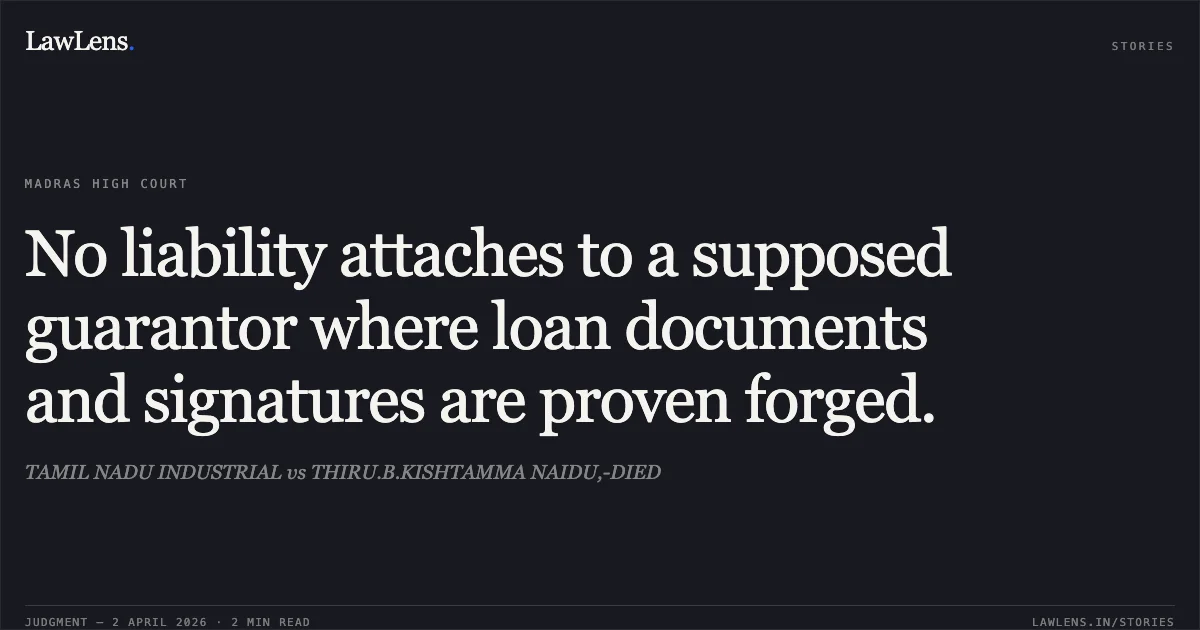
The Court dismissed the appeal and confirmed the judgment of the Single Judge, holding that the deceased fifth respondent (and his legal heirs) bore no liability for the debt
The Court held that since the documents were fraudulent and did not contain the respondent’s signature or photograph, no legal obligation was created
Source reference: p. 8, para 11No costs were awarded
Source reference: p. 8, para 13Acts & Sections Cited
2 provisions across 1 statute referred to in this judgment. Each provision opens on LawLens.
State Financial Corporations Act, 19512
Original Court PDF
TAMIL NADU INDUSTRIALvsTHIRU.B.KISHTAMMA NAIDU,-DIED
Click to open original judgment
Original judgment, available to read, download and summarize on LawLens.in