Facts
The petitioners were contractual employees working as Secretaries under the Integrated Watershed Management Programme on a fixed honorarium
Source reference: para. 3On December 21, 2016, the respondents issued an order terminating their services on the ground that the specific project was being closed
Source reference: para. 4The petitioners challenged this termination under Article 226 of the Constitution, arguing that the project was still active at the time of filing
Source reference: para. 5a successor project, the 'Pradhan Mantri Krishi Sinchai Yojna', was essentially the same program renamed to accommodate new recruits
Source reference: para. 6The project under which petitioners worked officially concluded in March 2017
Source reference: para. 5, 8Issues
1. Whether the termination of contractual employees due to the closure of a project is violative of the principles of natural justice
Source reference: para. 52. Whether the court can exercise its writ jurisdiction to direct the absorption of contractual employees into a new government project without proof of identical service conditions or a formal recruitment process
Source reference: para. 7Law Applied
The court primarily applied Article 226 of the Constitution of India regarding the scope of judicial review in matters of contractual employment and government policy
Source reference: para. 2, 7It relied on the principle that contractual employees do not have an inherent right to absorption in a new project unless they meet the specific qualification, eligibility, and recruitment criteria established by the fresh policy
Source reference: para. 7the court applied the principle that relief for honorarium during a 'status quo' period requires evidentiary proof of actual service rendered
Source reference: para. 8Reasoning
The court found that the petitioners failed to provide evidence demonstrating that the new 'Pradhan Mantri Krishi Sinchai Yojna' shared the same objectives, work area, or employment conditions as the closed project
Source reference: para. 7It reasoned that even if the projects were similar, the court cannot bypass the recruitment process; petitioners must apply and meet eligibility criteria under the new policy for any appointment
Source reference: para. 7Regarding back wages/honorarium, the court noted that although status quo orders were granted in some cases, there was no record of the petitioners actually working during that period
Source reference: para. 8Consequently, any payment of honorarium was made contingent upon proving they were on duty until the project’s closure in March 2017
Source reference: para. 9Holding
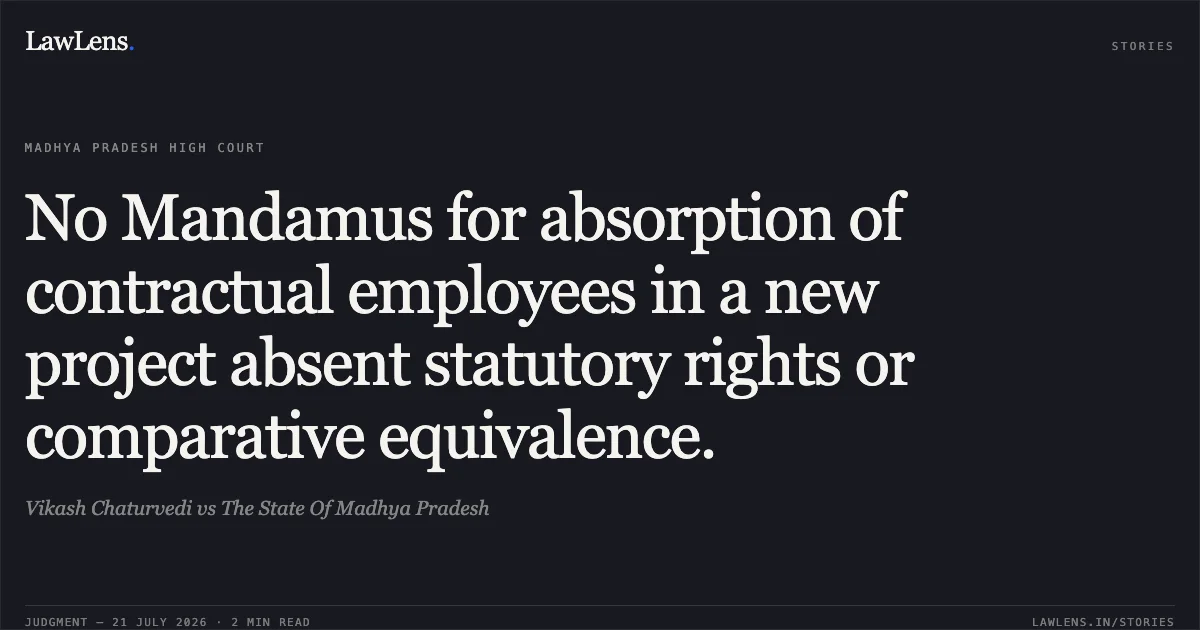
The court declined to quash the termination order or direct automatic reinstatement. It held that the petitioners must submit representations to the competent authority
The court ordered that: (i) if petitioners prove they were working when the status quo was granted, they shall receive honorarium until March 2017; and (ii) petitioners may apply for the new project, and if they meet eligibility criteria and vacancies exist, the respondents must consider their cases in accordance with the law
Source reference: para. 9, 10The petitions were disposed of with these directions
Source reference: para. 11Original Court PDF
Vikash ChaturvedivsThe State Of Madhya Pradesh
Click to open original judgment
Original judgment, available to read, download and summarize on LawLens.in