01Facts
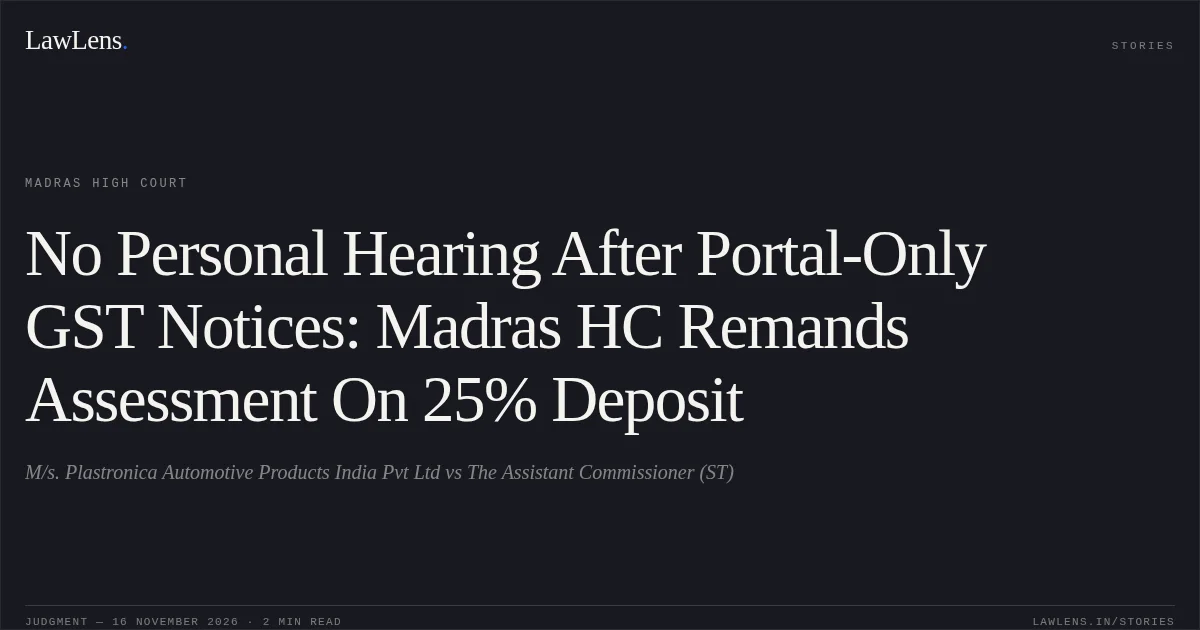
The petitioner challenged an assessment order dated 17 April 2024 under Section 73 of the GST Act for FY 2018–19.
¶ 3, 7 · pp. 2–3It said that notices uploaded under “View Additional Notices and Orders” on the GST portal had gone unnoticed, leaving it unable to respond, and that no personal hearing was provided.
¶ 3, 7 · pp. 2–3The petitioner offered to pay 25% of the disputed tax as a condition of remand. The respondent acknowledged that no personal hearing had been given and consented to remand subject to that payment.
¶ 4–5 · pp. 2–302Issues
i.Whether the assessment order should be set aside and the matter remanded where notices were uploaded on the GST portal, the taxpayer did not respond, and no personal hearing was provided
¶ 3, 7–9 · pp. 2–4ii.Whether remand should be conditional on the petitioner paying 25% of the disputed tax
¶ 4–5, 10 · pp. 2–3, 503Law Applied
Section 169(1) of the GST Act recognises prescribed modes of service, including service through the GST portal and other modes.
¶ 8–9 · pp. 4–5The Court stated that where a taxpayer does not respond to portal notices, the officer should consider serving notices through another prescribed mode, preferably registered post with acknowledgment due (RPAD), to achieve effective service rather than merely fulfil formalities.
¶ 8–9 · pp. 4–5Provisions in the judgment · 2
Goods and Services Tax Act, 2017 Section 73Section 169
04Reasoning
Although portal service was legally sufficient, the Court considered that the petitioner had not become aware of the notices and that the assessment was made without a personal hearing.
¶ 7–9 · pp. 3–5In the absence of any response to the portal notices, the officer should have explored another mode of service under Section 169(1); failing to do so amounted to inadequate effort to effect service.
¶ 7–9 · pp. 3–5Given the petitioner’s undertaking to pay 25% of the disputed tax, and the respondent’s consent to remand on that condition, the Court set aside the order subject to payment.
¶ 5, 10 · p. 3, 505Holding
The Court set aside the assessment order and remanded the matter for fresh consideration, with the setting aside taking effect upon the petitioner’s payment of 25% of the disputed tax within four weeks of receiving the order. The petitioner must file its reply and supporting documents within three weeks of payment. The first respondent must then give 14 days’ clear notice of a personal hearing, hear the petitioner, and pass a fresh order on the merits and in accordance with law.
¶ 10(i)–(iii) · p. 5The writ petition was disposed of without costs.
¶ 11 · p. 6Original Court PDF
M/s. Plastronica Automotive Products India Pvt LtdvsThe Assistant Commissioner (ST)
Click to open original judgment
Original judgment, available to read, download and summarize on LawLens.in