01Facts
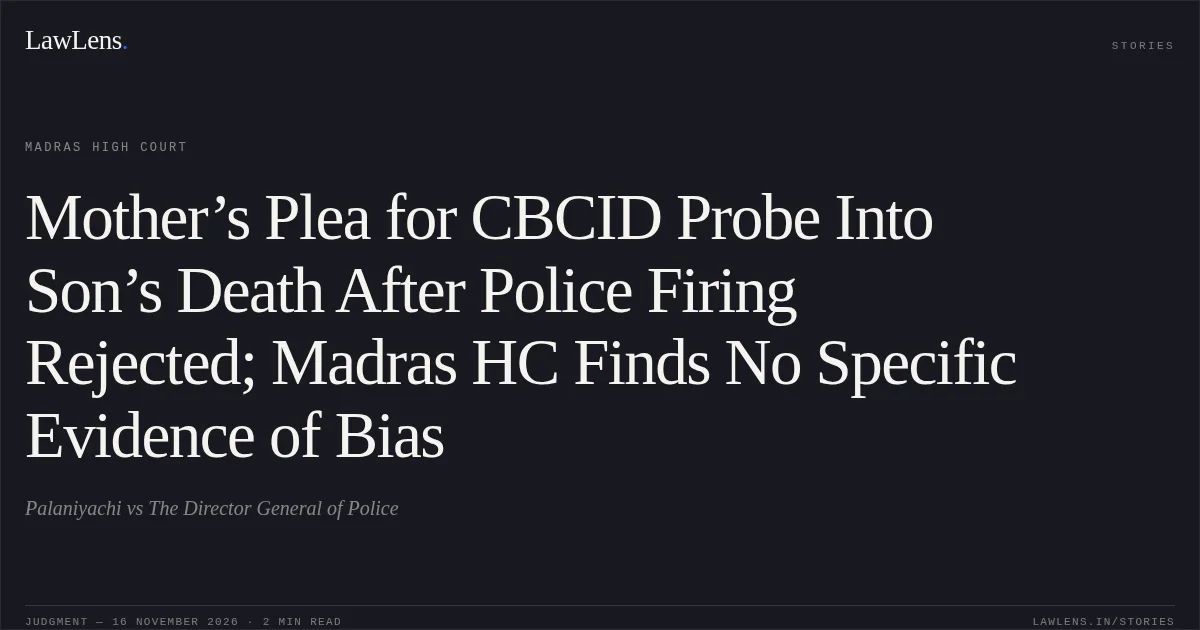
The petitioner’s son, Pechidurai, sustained a firearm injury during a police operation on 7 March 2024 and died on 11 March 2024.
¶ 3–4, 9–10, 18 · pp. 3–6, 10The police registered Crime No. 100 of 2024 under Section 176(1A)(i) CrPC. A Deputy Superintendent of Police was appointed to investigate, and a Judicial Magistrate conducted a statutory inquiry, which considered witness statements and medical, electronic and forensic materials.
¶ 3–4, 9–10, 18 · pp. 3–6, 10The investigating officer filed a final report recommending closure; the Magistrate accepted it on 9 December 2024.
¶ 3–4, 9–10, 18 · pp. 3–6, 10The petitioner sought a writ directing transfer of the investigation to CBCID, alleging police excess and lack of an independent investigation.
¶ 3–4, 9–10, 18 · pp. 3–6, 10The respondents opposed transfer, relying on the investigation, inquiry and closure order.
¶ 11–12 · p. 702Issues
i.Whether the petitioner established exceptional circumstances warranting transfer of the investigation in Crime No. 100 of 2024 to CBCID.
¶ 13–14 · pp. 7–8ii.Whether the petitioner could pursue remedies against the Magistrate’s acceptance of the final report notwithstanding the dismissal of the transfer petition.
¶ 18, 21 · p. 10, 1203Law Applied
Under Article 226 of the Constitution, transfer of an investigation to an independent agency is an exceptional remedy and is not ordered routinely; it may be warranted where the circumstances show that the investigation was unfair or that transfer is necessary to instil confidence in it.
¶ 14 · p. 8In cases of death during police action or an alleged encounter, the investigation must be independent, impartial and effective, and the police account cannot be accepted without scrutiny. The Court referred to People’s Union for Civil Liberties v. State of Maharashtra, (2014) 10 SCC 635, as laying down safeguards for investigations into police-encounter deaths.
¶ 13 · p. 8Section 176(1A)(i) CrPC governed the registration of the inquiry into the custodial death.
¶ 9 · p. 5Acceptance of a closure report does not extinguish an aggrieved person’s independent legal remedies.
¶ 18, 21 · p. 10, 12Provisions in the judgment · 7 · Linked ones open on LawLens
Code of Criminal Procedure, 1973 Section 176
Indian Penal Code, 1860 Section 294Section 302Section 307Section 506Section 427Section 34
04Reasoning
The Court acknowledged that the death followed a police firearm injury and held that neither the police claim of self-defence nor the fact of the shooting alone determined whether the police action was lawful.
¶ 15, 19 · p. 9, 11It found that the investigation was not left solely to the local police station: a Deputy Superintendent of Police was appointed, and the Judicial Magistrate’s inquiry considered witness statements and medical, electronic and forensic materials.
¶ 16–17 · pp. 9–10The petitioner had not identified specific evidence of suppression, fabrication, failure to examine material witnesses, or other fundamental investigative defects. The Court therefore found no sufficient basis to order the extraordinary remedy of transfer.
¶ 20 · p. 12It also clarified that the father’s stated lack of objection to the closure report did not waive the petitioner’s own remedies.
¶ 18 · p. 1005Holding
The Court dismissed the writ petition, declining to transfer the investigation to CBCID.
¶ 21–23 · pp. 12–13It granted the petitioner liberty to pursue remedies against the Magistrate’s order accepting the final report and to place fresh or additional material before the competent Court. The connected miscellaneous petitions were closed.
¶ 21–23 · pp. 12–13Original Court PDF
PalaniyachivsThe Director General of Police
Click to open original judgment
Original judgment, available to read, download and summarize on LawLens.in