01Facts
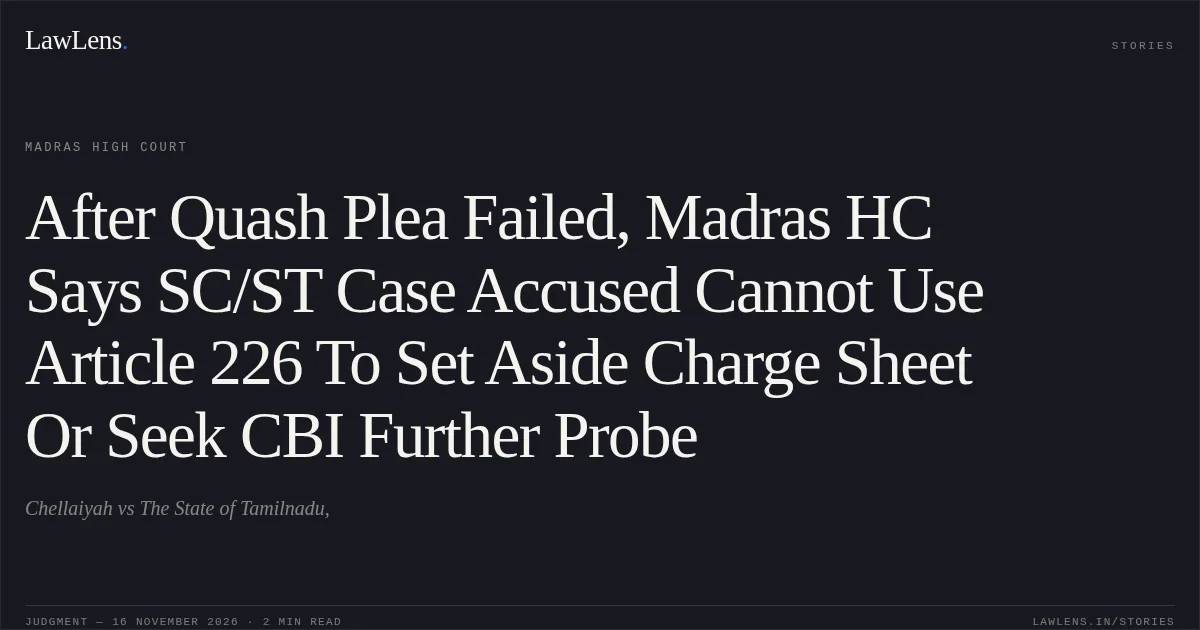
The petitioner, the first accused in Spl. S.C. No. 54 of 2026, sought to set aside the final report/charge sheet in Crime No. 47 of 2026 and to direct the CBI to conduct further investigation.
p. 3, 5 · ¶ 1, 7–8His counsel acknowledged that the petitioner’s separate petition to quash the proceedings, Crl. O.P. (MD) No. 25191 of 2026, had been dismissed on 10 November 2026.
p. 4 · ¶ 3The petitioner sought liberty to pursue discharge before the trial court.
p. 6 · ¶ 1002Issues
i.Whether the accused could use Article 226 to set aside the charge sheet after his petition to quash the proceedings had been dismissed.
p. 4 · ¶ 3ii.Whether the accused could obtain a direction for further investigation by the CBI.
pp. 4–5 · ¶ 4–703Law Applied
Section 193 of the Bharatiya Nagarik Suraksha Sanhita (BNSS) permits a police officer, upon learning of further evidence after filing the police report, to conduct further investigation and submit a further report.
p. 4 · ¶ 5The Court held that the BNSS or other applicable law does not confer on an accused a right to demand further investigation; it may be undertaken by the investigating agency or ordered suo motu by the competent court.
pp. 3–5 · ¶ 2, 4–5Relying on Sri Bhagwan Samardha Sreepada Vallabha Venkata Vishwanandha Maharaj v. State of Andhra Pradesh (1999) and Vinay Tyagi v. Irshad Ali (2013), the Court noted that a Magistrate is not required to hear the accused before directing further investigation.
p. 5 · ¶ 5Provisions in the judgment · 1 · Linked ones open on LawLens
Bharatiya Nagarik Suraksha Sanhita, 2023 Section 193
04Reasoning
The Court treated the challenge to the charge sheet as an attempt to obtain, through Article 226, relief that had already been refused in the petitioner’s quash petition; it therefore found the prayer to set aside the charge sheet not maintainable.
p. 4 · ¶ 3It also held that the accused could not require the police or the High Court to initiate further investigation at his request, and that the petitioner had not first pursued any request before the court concerned.
pp. 4–5 · ¶ 4, 7Further, setting aside the charge sheet would be inconsistent with the requested supplementary investigation, which presupposes an existing investigation and report.
p. 5 · ¶ 805Holding
The writ petition was dismissed as not maintainable, without hearing the private respondents.
p. 6 · ¶ 9The Court left the petitioner at liberty to file a discharge petition before the trial court, which was directed to decide any such application on its merits and in accordance with law.
p. 6 · ¶ 10Original Court PDF
ChellaiyahvsThe State of Tamilnadu,
Click to open original judgment
Original judgment, available to read, download and summarize on LawLens.in