Facts
The applicant’s brother, Arshid Ahmad Najar, was engaged as a Casual Labour/Helper to Lineman in the Power Development Department in 2000 and died on 03.11.2007 following a fatal accident involving an electric pole while performing official duties.
Source reference: para. 02Seeking compassionate appointment under SRO 43 of 1994, the applicant filed SWP No. 310/2010, where the High Court directed the respondents to consider the claim in light of the Division Bench judgment in State of J v. Safia Begum.
Source reference: para. 04The respondents rejected the claim via order dated 20.09.2013, erroneously treating the deceased as an "apprentice".
Source reference: para. 06This rejection was set aside in SWP No. 2646/2013 on 18.02.2015, with a mandate for "meaningful reconsideration".
Source reference: para. 07-08Despite this, respondent No. 2 passed the impugned order No. 362/2015 on 12.12.2015, again rejecting the claim on the grounds that a casual labourer is not a "Government employee" and that compensation under the Workmen’s Compensation Act had already been paid.
Source reference: para. 09-13Issues
1. Whether the respondents’ rejection of compassionate appointment via the impugned order dated 12.12.2015 constitutes a failure to comply with prior judicial directions to apply the ratio of Safia Begum.
Source reference: para. 20-222. Whether a casual labourer can be excluded from the definition of "Government employee" under SRO 43 of 1994 for the purpose of compassionate appointment.
Source reference: para. 26-283. Whether the receipt of statutory compensation under the Workmen’s Compensation Act disentitles a claimant from seeking compassionate appointment.
Source reference: para. 13Law Applied
SRO 43 of 1994, which governs compassionate appointments in J
Source reference: para. 01State of J Ors. v. Safia Begum (2010): The expression "Government employee" must receive a purposive interpretation to advance the scheme's object rather than a narrow, pedantic one.
Source reference: para. 11, 26, 28The Tribunal distinguished State of Haryana Ors. v. Rani Devi (1996), noting it applied to specific instructions regarding apprentices that did not mirror the broad scope of SRO 43.
Source reference: para. 25SRO 199 of 2008 regarding cash compensation was identified as a material alternative consideration.
Source reference: para. 31Reasoning
The Tribunal found the impugned order to be a "mechanical exercise of power" that failed to comply with the High Court's directions in letter and spirit.
Source reference: para. 23The respondents merely reproduced portions of the Safia Begum judgment without performing an independent analysis of how it applied to the applicant’s facts.
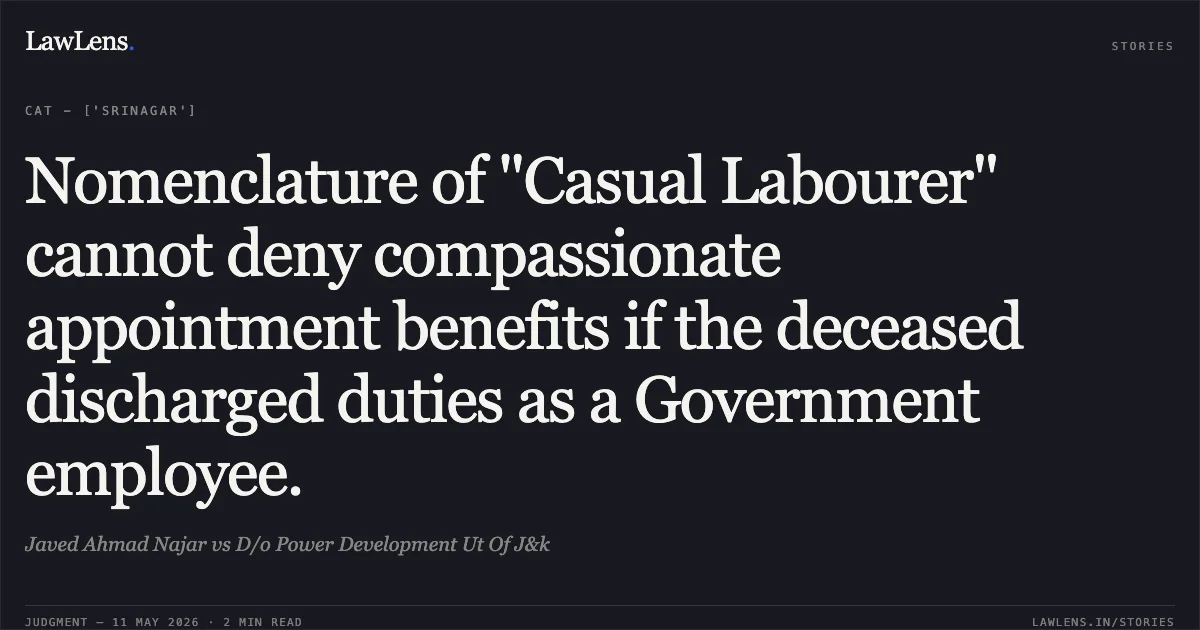
Source reference: para. 22The Division Bench in Safia Begum had already expressly distinguished Rani Devi and ruled that nomenclature (like "casual labourer") cannot be used to deny benefits when the deceased was under the department's control.
Source reference: para. 25-26The impugned order was legally flawed because it was silent on the applicant's alternative claim for cash compensation under SRO 199/2008 and failed to provide a reasoned analysis for why the applicant fell outside the scheme.
Source reference: para. 31-32Holding
The Tribunal held that the impugned order dated 12.12.2015 suffered from non-application of mind and non-compliance with binding judicial directions.
The order was set aside and the competent authority was directed to reconsider the claim afresh, strictly adhering to the ratios in Safia Begum and the High Court orders dated 11.07.2012 and 18.02.2015, by passing a comprehensive, reasoned, and speaking order within eight weeks.
Source reference: para. 35, 36, 37Acts & Sections Cited
3 provisions across 3 statutes referred to in this judgment. Linked provisions open on LawLens.
Compassionate Appointment Rules, 1994 (SRO 43)1
SRO 199 of 20081
Workmen1
Original Court PDF
Javed Ahmad NajarvsD/o Power Development Ut Of J&k
Click to open original judgment
Original judgment, available to read, download and summarize on LawLens.in