Facts
The case pertains to the 2021 election to the Karnataka Legislative Council from the 12-Chikkamagaluru Local Authorities Constituency
Source reference: para. 4The electoral roll included 12 members nominated by the State Government under Section 352(1)(b) of the Karnataka Municipalities Act (KMA), 1964
Source reference: para. 4The appellant was declared elected by a narrow margin of 6 votes
Source reference: para. 5Respondents challenged the inclusion of these nominated members in the electoral rolls and their subsequent voting rights through writ petitions and election petitions
Source reference: para. 6, 7The High Court of Karnataka held their inclusion unconstitutional and ordered a recount of votes excluding the 12 nominated members
Source reference: para. 2, 8The appellant challenged these orders before the Supreme Court, arguing that the term "member" in electoral laws includes nominated members and that the electoral roll, once finalized, cannot be questioned
Source reference: para. 11Issues
1. Whether nominated members of Town Panchayats have the right to be included in electoral rolls and vote in elections to the Legislative Council from a Local Authorities’ Constituency
Source reference: para. 212. Whether a writ petition challenging the legality of an electoral roll is maintainable in light of the bar under Article 329(b) and the availability of alternative remedies
Source reference: para. 22, 233. Whether the inclusion of allegedly ineligible voters in a finalized electoral roll can be a ground to set aside an election under Section 100(1)(d)(iii) of the Representation of the People Act, 1951
Source reference: para. 7, 39Law Applied
Article 171(3)(a) of the Constitution regarding the composition of Legislative Councils
Source reference: para. 27Section 27(2)(b) of the Representation of the People Act, 1950, concerning the registration of "every member" in electoral rolls
Source reference: para. 27Article 243-R, which prohibits nominated members from voting in municipal meetings
Source reference: para. 29Section 100(1)(d)(iii) of the 1951 Act regarding void votes
Source reference: para. 43The Court followed the precedent in Ramesh Mehta v. Sanwal Chand Singhvi (2004) and Shelly Oberoi v. Office of Lieutenant Governor of Delhi (2023), which established that nominated members are distinct from elected representatives and lack certain voting rights to preserve democratic decentralization.
Source reference: para. 33, 34Reasoning
The Court rejected the appellant's literal interpretation of the term "every member," holding that constitutional provisions must be read harmoniously with the post-74th Amendment framework in Part IX-A
Source reference: para. 29, 36The Court reasoned that since Article 243-R and Section 352 of the KMA expressly bar nominated members from voting in municipal meetings due to their advisory role, it would be "unreasonable" and "contradictory" to allow them to vote in a higher constitutional legislative body
Source reference: para. 30, 36On the issue of maintainability, the Court held that the writ petition was valid as the challenge concerned a foundational illegality in the electoral college and a pure question of law, making the statutory remedy under the 1950 Act "illusory"
Source reference: para. 24, 25The Court determined that the principle of "finality of electoral rolls" cannot override constitutional mandates; the reception of 12 unconstitutional votes in an election decided by a 6-vote margin clearly satisfied the "materially affected" test under Section 100(1)(d)(iii) of the 1951 Act
Source reference: para. 40, 44Holding
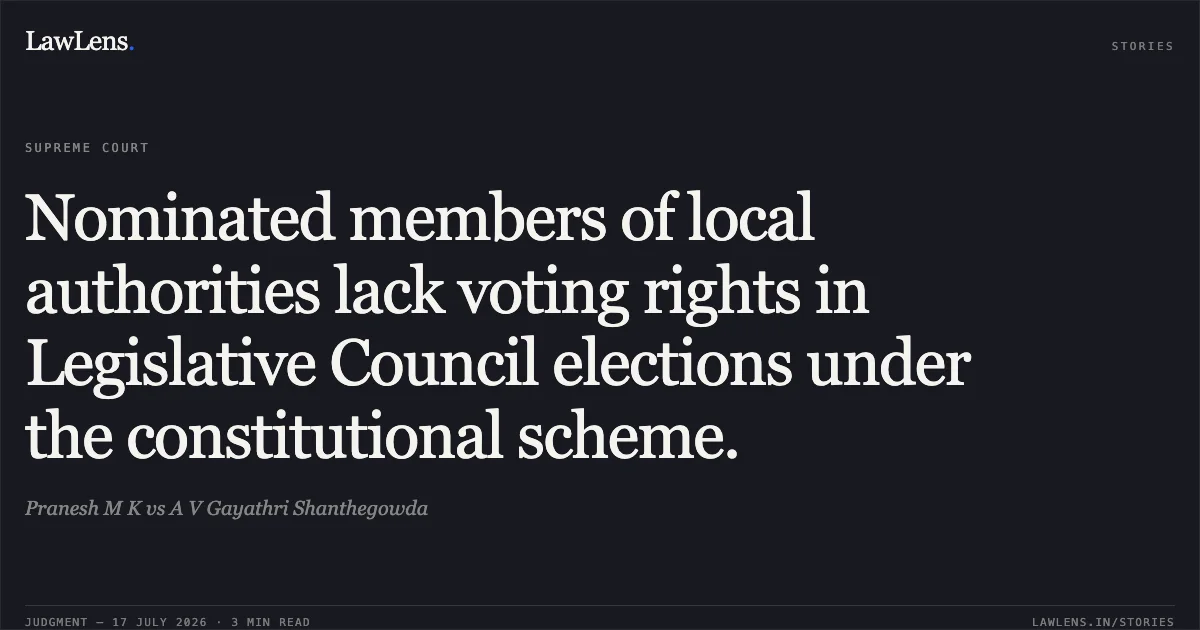
The Court held that nominated members under Section 352(1)(b) of the KMA are not entitled to vote in Legislative Council elections as their inclusion in the electoral roll is contrary to the constitutional scheme
The final holding confirms that "members" under Article 171(3)(a) refers only to those with democratic mandates and municipal voting rights
Source reference: para. 37The Supreme Court dismissed the appeals and affirmed the High Court’s judgments
Source reference: para. 49The Court directed the transmission of the recount report to the High Court of Karnataka to finalize the election results based on the exclusion of the 12 invalid votes
Source reference: para. 50Acts & Sections Cited
6 provisions across 3 statutes referred to in this judgment. Each provision opens on LawLens.
Representation of the People Act, 19502
Representation of the People Act, 19512
KARNATAKA MUNICIPALITIES ACT, 19642
Original Court PDF
Pranesh M KvsA V Gayathri Shanthegowda
Click to open original judgment
Original judgment, available to read, download and summarize on LawLens.in