Facts
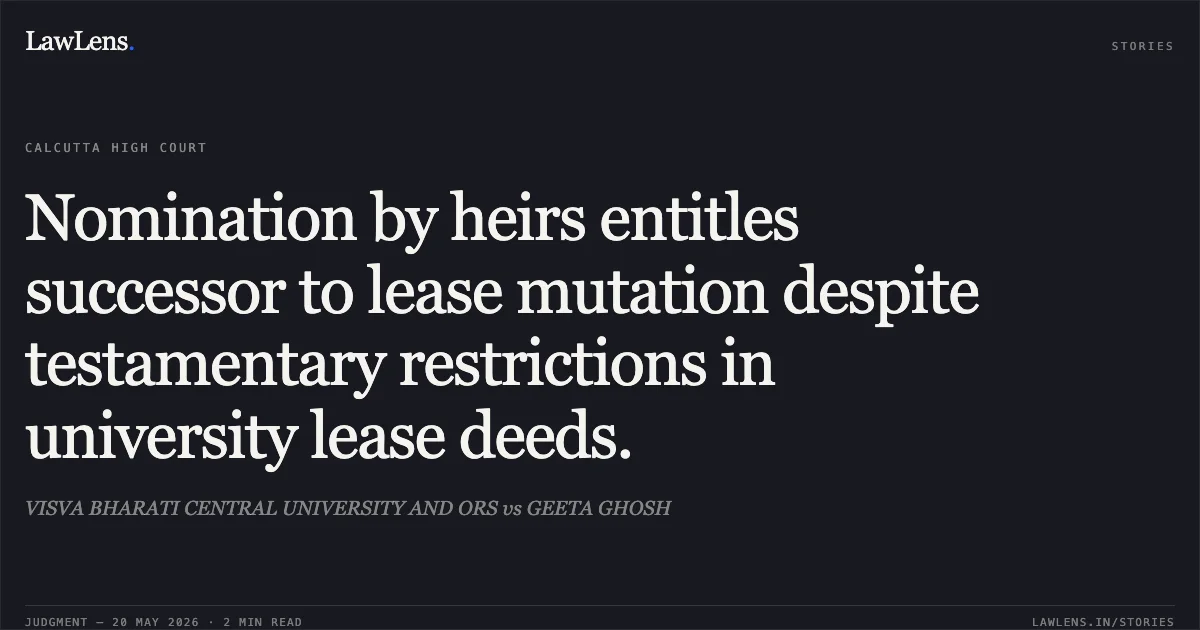
The respondent, Geeta Ghosh, sought mutation of a leasehold property originally leased to Gyan Ghosh in 1951.
Source reference: para. 4Upon Gyan’s death, the property was mutated to his son, Priyabrata Ghosh (the respondent's late husband), based on a nomination by other heirs.
Source reference: para. 8, 39After Priyabrata’s demise, the respondent applied for mutation based on a probated Will and a registered release deed executed by Priyabrata’s other heirs.
Source reference: para. 9, 20Visva Bharati (the appellant) refused the mutation, citing Clause 10 of the parent lease, which prohibits "assignment" or "transfer" without prior written consent.
Source reference: para. 4, 10A Single Judge set aside this refusal, leading to this appeal.
Source reference: para. 3Issues
1. Whether a testamentary disposition (Will) falls within the definition of "assignment" or "transfer" requiring prior lessor consent under the lease deed.
Source reference: para. 12, 242. Whether the respondent is entitled to mutation as a "nominee of the heirs" under Clause 11(b)(v) of the lease deed, independent of the Will.
Source reference: para. 36, 42Law Applied
The Court applied the interpretation of "assignment" as established by the Supreme Court in State of West Bengal v. Kailash Chandra Kapur (1997), which holds that in a generic sense, "assign" or "transfer" includes testamentary dispositions.
Source reference: para. 12, 24Clause 10 of the parent lease barring assignment without consent.
Source reference: para. 4Clause 11(b)(v)—a "re-entry" clause that provides an exception for a nominee of the heirs to be recognized as a lessee for all purposes if the original lessee dies without a valid transfer.
Source reference: para. 30, 45Reasoning
The Court first agreed with the appellant that, per Kailash Chandra Kapur, Clause 10’s bar on assignment effectively precluded the respondent from claiming rights solely based on the Will without prior consent.
Source reference: para. 24, 28The Court pivoted to Clause 11(b)(v), interpreting it as a mandatory provision that prohibits the University from refusing mutation if the applicant is a nominee of the remaining heirs.
Source reference: para. 33, 36The Court noted that the requirement of "Life Membership" mentioned in the clause was obsolete since the University became a statutory body, and even previously, the proviso made such membership a matter of course.
Source reference: para. 34, 37Since the appellant had previously allowed mutation for Priyabrata under identical circumstances (nomination by heirs) in 1995, it was bound by its own interpretation of the lease terms.
Source reference: para. 39, 40Consequently, the Court found that the registered release deed from the other heirs constituted a valid nomination, granting the respondent a right to mutation independent of the Will.
Source reference: para. 42, 43Holding
The Court held that while a Will is an "assignment" requiring consent, the respondent is entitled to mutation under the nomination exception in Clause 11(b)(v) due to the registered release deed from the other heirs.
The Division Bench dismissed the appeal (MAT 1949 of 2025) and affirmed the Single Judge's conclusion to set aside the University's refusal; the appellant-authority is directed to mutate Geeta Ghosh's name in respect of the subject property within one month.
Source reference: para. 50, 51Acts & Sections Cited
1 provisions across 1 statute referred to in this judgment. Each provision opens on LawLens.
Transfer of Property Act, 18821
Original Court PDF
VISVA BHARATI CENTRAL UNIVERSITY AND ORSvsGEETA GHOSH
Click to open original judgment
Original judgment, available to read, download and summarize on LawLens.in