Facts
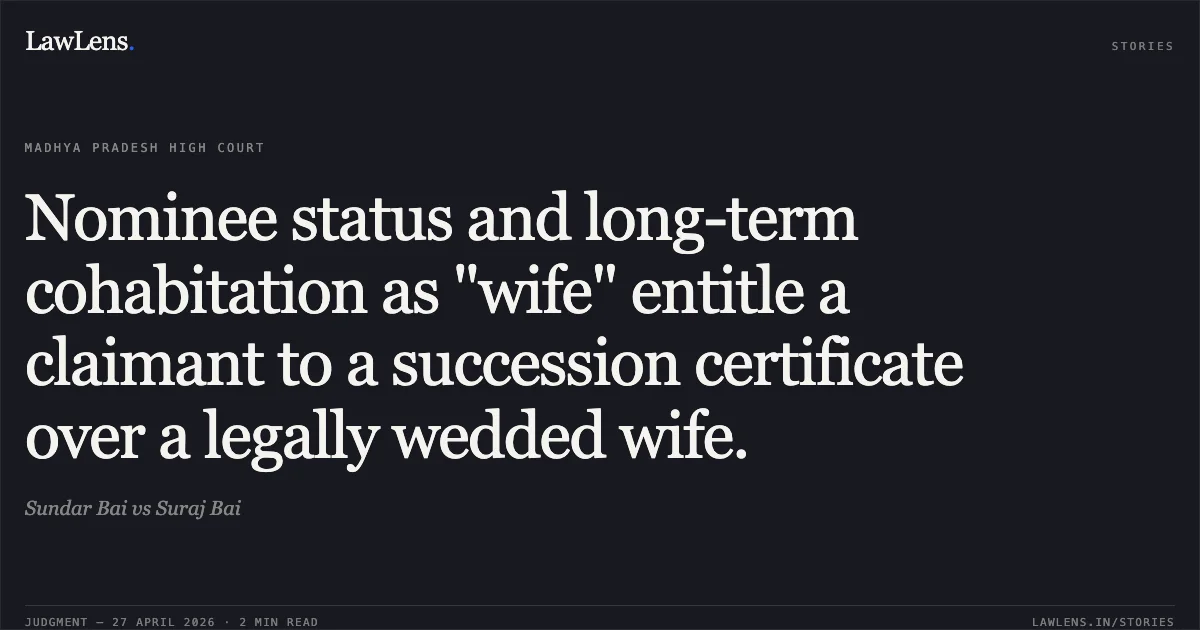
The respondents (Suraj Bai and another) filed for a succession certificate under Sections 371/372 of the Indian Succession Act, 1925, claiming the terminal benefits of the deceased, Late Sher Singh, wherein Respondent No. 1 claimed to be the legally wedded wife.
Source reference: para 02The applicant (Sundar Bai) filed a counter-claim, asserting she was the nominee in the bank and service records and had lived with the deceased as his wife following his divorce from Respondent No. 1.
Source reference: para 02The Trial Court and First Appellate Court granted the certificate to Respondent No. 1, dismissing the applicant's claim on the ground that the second marriage was not legally valid.
Source reference: para 02-04The applicant challenged these orders via civil revision.
Source reference: para 01Issues
1. Whether a nominee, who lived with the deceased as a wife for a long period, is entitled to a succession certificate over a legally wedded wife who lived separately.
Source reference: para 03/062. Whether the Courts below committed a jurisdictional error by conducting a full trial instead of the summary inquiry contemplated under Sections 371/372 of the Indian Succession Act.
Source reference: para 03Law Applied
The Court applied Section 372 of the Indian Succession Act, 1925, which governs the grant of succession certificates.
Source reference: para 06It relied on the Supreme Court precedent in Vidhyadhari & Ors. v. Sukhrana Bai & Ors. (2008), which established that while a second marriage during the subsistence of a first may be void, a nominee who was a "person of confidence" and stayed with the deceased for a long time is preferable for the grant of a succession certificate to collect dues, provided they protect the shares of other legal heirs.
Source reference: para 06Further, it applied Smt. Meeta Nathaniel v. Union of India (2016), holding that a nominee's claim should not be rejected solely because the second marriage was unsustainable under personal laws.
Source reference: para 07Reasoning
The Court observed that the applicant, Sundar Bai, was the recorded nominee in the deceased's service and bank records.
Source reference: para 02Evidence showed she lived with the deceased for a considerable period; notably, the deceased's daughter-in-law recognized the applicant as her mother-in-law.
Source reference: para 06The Court reasoned that the lower courts erred by focusing strictly on the legality of the marriage rather than the summary nature of succession proceedings and the status of the nomination.
Source reference: para 03/06Following the Vidhyadhari principle, the Court found that the applicant, as the nominee and long-term companion, was the appropriate person to receive the certificate to collect death benefits, regardless of whether her status as a "legally wedded wife" was technically valid.
Source reference: para 06/08Holding
The Court held that the succession certificate shall be issued in favor of the applicant (Sundar Bai) as she was the nominee of the deceased.
The High Court allowed the revision petition and set aside the orders of the Trial Court and the Appellate Court.
Source reference: para 08/09The Court further clarified that this order does not finally decide the legal status of the parties and other legal heirs remain at liberty to establish their rights through independent legal proceedings.
Source reference: para 08Acts & Sections Cited
1 provisions across 1 statute referred to in this judgment. Each provision opens on LawLens.
Code of Civil Procedure, 19081
Original Court PDF
Sundar BaivsSuraj Bai
Click to open original judgment
Original judgment, available to read, download and summarize on LawLens.in