Facts
The petitioner, a police constable posted in District Guna, was allegedly depicted in a newspaper photograph receiving an article or money from a person seated in an overloaded truck and permitting the truck to enter a no-entry zone.
Source reference: para. 2; p. 2He was suspended on 3 June 2010, served with a charge-sheet on 29 June 2010, and subjected to a departmental inquiry.
Source reference: para. 2; pp. 2–3After recording evidence and considering the petitioner’s reply to the show-cause notice, the disciplinary authority imposed the penalty of withholding one annual increment with cumulative effect by order dated 24 December 2010.
Source reference: para. 2; pp. 2–3The petitioner’s departmental appeal and mercy petition were rejected on 12 October 2011 and 28 July 2012, respectively.
Source reference: para. 2; p. 3Before the High Court, he challenged the three orders, sought payment of salary for the suspension period from 3 June 2010 to 11 August 2010, and claimed consequential increment and salary benefits.
Source reference: para. 1; p. 1His principal objections were that no Presenting Officer had been appointed, the Inquiry Officer had cross-examined witnesses, and the prosecution witnesses had not conclusively identified him or the truck driver/cleaner.
Source reference: para. 2.1; pp. 2–3Issues
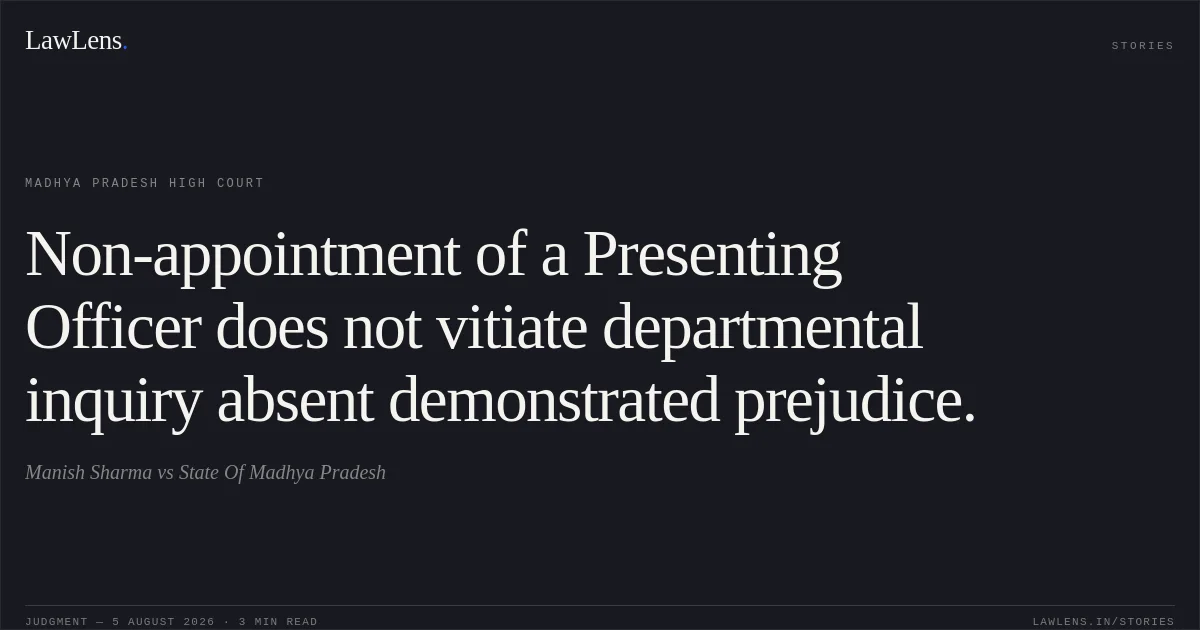
Whether the departmental inquiry was vitiated merely because no Presenting Officer was appointed.
Source reference: paras. 5–9; pp. 4–9Whether the questioning or cross-examination conducted by the Inquiry Officer amounted to the Inquiry Officer assuming the role of prosecutor and thereby violated natural justice.
Source reference: paras. 6–9, 20; pp. 4–9, 22–23Whether the disciplinary and appellate authorities’ findings were based on no evidence or were otherwise subject to interference under Article 226 of the Constitution.
Source reference: paras. 10–17; pp. 9–21Whether the punishment of withholding one annual increment with cumulative effect was liable to be set aside or modified.
Source reference: paras. 21–22; pp. 22–23Law Applied
The Court applied Article 226 principles governing judicial review of disciplinary proceedings.
Source reference: no citationRelying on Union of India v. Mohd. Naseem Siddiqui, as approved in Union of India v. Ram Lakhan Sharma, it held that non-appointment of a Presenting Officer does not, by itself, invalidate an inquiry; however, an Inquiry Officer must not assume the role of prosecutor by conducting examination-in-chief, putting leading or suggestive questions, or cross-examining defence witnesses, although clarificatory questions may be asked.
Source reference: paras. 6–8; pp. 4–9Under State of Karnataka v. N. Gangraj, State of A.P. v. S. Sree Rama Rao, and B.C. Chaturvedi v. Union of India, judicial review is confined to the decision-making process, compliance with statutory procedure and natural justice, and the existence of some evidence; the High Court cannot reappreciate evidence as an appellate court.
Source reference: paras. 11–13, 16–17; pp. 9–21State Bank of Bikaner & Jaipur v. Nemi Chand Nalwaya and Union of India v. Sardar Bahadur establish that adequacy or reliability of evidence is ordinarily not reviewable where the inquiry is fair and the findings are reasonably supported.
Source reference: no citationUnder Union of India v. P. Gunasekaran, the Court cannot reappreciate evidence, assess its adequacy or reliability, or interfere with punishment unless the case falls within recognised grounds such as perversity, violation of natural justice, mala fides, or shocking disproportionality.
Source reference: paras. 12–13; pp. 13–17Reasoning
The Court examined the inquiry record and found that the Inquiry Officer had not conducted a regular examination-in-chief, put leading questions, manipulated the witnesses, or interrupted the petitioner’s defence.
Source reference: para. 9; p. 9The petitioner was permitted to participate in the inquiry, submit his defence, and produce evidence.
Source reference: para. 9; p. 9The questions attributed to the Inquiry Officer were held to be merely clarificatory, and the petitioner failed to demonstrate any prejudice resulting from them.
Source reference: para. 20; pp. 22–23Accordingly, the absence of a Presenting Officer did not invalidate the inquiry.
Source reference: no citationThe statements of prosecution witnesses, including the newspaper report and duty records referring to the petitioner’s posting at the relevant location, constituted material capable of supporting the departmental findings.
Source reference: paras. 18–19; pp. 21–22The petitioner’s arguments concerning identification, inconsistencies, and the route taken by the truck invited reappreciation of evidence, which was impermissible in writ jurisdiction.
Source reference: no citationSince the inquiry complied with natural justice and the findings were supported by some evidence, no ground for judicial review was established.
Source reference: paras. 15–17, 21; pp. 20–23Holding
The High Court held that the departmental inquiry was not vitiated by the non-appointment of a Presenting Officer or by the Inquiry Officer’s clarificatory questioning.
The disciplinary and appellate orders were reasoned, procedurally valid, and supported by evidence; the Court found no violation of natural justice, bias, perversity, or jurisdictional error.
Source reference: paras. 15, 20–22; pp. 20–23The challenge to the punishment of withholding one annual increment with cumulative effect, along with the claims for suspension-period salary and consequential benefits, was rejected.
Source reference: para. 22; p. 23The writ petition was dismissed as devoid of merit.
Source reference: para. 22; p. 23Original Court PDF
Manish SharmavsState Of Madhya Pradesh
Click to open original judgment
Original judgment, available to read, download and summarize on LawLens.in