Facts
The Plaintiffs (real estate developers) entered into six agreements for sale and one development agreement with the Defendants (mother and daughter) on August 5, 1987, regarding premises at 215 and 217 Netaji Subhas Chandra Bose Road, Kolkata
Source reference: p. 2-4The Plaintiffs paid earnest money via twelve banker’s cheques
Source reference: p. 4Following delays due to municipal law changes and a 1995 refusal by the Defendants to proceed, the Plaintiffs filed a suit for specific performance in 1996
Source reference: p. 5, 11During the penetration of the suit, Defendant No. 1 (the mother) entered into a compromise decree with the Plaintiffs in 2014
Source reference: p. 10Defendant No. 2 (the daughter) contested the suit, alleging the agreements were obtained through coercion, were barred by limitation, and violated Section 31 of the Foreign Exchange Regulation Act (FERA), 1973, as her mother was a Japanese citizen
Source reference: p. 8, 11, 13Issues
1. Whether the suit for specific performance was barred by the law of limitation under Article 54 of the Limitation Act, 1963
Source reference: p. 112. Whether the agreements were void ab initio due to non-compliance with Section 31 of FERA, 1973
Source reference: p. 133. Whether the agreements were vitiated by coercion or undue influence exercised upon Defendant No. 2
Source reference: p. 144. Whether the Plaintiffs demonstrated readiness and willingness to perform their contractual obligations under Section 16(c) of the Specific Relief Act
Source reference: p. 20, 22Law Applied
Article 54 of the Limitation Act, 1963, which prescribes a three-year period for specific performance from the date fixed for performance or the date of notice of refusal
Source reference: p. 11Section 31 of the Foreign Exchange Regulation Act (FERA), 1973, noting it restricts the "transfer" of property by foreign nationals but does not necessarily void an "agreement for sale" ab initio
Source reference: p. 13-14Sections 15 and 16 of the Indian Contract Act, 1872, establishing that contracts made under coercion or undue influence are voidable at the option of the party whose consent was so caused, provided they are timeously avoided
Source reference: p. 15-16Section 16(c) of the Specific Relief Act, 1963, requiring the plaintiff to aver and prove continuous readiness and willingness, as interpreted in U.N. Krishnamurthy v. A.M. Krishnamurthy
Source reference: p. 22Reasoning
The Court found the suit was within the limitation period as the Defendants' refusal was only clearly communicated in 1995, and the suit followed in 1996
Source reference: p. 12-13It rejected the FERA defense, noting that FERA did not bar the execution of agreements for sale and had since been repealed; furthermore, Defendant No. 2 is an Indian citizen
Source reference: p. 14On coercion, the Court observed that Defendant No. 2 failed to lodge any police complaint or take legal steps to avoid the "voidable" contracts between 1987 and 1996, rendering her defense of non-voluntary consent untrustworthy
Source reference: p. 16Regarding readiness and willingness, the Court determined that the Plaintiffs' actions—including obtaining municipal sanctions, pursuing amalgamation of plots, and successfully concluding a compromise for half the property with Defendant No. 1—constituted sufficient evidence of financial capacity and intent
Source reference: p. 21-23Holding
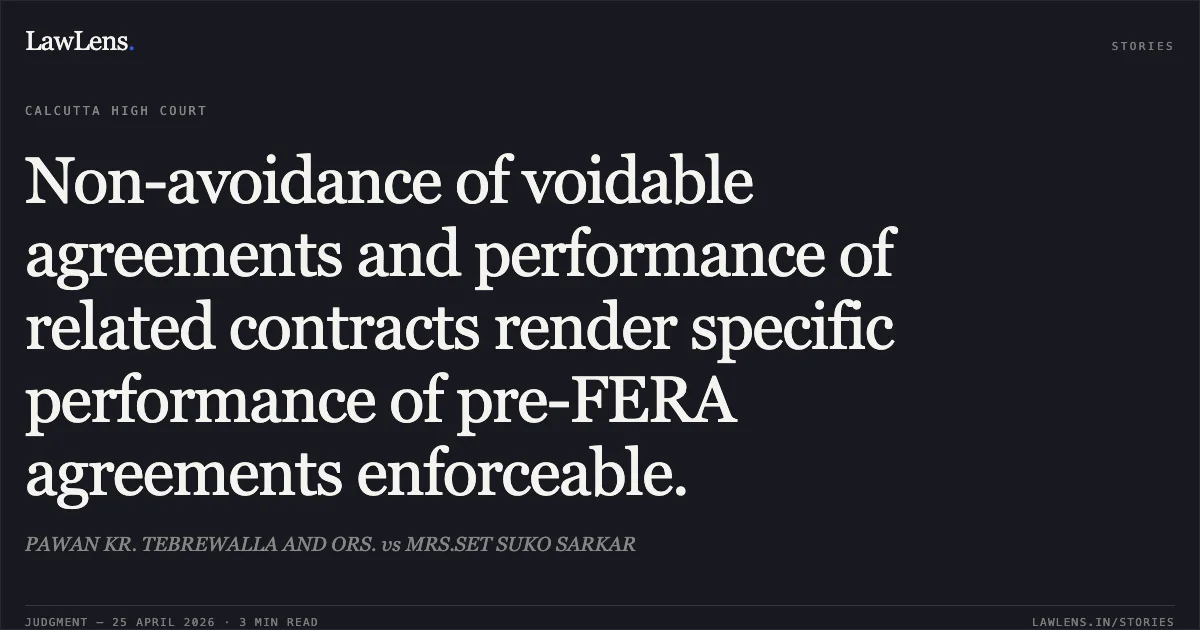
The Court decided all issues in favor of the Plaintiffs, holding that the six agreements dated August 5, 1987, are valid and enforceable
The Court granted a decree of specific performance in favor of the Plaintiffs and exercised its equitable jurisdiction by appointing a Chartered Valuer to determine the current market value of the property, which the Plaintiffs agreed to pay
Source reference: p. 23, 24Acts & Sections Cited
4 provisions across 4 statutes referred to in this judgment. Each provision opens on LawLens.
calcutta municipal corporation act, 19801
Limitation Act, 19631
Registration Act, 19081
Specific Relief Act, 19631
Original Court PDF
PAWAN KR. TEBREWALLA AND ORS.vsMRS.SET SUKO SARKAR
Click to open original judgment
Original judgment, available to read, download and summarize on LawLens.in