Facts
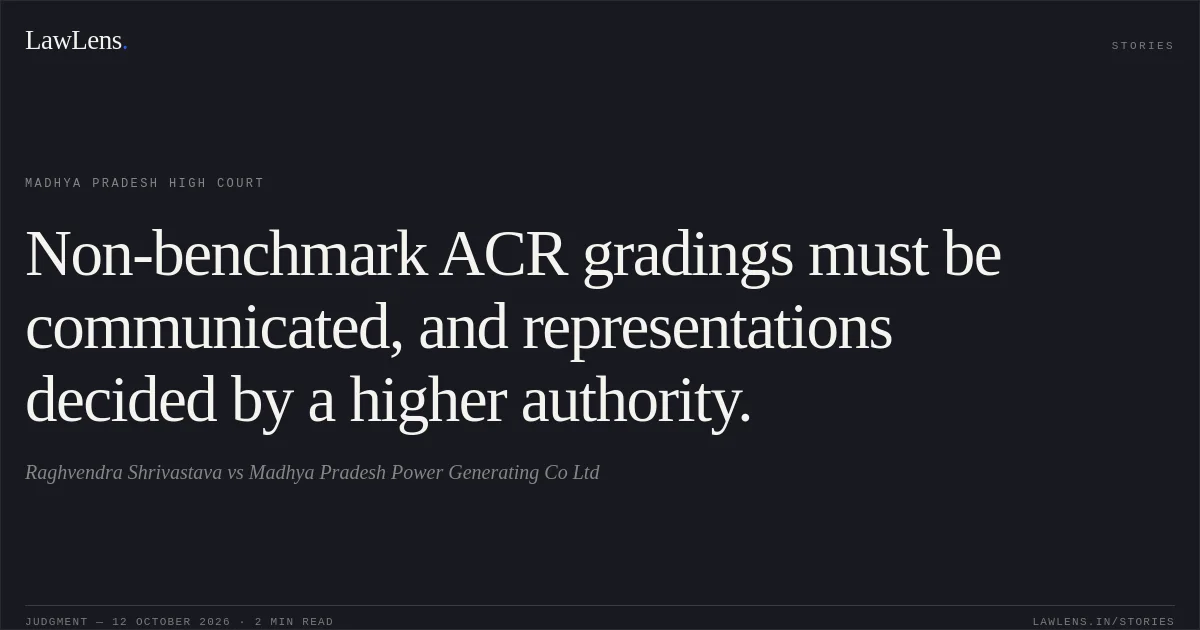
The petitioner, a Superintending Engineer, challenged the communication dated 23 April 2017 stating that he had not achieved the 13-mark benchmark for the third time scale of pay and that his case would be considered after receipt of the next appraisal report.
Source reference: p.1Information obtained under the RTI Act showed an ‘A’ grading for 2011–12, ‘B’ gradings for 2012–13 to 2014–15, and an ‘A’ grading for 2015–16. On the respondent’s scoring method, these gradings yielded 12 marks.
Source reference: p.2The petitioner contended that the reduction from ‘A’ to ‘B’ had not been communicated; the respondent argued that its policy did not require communication of a ‘B’ grading.
Source reference: p.1Issues
1. Whether the petitioner’s ‘B’ ACR gradings, representing a downgrade from ‘A’, were required to be communicated and supported by recorded reasons.
Source reference: p.1–22. Whether the petitioner’s representation and eligibility for the third time scale of pay required reconsideration in light of those gradings.
Source reference: p.2–3Law Applied
In U.P. Jal Nigam v. Prabhat Chandra Jain, (1996) 2 SCC 363, a change in grading from “Very Good” to “Good” requires reasons to be recorded in the employee’s personal file.
Source reference: p.2In Dev Dutt v. Union of India, (2008) 8 SCC 725, the Supreme Court held that service gradings must be communicated to employees, other than those in the military, within a reasonable time, allowing an opportunity to represent against them; the representation must be fairly decided within a reasonable time by an authority higher than the one that made the entry.
Source reference: p.1–2These requirements flow from fairness, non-arbitrariness and natural justice.
Source reference: p.2Reasoning
The ‘B’ gradings reduced the petitioner’s score below the 13-mark benchmark, while the record disclosed no reasons for the downgrade from ‘A’ to ‘B’.
Source reference: p.2Applying Dev Dutt, the Court held that the petitioner’s challenge had to be considered by an authority higher than the authority that assigned the ‘B’ grading, notwithstanding the respondent’s policy position.
Source reference: p.2–3The Court therefore ordered reconsideration of the representation and linked any resulting change in eligibility to a fresh assessment of the petitioner’s time-scale claim.
Source reference: p.3Holding
The petition was disposed of with directions to decide the petitioner’s representation against the adverse grading through a higher authority within 30 days.
If the grading was upgraded, the petitioner was to receive the benefit of the third time scale of pay; if it was not upgraded, the respondent was directed to consider the previous three years’ ACRs and take an appropriate decision on the basis of the scorecard within the same period.
Source reference: p.3Original Court PDF
Raghvendra ShrivastavavsMadhya Pradesh Power Generating Co Ltd
Click to open original judgment
Original judgment, available to read, download and summarize on LawLens.in