Facts
The Petitioner was arrested at 22:29 hours on May 21, 2026, following an FIR registered at Tardeo Police Station alleging various offenses under the Bharatiya Nyaya Sanhita, 2023 (BNS), including rape, sexual exploitation, and extortion.
Source reference: p. 3Upon production before the Magistrate on May 22, 2026, the Petitioner challenged the arrest’s legality, asserting that the "grounds of arrest" were not communicated as required by Section 47(1) of the Bharatiya Nagarik Suraksha Sanhita, 2023 (BNSS).
Source reference: p. 4The Magistrate granted police custody, reasoning that the presence of the Petitioner’s counsel fulfilled the purpose of legal aid.
Source reference: p. 4-5Subsequent remands were granted until the Petitioner moved the High Court seeking to quash the remand orders and declare the arrest illegal under Articles 21 and 22 of the Constitution.
Source reference: p. 2, 5-6Issues
1. Whether the Petitioner was communicated with the grounds of arrest when he was apprehended or immediately thereafter?
Source reference: p. 10 / para. 112. Whether the arrest and subsequent remands to police and judicial custody were illegal due to non-communication of the grounds of arrest?
Source reference: p. 10 / para. 11Law Applied
Article 22(1) of the Constitution of India, which mandates that no person shall be detained in custody without being informed of the grounds for such arrest.
Source reference: p. 13Section 47(1) of the BNSS, which requires communicating grounds of arrest to the accused.
Source reference: p. 4, 16Section 35(1)(b) of the BNSS regarding reasons for arrest.
Source reference: p. 11Precedent in Prabir Purkayastha v. State (NCT of Delhi), which distinguished "reasons for arrest" (formal parameters) from "grounds of arrest" (personal, basic facts necessitating arrest).
Source reference: p. 12Vihaan Kumar v. State of Haryana, establishing that non-compliance with Article 22(1) vitiates the arrest and subsequent remands.
Source reference: p. 13-14Mihir Rajesh Shah v. State of Maharashtra, requiring grounds to be supplied in writing at least two hours prior to the remand production.
Source reference: p. 15, 19Reasoning
The Court found that while the police provided "reasons for arrest" (e.g., to prevent evidence tampering or fleeing), they failed to provide "grounds of arrest"—the specific facts and allegations justifying the detention.
Source reference: p. 12, 17The communication under Section 47(1)(2) merely stated that the victim filed a report and that the Petitioner was "involved," which the court deemed insufficient to allow the accused to defend himself against remand or seek bail.
Source reference: p. 16-17The court rejected the State's "prejudice-oriented test" from State of Karnataka v. Sri Darshan, noting that procedural safeguards for personal liberty under Article 22(1) are mandatory and their violation cannot be cured by the mere presence of counsel or later explanations by the Magistrate.
Source reference: p. 18-20The Magistrate’s failure to verify compliance with constitutional safeguards during the first remand further vitiated the proceedings.
Source reference: p. 17-18Holding
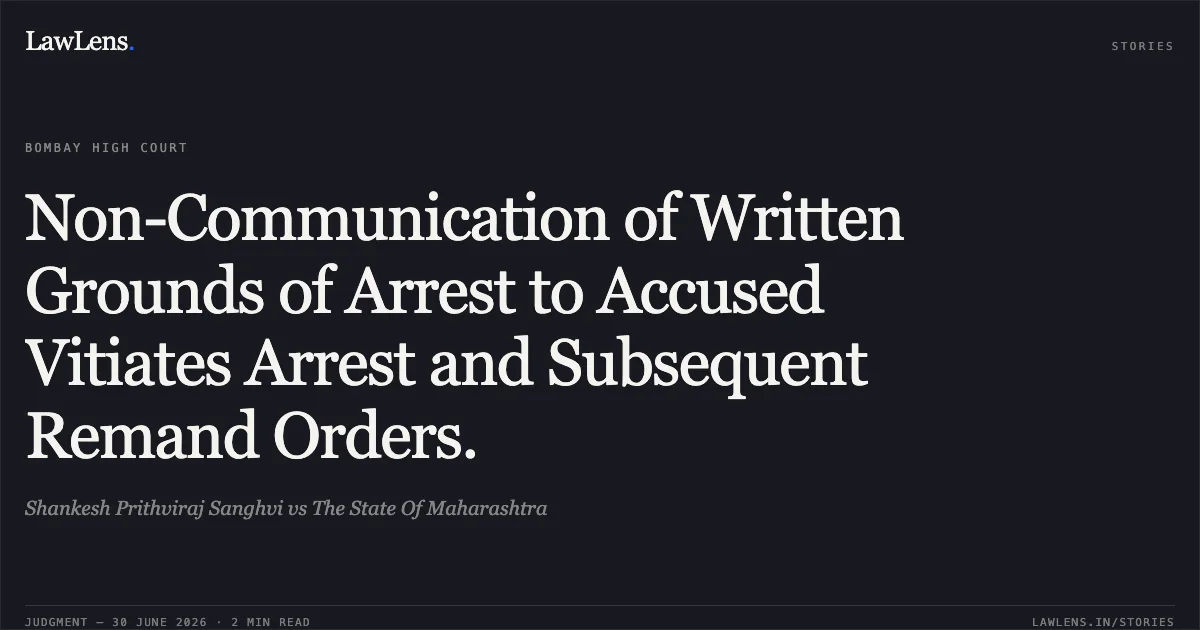
The Court held that the mandate of furnishing grounds of arrest was not complied with, rendering the arrest illegal.
The arrest and the subsequent remand orders dated May 22, May 25, and May 28, 2026, were quashed and set aside. The Petitioner was ordered to be released forthwith from judicial custody, though liberty was granted to the State to take recourse to law for a fresh arrest if a legal case is made out.
Source reference: p. 21 / para. 28Acts & Sections Cited
3 provisions across 1 statute referred to in this judgment. Each provision opens on LawLens.
Bharatiya Nagarik Suraksha Sanhita, 20233
Original Court PDF
Shankesh Prithviraj SanghvivsThe State Of Maharashtra
Click to open original judgment
Original judgment, available to read, download and summarize on LawLens.in