Facts
The appellant-assessee, engaged in chemical manufacturing, entered into an agreement with M/s. Chemcrown (India) Ltd. on March 26, 1996, to acquire goodwill, brand names, and restrictive non-compete covenants for a consideration of ₹80 Lakhs
Source reference: p. 3, 26-29The assessee initially claimed 1/5th (₹16 Lakhs) as revenue expenditure through amortization, but later sought the full amount as a revenue deduction
Source reference: p. 4-5Additionally, the assessee incurred ₹34,10,824 for a project with Dupont to acquire technology for manufacturing Chlorobenzene
Source reference: p. 11This project was ultimately aborted
Source reference: p. 12The Assessing Officer (AO) and the ITAT treated both expenditures as capital in nature, holding that the former provided an enduring benefit and the latter was for acquiring a capital asset
Source reference: p. 13-14Issues
1. Whether the payment of ₹80,00,000 to M/s. Chemcrown (India) Ltd. for a non-compete agreement is a capital expenditure or an allowable revenue expenditure.
Source reference: p. 2 / para 2(i)2. Whether the expenditure of ₹34,10,824 for acquiring technology for an aborted project (Chlorobenzene) is capital expenditure or allowable revenue expenditure.
Source reference: p. 2-3 / para 2(ii)Law Applied
The court applied Section 37(1) of the Income Tax Act, 1961, which allows deductions for expenditure laid out wholly and exclusively for business purposes, provided it is not in the nature of capital expenditure
Source reference: p. 41-42It relied on the Supreme Court ruling in Sharp Business System v. CIT [2025], which established that non-compete fees are revenue expenditures if they facilitate more efficient business operations without creating a new asset or profit-earning apparatus
Source reference: p. 36-40For the second issue, the court applied the principle from Dy. CIT v. Gujarat Narmada Valley Fertilizers Co. Ltd. [2015], which holds that expenses incurred for a project that never materializes (aborted project) and results in no capital asset are treated as revenue expenditure
Source reference: p. 53-54Reasoning
Regarding the first issue, the High Court observed that the ITAT erred by isolating the goodwill acquisition clause while ignoring the negative covenants (non-compete clauses)
Source reference: p. 34-35Under the authority of Sharp Business System, the Court determined that the payment was a composite consideration intended to protect the business and facilitate efficient operations rather than creating a new capital asset
Source reference: p. 35, 49Regarding the second issue, the Court found the ITAT’s reliance on cases involving failed but existing assets (like a dry tubewell) misplaced.
Source reference: p. 52Since the Dupont project was abandoned at the feasibility/legal stage and no asset ever came into existence, the expenditure was purely revenue in nature as per the precedent in Gujarat Narmada Valley Fertilizers
Source reference: p. 52-54Holding
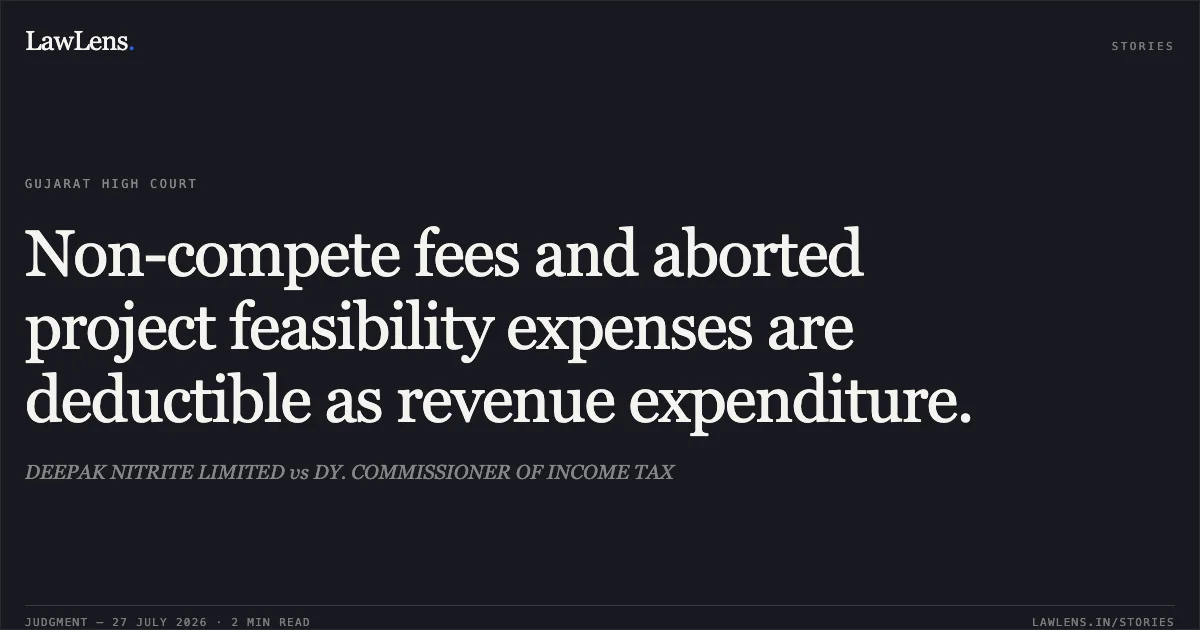
The High Court answered Question 1 partly in favor of the assessee, holding that the ₹80 Lakhs is a revenue expenditure to be spread over five years (₹16 Lakhs for the current year)
It answered Question 2 entirely in favor of the assessee, holding that expenses for the aborted Dupont project are revenue expenditures as no capital asset was created
Source reference: p. 54The ITAT order was modified accordingly, and the appeal was disposed of
Source reference: p. 51, 54Acts & Sections Cited
10 provisions across 1 statute referred to in this judgment. Linked provisions open on LawLens.
Income Tax Act, 1961
Original Court PDF
DEEPAK NITRITE LIMITEDvsDY. COMMISSIONER OF INCOME TAX
Click to open original judgment
Original judgment, available to read, download and summarize on LawLens.in